 TechOffice
Apple Radically Restructures Mac Chip Roadmap, Skipping M6 Pro and Max Variants In a strategic shift that marks one of the most significant changes in its silicon history, Apple is reportedly restructuring its Mac chip development roadmap, eliminating the traditional Pro and Max variants for the upcoming M6 generation while accelerating its timeline for future AI-focused processors. Breaking with Tradition: The End of the M6 Pro and Max According to sources familiar with Apple's plans reported by Bloomberg's Mark Gurman, the company will launch the base M6 chip later this year in a departure from its established pattern. For the first time since introducing the M1 family, Apple will not release corresponding Pro and Max variants of the M6 architecture. This unprecedented decision signals a major strategic pivot for Apple's silicon division, which has consistently followed a tiered approach with each chip generation. Previously, Apple has released base, Pro, Max, and Ultra variants of each architecture, allowing for precise differentiation across its product lineup from entry-level MacBook Air to high-end Mac Studio and Mac Pro models. The Final M5 Ultra: A Grand Finale Before transitioning to the M6 architecture, Apple plans to release one final M5 chip later this year: the M5 Ultra. This high-end processor is expected to represent the pinnacle of Apple's current silicon capabilities, featuring: Up to 36 CPU cores 80 GPU cores Support for as much as 768GB of unified memory The M5 Ultra is anticipated to be Apple's most powerful chip to date, potentially finding its way into the top-tier Mac Studio and Mac Pro models, cementing the M5 generation as a significant milestone in Apple's silicon journey. Accelerating to M7: Apple's AI Strategy Takes Center Stage Following the base M6 launch, Apple is reportedly planning to bypass the M6 Pro and Max entirely, jumping straight to M7 Pro and M7 Max variants in 2027. This accelerated timeline appears to be driven by Apple's intensified focus on artificial intelligence capabilities. The M7 chip family is expected to follow a more traditional progression: Base M7: First half of 2027 M7 Pro and M7 Max: Later in 2027 M7 Ultra: Currently planned for 2028 This compressed development cycle suggests that Apple is prioritizing AI advancements in its silicon architecture, potentially dedicating more resources to neural engines and specialized AI accelerators that will power next-generation features across its ecosystem. Comparing Apple's Chip Roadmap: Past, Present, and Future Generation Traditional Timeline New Reported Timeline Variants M5 2022-2023 2022-2023 (with final Ultra in 2024) Base, Pro, Max, Ultra M6 Expected 2024 2024 (base only) Base only M7 Expected 2025-2026 2027 (base), 2027 (Pro/Max), 2028 (Ultra) Base, Pro, Max, Ultra Strategic Implications of Apple's Chip Roadmap Restructuring This significant change in Apple's silicon development strategy likely reflects several underlying priorities: 1. AI Acceleration The compressed timeline and skipped generations suggest that Apple is dedicating substantial resources to developing specialized AI capabilities. With competitors rapidly advancing in AI chip technology, Apple may be accelerating its roadmap to maintain competitiveness in the AI arms race. 2. Resource Allocation By eliminating the M6 Pro and Max variants, Apple can potentially reallocate engineering resources to focus more intensely on the M7 generation, which will likely incorporate more advanced AI features and possibly other architectural innovations. 3. Product Differentiation Strategy The new approach may indicate a shift in how Apple differentiates its Mac product lineup. Instead of relying solely on chip variants, Apple might implement other strategies such as feature differentiation, form factor innovations, or software optimizations to distinguish between its Mac offerings. Impact on Apple's Product Ecosystem This restructuring of Apple's chip roadmap will have significant implications for its product ecosystem: Mac Lineup Evolution The elimination of M6 Pro and Max variants suggests that Apple may be reconsidering how it segments its Mac product lineup. It's possible that the company will: Focus on differentiating Macs through design and form factors rather than raw performance tiers Implement more granular feature differentiation between models Potentially introduce new product categories that don't fit the traditional Mac lineup Software Development Considerations For developers, this change presents both challenges and opportunities. The reduced variation in chip architectures could simplify optimization efforts for the M6 generation, while the anticipated AI advancements in the M7 family will require developers to adapt to new capabilities and potentially develop AI-optimized applications. The Competitive Landscape Apple's accelerated AI-focused chip development comes at a time when competitors are also heavily investing in AI capabilities. Companies like Intel, AMD, and Qualcomm are all developing specialized AI accelerators, and Apple's move suggests it intends to maintain or extend its lead in silicon innovation, particularly for AI workloads. Conclusion: A New Era for Apple Silicon The reported restructuring of Apple's Mac chip roadmap represents a significant departure from the company's established approach and signals a new strategic direction for its silicon division. By skipping traditional variants and accelerating its development timeline, Apple appears to be prioritizing AI capabilities and potentially rethinking how it differentiates its product lineup. As Apple transitions from the M5 Ultra to the base M6 and then jumps to the M7 family, the company is positioning itself to lead in AI-powered computing across its ecosystem. While this transition may create some uncertainty in the short term, it ultimately reflects Apple's commitment to innovation and its willingness to make bold strategic decisions to maintain its competitive edge. As with all unreported information, details about Apple's chip roadmap are subject to change, and the company may adjust its plans based on technological advancements, market conditions, and other factors. However, the reported changes underscore Apple's continued commitment to vertical integration and its determination to control the hardware-software experience that defines its products.

Xiaomi YU7 GT Makes History with First Driverless Nürburgring Lap The automotive world was recently abuzz with news that Xiaomi's YU7 GT has successfully completed a fully autonomous lap around the legendary Nürburgring circuit. This unprecedented achievement marks a significant milestone for both Xiaomi's automotive division and the broader autonomous driving industry, raising numerous questions about the future of intelligent mobility. Breaking New Ground The YU7 GT, Xiaomi's flagship electric vehicle, completed its driverless lap at the Nürburgring's challenging 20.832-kilometer (12.94-mile) Nordschleife circuit without any human intervention. This accomplishment places Xiaomi among an elite group of companies that have successfully tested autonomous technology at one of the world's most demanding racetracks. The Nürburgring, often referred to as "The Green Hell," is widely considered the ultimate proving ground for vehicles due to its combination of high-speed straights, technical corners, and elevation changes. Completing a lap autonomously represents a significant technical achievement that few manufacturers have managed to accomplish. The YU7 GT: A Technological Marvel The YU7 GT represents Xiaomi's ambitious entry into the competitive electric vehicle market. Beyond its autonomous capabilities, the vehicle boasts impressive specifications that position it as a serious contender in the premium EV segment: Specification Detail Powertrain Dual-motor all-wheel drive Power Output 671 horsepower (500 kW) 0-100 km/h 3.7 seconds Range 700+ km (WLTP) Autonomous Level L3 capable (with L4 potential) The Autonomous Driving System At the heart of the YU7 GT's autonomous capabilities is Xiaomi's proprietary "HyperOS" automotive system, which integrates advanced sensor technology, artificial intelligence, and machine learning algorithms. The system features: Comprehensive Sensor Suite: Including lidar, radar, cameras, and ultrasonic sensors providing 360-degree perception Edge Computing: Onboard processing units capable of handling complex real-time calculations High-Definition Mapping: Precise 3D mapping of the Nürburgring for navigation Predictive AI: Machine learning algorithms that can anticipate vehicle dynamics and track conditions The Significance of the Achievement Completing a driverless lap at the Nürburgring represents more than just a technical demonstration. It serves as a validation of Xiaomi's approach to autonomous driving and highlights several key aspects: Technical Capability: The complex nature of the Nürburgring requires vehicles to handle rapidly changing conditions, varying speeds, and precise navigation through challenging corners. Real-World Testing: Unlike controlled test environments, the Nürburgring provides unpredictable conditions that test the limits of autonomous systems. Brand Prestige: Success at this iconic track enhances Xiaomi's credibility as a serious automotive manufacturer. Questions Raised by the Achievement While the successful autonomous lap is undoubtedly impressive, it raises several important questions that industry observers and potential customers are asking: 1. Safety and Reliability How does Xiaomi ensure the safety of autonomous systems in unpredictable real-world conditions? The Nürburgring testing, while comprehensive, doesn't fully represent everyday driving scenarios with traffic lights, pedestrians, and other unpredictable variables. 2. Regulatory Approval What is the timeline for regulatory approval of Xiaomi's autonomous driving technology? Different regions have varying requirements for autonomous vehicle certification, and achieving widespread adoption will depend on navigating these complex regulatory landscapes. 3. Competitive Landscape How does Xiaomi's autonomous technology compare to established players like Tesla, Waymo, and traditional automakers? The EV market is becoming increasingly crowded, and differentiation will be crucial for Xiaomi's success. 4. Consumer Acceptance Will consumers trust a relatively new automotive brand with their safety? Building trust in autonomous technology is a challenge that all manufacturers face, and Xiaomi's entry into this space comes with additional hurdles as a newcomer. The Road Ahead Xiaomi has indicated that the Nürburgring testing is part of a broader autonomous driving development program. The company plans to: Expand testing to more diverse environments and conditions Refine the autonomous algorithms based on data collected during testing Work with regulatory bodies to achieve necessary certifications Gradually introduce autonomous features in upcoming production models Industry Implications Xiaomi's achievement at the Nürburgring sends a clear signal that technology companies can compete effectively in the automotive industry. This success could potentially: Accelerate the development of autonomous driving technology across the industry Increase competition in the EV market, potentially leading to faster innovation Challenge traditional automotive manufacturers to adapt their business models Highlight the importance of software development in modern vehicles Conclusion The Xiaomi YU7 GT's successful autonomous lap at the Nürburgring represents a remarkable achievement that underscores the rapid advancement of autonomous driving technology. While questions remain about safety, regulation, and consumer acceptance, this milestone demonstrates Xiaomi's serious commitment to establishing itself as a major player in the automotive industry. As the technology continues to evolve and regulatory frameworks develop, we can expect to see more autonomous vehicles taking to public roads. Xiaomi's success at one of the world's most challenging racetracks suggests that the future of autonomous driving may arrive sooner than many anticipated, with technology companies playing an increasingly significant role in shaping this transformation.

Apple Announces Significant Price Increases: An Analysis On June 26, 2026, Apple Inc. made headlines as the company unveiled significant price increases across various product categories. This announcement has sent ripples through the tech community, raising questions about consumer reaction, market dynamics, and the long-term implications for the brand. Details of the Price Increases The price adjustments affect a broad spectrum of Apple’s offerings, including flagship devices, accessories, and subscription services. Below is a detailed breakdown of the affected products and their corresponding new prices: Product Category Previous Price New Price Increase iPhone 15 Pro $999 $1,099 $100 iPad Pro $799 $899 $100 Apple Watch Series 8 $399 $449 $50 MacBook Air (M2) $999 $1,199 $200 Apple Music Subscription $9.99/month $12.99/month $3.00/month iCloud Storage (2TB) $9.99/month $12.99/month $3.00/month Reasons Behind the Price Increase Apple's management cited multiple factors contributing to the decision to raise prices. These include: Inflation: Rising costs for raw materials and manufacturing. Supply Chain Issues: Ongoing disruptions in logistics and production, exacerbated by global events. Enhanced Features: The introduction of advanced technology in new products that justify a higher price point. Market Positioning: Aligning prices with competitors in high-end segments to reinforce brand prestige. Consumer Reactions The initial consumer response has been mixed. While loyal Apple customers are likely to remain steadfast, initial surveys indicate that some users are reconsidering their purchasing decisions due to the substantial price hikes. Social media platforms have been rife with discussions, showcasing a blend of frustration and acceptance. Industry analysts have also chimed in, suggesting that this price adjustment could lead to a tiered market where budget-conscious consumers may turn to alternative brands. Competitors like Samsung and Google are likely to seize this opportunity to attract those who may feel priced out of the Apple ecosystem. Implications for Apple’s Market Position As Apple navigates this transition, the long-term implications of the price increases could reshape its market strategy. The company is known for its premium positioning, but the effectiveness of such moves depends on maintaining or enhancing brand loyalty. Key considerations for Apple include: Retention of Existing Customers: Introducing loyalty programs or trade-in offers to soften the blow of price increases. Innovation: Focusing on cutting-edge features that genuinely enhance user experience to justify higher price points. Global Markets: Adjusting pricing strategies based on local market conditions, allowing for flexibility in regions experiencing different economic pressures. Conclusion Apple's decision to increase prices across its product lines illustrates the company's strategic focus in a challenging economic landscape. While the immediate fallout may pose challenges, the success of this initiative will largely depend on how well Apple can maintain its brand loyalty while navigating consumer expectations and competition. The coming months will be crucial in determining the long-term effects of this pricing strategy on Apple’s standing in the tech market.

The Future of iPhone Accessories: Insights into the Foldable iPhone Ultra Case Design As the anticipation mounts around Apple’s next major innovation, the foldable iPhone Ultra, recent leaks regarding its case design have surfaced, offering valuable insights into the technology giant’s accessory strategy. While Apple has consistently pushed the boundaries of smartphone technology, it appears that the company may be opting for a more conservative approach when it comes to the materials and design elements of its accessories. What the Leaks Suggest The leaked design of the case indicates that Apple is unlikely to make significant changes to its accessory lineup. Instead, the company seems to be focusing on continuity, ensuring that existing iPhone users will feel a sense of familiarity with the new foldable model. This approach aligns with Apple's historical commitment to maintaining consistent user experiences across its products. Materials Used: The case is expected to utilize premium materials that consumers have come to associate with iPhone accessories over the years. Design Aesthetics: The overall aesthetics and functionality appear to mirror previous iPhone cases, allowing for easy integration into existing accessory ecosystems. User Familiarity: By sticking to recognizable designs, Apple aims to reassure consumers who may be hesitant about the transition to a foldable smartphone. Speculations and Industry Impact While this leak has sparked excitement, it is essential to approach these claims with caution, as they are based on unofficial sources. Until Apple formally unveils the iPhone Ultra, elements of the case design and accessories should be viewed as speculative. However, if the leaks hold true, they could have several implications for the market: Consumer Confidence: Familiar designs may encourage loyal Apple users to transition to the foldable iPhone Ultra without concerns about compatibility and usability. Competition: By maintaining standard accessory designs, Apple may differentiate itself in the foldable smartphone market, appealing to consumers laid-back about drastic changes. Conclusion The potential design of the foldable iPhone Ultra case serves as a reflection of Apple's overarching strategy—prioritizing familiarity and reliability for its consumers. As we await more concrete information and an official announcement from Apple, it remains prudent for fans and investors alike to monitor further developments closely. Summary of Expectations for the Foldable iPhone Ultra Aspect Expected Features Design Similar aesthetics to existing iPhone cases Materials Premium materials familiar to users User Experience Seamless integration with existing accessories Market Impact Potential to boost consumer confidence and differentiate from competitors In the rapidly evolving smartphone landscape, Apple's approach with the foldable iPhone Ultra will be closely scrutinized, both by loyal customers and industry analysts. The upcoming launch promises to be a significant chapter in Apple's product history, and the case design offers a glimpse of what users can expect.

Amazon US Prime Day Deals: Sales on Samsung Galaxy S26 Series As the much-anticipated Amazon US Prime Day unfolds, tech enthusiasts and smartphone aficionados alike are buzzing with excitement over the highly competitive discounts available on some of the most sought-after devices of the year. Among these deals is the Samsung Galaxy S26 series, which includes the Galaxy S26, S26+, and the S26 Ultra. This article delves into the details of these discounts and provides insights into the features of each model. Overview of the Samsung Galaxy S26 Series The Samsung Galaxy S26 series is renowned for its cutting-edge technology, sophisticated design, and powerful performance. With the Prime Day discounts, these flagship devices are more accessible to consumers looking to upgrade their smartphones. Model Display Size Camera Resolution Battery Capacity Memory Options Approximate Discount Galaxy S26 6.1 inches 50 MP (triple camera) 3,900 mAh 128/256 GB 15% Galaxy S26+ 6.6 inches 50 MP (triple camera) 4,700 mAh 256/512 GB 18% Galaxy S26 Ultra 6.8 inches 200 MP (quad camera) 5,000 mAh 256/512/1 TB 20% Detailed Features of Each Model Galaxy S26 The Galaxy S26 is equipped with a dynamic 6.1-inch display that not only enhances the viewing experience but also allows for impressive responsiveness thanks to its high refresh rate. Its camera system, featuring a triple camera setup with a robust 50 MP main lens, captures stunning photographs, making it ideal for photography enthusiasts. Galaxy S26+ For users who prefer a larger screen, the Galaxy S26+ offers a 6.6-inch display that caters to multimedia consumption and gaming. In addition to its impressive display, the S26+ boasts a 4,700 mAh battery, which promises prolonged usage between charges. The camera system mirrors that of the S26 but with enhanced performance in low-light conditions. Galaxy S26 Ultra The Galaxy S26 Ultra stands as the flagship model of the series. With a massive 6.8-inch display, it captures the essence of immersive viewing. It's equipped with a professional-grade 200 MP quad-camera system, allowing users to take detailed and vivid photos. Coupled with an extensive memory capacity that goes up to 1 TB, this device is perfect for power users and content creators. Conclusion This Prime Day, the significant discounts on the Samsung Galaxy S26 series present an excellent opportunity for consumers looking to upgrade their smartphone experience with high-performance devices. With each model catering to varying preferences and needs, there is a Samsung Galaxy S26 device for everyone. Don’t miss the chance to take advantage of these deals while they last!

Leaked Design of the Nothing Phone (4b) Sparks Enthusiasm Among Tech Enthusiasts The tech community is buzzing with excitement following the recent leak of the Nothing Phone (4b) design. Renowned tipster @yabhishekhd has provided a glimpse into the aesthetics and features of this upcoming smartphone, stirring discussions on various tech forums and social media platforms. Design Features The Nothing Phone (4b) appears to be built on an innovative design philosophy, characteristic of the brand’s previous offerings. Here are some of the standout features observed in the leaked images: Dual Camera Setup: One of the most anticipated features, the dual camera system promises improved photography capabilities, allowing users to capture high-quality images effortlessly. Flat Frame: The device maintains a sleek design with a flat frame, reflecting current design trends that prioritize minimalism paired with functionality. Glyph Lite: Continuing the brand’s identity, the Glyph Lite feature is expected to enhance user interface interactions, potentially through LED notifications that align with user activities. Feature Description Camera Dual camera setup for enhanced photography Frame Design Sleek, flat-frame design Glyph Lite Interactive LED notifications Color Variants The Nothing Phone (4b) will be available in three distinct color options, catering to diverse user preferences: Blue 💙 Black 🖤 White 🤍 Conclusion With the leaked design details, the anticipation for the Nothing Phone (4b) intensifies. As the brand continues to innovate within the smartphone market, tech enthusiasts eagerly await official announcements regarding specifications and launch dates. The combination of a dual camera setup, a sleek design, and the unique Glyph Lite feature positions the Nothing Phone (4b) as a worthy contender in the competitive smartphone landscape. Stay tuned for further updates as more information becomes available and the official launch approaches. Tech aficionados and consumers alike are ready to see how this new device will perform in the ever-evolving world of smartphones.
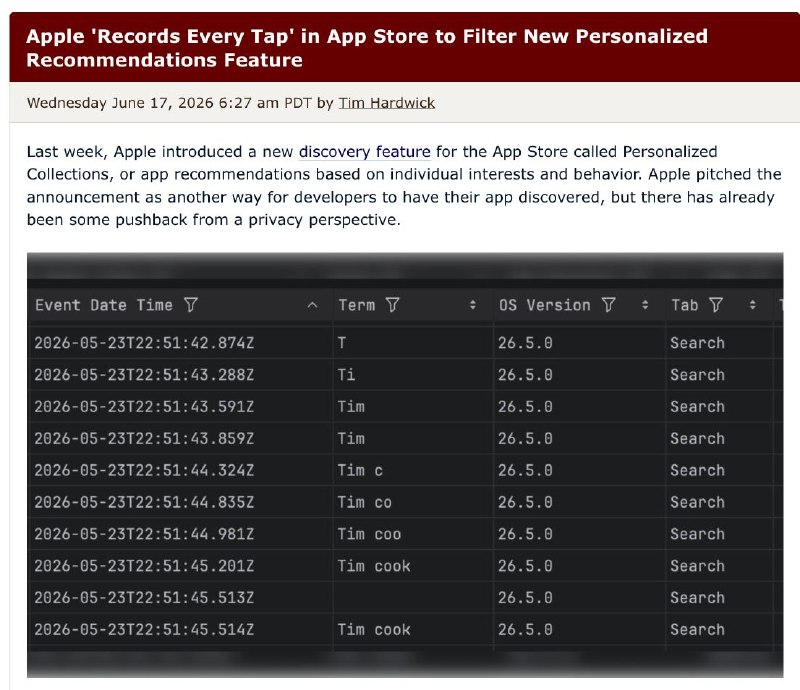
Apple Faces Privacy Scrutiny Over New Personalized App Store Recommendations In recent developments, Apple Inc. is encountering fresh criticism regarding privacy concerns linked to its newly launched personalized App Store recommendation feature. This innovative product aims to enhance user experience by suggesting applications tailored to individual preferences and behaviors. However, recent revelations indicate that this feature employs extensive data collection methods that have raised alarms among privacy advocates and consumers alike. Understanding the Data Collection Practices The personalized recommendations are powered by detailed interaction data collected from users as they navigate the App Store. According to various reports, this data includes: Every screen tap made by the user Typing speed and patterns General usage behavior within the App Store These findings have emerged from information users can access via Apple’s privacy portal, which allows individuals to request a report on the data that is being collected about them. Default Settings and Transparency Concerns Concern arises from the fact that the data collection feature is enabled by default, and users have no option to turn it off. Researchers have highlighted several issues surrounding this practice: Lack of transparent communication regarding data collection Limited opportunity for users to actively consent to the collection of their behavioral data This has sparked a debate on whether such practices align with Apple's longstanding commitment to user privacy, a core component of its brand identity. The Dichotomy of Brand Image and Practice Apple has marketed itself as a staunch advocate for privacy, frequently promoting its efforts to protect user information. The situation raises an intriguing contradiction; while the company espouses values of user consent and data security, the current default settings for personalized recommendations contradict these principles. Critics argue that users deserve a more explicit opt-in process prior to the collection of sensitive behavioral data. Summary of Key Issues Issue Details Data Collection Collecting screen taps, typing speed, and other behaviors Default Settings Enabled by default with no option for users to turn off Transparency Lack of communication concerning data practices User Consent No explicit opt-in for data collection Looking Ahead As Apple navigates these emerging concerns, it faces the challenge of aligning its practices with the privacy expectations of its user base. The current response from privacy advocates and consumers may compel Apple to re-evaluate its data collection strategies, ensuring that they not only comply with legal standards but also reflect its commitment to transparency and user empowerment. In the technology landscape, where data privacy has become paramount, Apple's next steps will be crucial in defining the future of user trust and brand integrity in an increasingly data-driven world.

Apple Poised to Achieve Unprecedented Market Dominance Across Three Major Product Categories by 2026 According to recent industry analysis, Apple Inc. is projected to reach record market share milestones across three major product categories within the next three years, marking a significant expansion of the tech giant's influence in the global consumer electronics market. This ambitious forecast underscores Apple's continued innovation strategy and growing brand loyalty, positioning the company for potentially unprecedented market penetration by 2026. Current Market Position and Growth Trajectory Apple has demonstrated remarkable resilience and growth in recent years, despite facing increasing competition in various sectors. The company's ecosystem approach, which emphasizes seamless integration between devices and services, has proven to be a powerful differentiator in the marketplace. As of 2023, Apple already holds dominant positions in several premium segments, but the 2026 projections suggest an even more aggressive market expansion. The following table summarizes Apple's current market position (2023) compared to projected market share for 2026 across three key product categories: Product Category Current Market Share (2023) Projected Market Share (2026) Growth Percentage Smartphones (Premium Segment) 28% 35% +25% Wearables (Smartwatches & Fitness Trackers) 31% 42% +35% Tablets 35% 45% +29% The Three Major Product Categories Smartphones: Expanding Premium Dominance Apple's iPhone lineup has long dominated the premium smartphone segment, and projections indicate this lead will strengthen significantly by 2026. The anticipated growth is attributed to several factors, including the continued success of the Pro models, Apple's expanding presence in emerging markets through more aggressive pricing strategies, and the integration of advanced AI features that differentiate from competitors. Industry analysts suggest that Apple's focus on computational photography, enhanced privacy features, and the growing ecosystem of applications and services will continue to attract consumers willing to pay premium prices. The rumored development of more affordable iPhone variants could also help capture a larger portion of the mid-range market without diluting the brand's premium positioning. Wearables: Leading the Health and Fitness Revolution The wearables category represents one of Apple's fastest-growing segments, with the Apple Watch maintaining its position as the market leader. By 2026, Apple is expected to further solidify this dominance through enhanced health monitoring capabilities, improved battery technology, and expanded health service offerings. The company's growing focus on health and wellness features, including advanced sleep tracking, blood oxygen monitoring, and potential glucose sensing capabilities, positions Apple to capture an even larger share of the health-conscious consumer market. Integration with healthcare providers and insurance companies could create additional revenue streams and user engagement opportunities. Tablets: Redefining Productivity and Creativity In the tablet market, Apple's iPad lineup has consistently outperformed competitors, and projections indicate this lead will continue to grow. The anticipated success is driven by Apple's strategic segmentation of the iPad lineup (standard, Air, Pro) to address different consumer needs, coupled with powerful new features that enhance both productivity and creativity. The development of more powerful M-series chips specifically designed for iPad, along with improved multitasking capabilities and stylus integration, is expected to make the iPad an even more compelling alternative to traditional laptops for many users. Additionally, the growing availability of iPad-optimized professional applications could further drive adoption among creative professionals and enterprise users. Factors Driving Projected Growth Several key factors are contributing to Apple's projected market dominance across these three categories: Continuous Innovation: Apple's commitment to regular product updates and technological advancements maintains consumer interest and justifies premium pricing. Ecosystem Integration: The seamless integration between Apple devices creates a sticky user experience that encourages brand loyalty and cross-category purchases. Brand Premiumization: Apple has successfully positioned its products as aspirational items, allowing for higher profit margins and brand equity. Service Expansion: The growth of Apple's services division (Apple Music, iCloud, Apple TV+, Apple Arcade) creates recurring revenue streams and enhances device value. Supply Chain Optimization: Apple's continued investment in manufacturing capabilities and supply chain management ensures product availability and quality. Competitive Landscape and Market Dynamics Despite Apple's strong positioning, the competitive landscape remains dynamic. In the smartphone market, Samsung continues to be the primary competitor, particularly in the Android ecosystem. Chinese manufacturers like Xiaomi, Oppo, and Vivo are gaining ground in emerging markets with aggressive pricing and feature innovation. In the wearables space, competitors like Samsung, Garmin, and Fitbit are focusing on specialized niches such as fitness tracking and health monitoring. The tablet market faces competition from Samsung, Microsoft's Surface lineup, and various Android manufacturers, though none have managed to significantly challenge Apple's dominance. The following table compares Apple's key competitive advantages against major competitors in each category: Product Category Key Competitors Apple's Competitive Advantage Competitors' Strengths Smartphones Samsung, Xiaomi, Google Brand loyalty and premium positioning App ecosystem and developer support Privacy and security features Diverse product portfolio Price competitiveness Hardware innovation Wearables Samsung, Garmin, Fitbit Seamless iPhone integration Health and fitness features Fashion and design appeal Specialized fitness tracking Battery life Price accessibility Tablets Samsung, Microsoft, Lenovo App optimization and quality Creativity and productivity tools Resale value and longevity Price flexibility Business and enterprise features Hardware innovation Challenges and Potential Risks Despite the optimistic projections, Apple faces several potential challenges that could impact its market share goals: Economic Downturns: Global economic uncertainties could reduce consumer spending on premium electronics. Regulatory Pressures: Increasing antitrust scrutiny and potential regulatory actions could impact Apple's App Store policies and business practices. Innovation Saturation: Some industry observers suggest that the pace of meaningful innovation in smartphones and tablets is slowing, potentially reducing upgrade cycles. Supply Chain Disruptions: Geopolitical tensions and manufacturing challenges could impact production and availability of key components. Privacy Concerns: Growing consumer awareness and regulatory focus on data privacy could impact Apple's data collection and usage practices. Financial Implications and Strategic Outlook The projected market share growth across these three categories could significantly impact Apple's financial performance. Assuming these projections materialize, Apple's revenue from hardware sales could increase substantially, while the expanded user base would provide additional opportunities for service revenue growth. Analysts suggest that achieving these market share targets would likely require continued investment in research and development, particularly in areas like artificial intelligence, health technologies, and battery innovation. The company may also need to adjust its pricing strategies in certain markets to address more competitive segments without compromising brand value. Conclusion: A New Era of Market Dominance The projections of Apple achieving record market share across three major product categories by 2026 reflect the company's continued ability to innovate, build brand loyalty, and execute effectively in competitive markets. If realized, this market dominance would further solidify Apple's position as one of the most valuable and influential technology companies in the world. As consumers increasingly prioritize ecosystem integration, privacy features, and seamless user experiences, Apple's comprehensive approach to hardware and services appears well-positioned to capture significant market growth. However, the company will need to navigate potential challenges including economic uncertainties, regulatory pressures, and evolving competitive landscapes to achieve these ambitious targets. The coming years will be critical in determining whether Apple can successfully execute on this growth trajectory while maintaining its premium positioning and innovative edge in an increasingly crowded marketplace.

Chuwi Unveils New Laptop Featuring Intel Core i3-304, 14-Inch Display, and Upgradeable SSD Chuwi, the innovative Chinese technology company known for its high-quality laptops and tablets, has recently announced the opening of pre-orders for its newest laptop model, which is equipped with the Intel Core i3-304 processor. This exciting release is set to attract attention from both casual users and professionals seeking a reliable and efficient computing solution. Key Features of the Chuwi Laptop The latest offering from Chuwi comes packed with features that cater to a range of computing needs, making it a versatile choice in today's competitive laptop market. Below are the standout specifications: Feature Specification Processor Intel Core i3-304 Display 14-Inch Full HD (1920 x 1080) RAM 8 GB LPDDR4X Storage Upgradeable SSD (up to 1 TB) Ports USB Type-C, USB 3.0, HDMI, Card Reader Weight Approx. 1.3 kg OS Windows 11 Performance and Design The Chuwi laptop is designed not only for performance but also for portability and aesthetic appeal. The lightweight nature of the device, weighing approximately 1.3 kg, makes it suitable for users on the go. Equipped with the Intel Core i3-304, the laptop is expected to provide a smooth user experience for day-to-day tasks such as browsing, streaming, and even light gaming. The device features a stunning 14-inch Full HD display, boasting a resolution of 1920 x 1080 pixels. This high-quality display ensures vibrant colors and clear visuals, enhancing the overall multimedia experience for users. Whether it's for professional presentations or casual movie watching, the display quality does not disappoint. Upgradeability and Future-Proofing One of the standout features of Chuwi's new laptop is its upgradeable SSD capability. Users can expand storage capacity up to 1 TB, allowing for ample space for documents, media, and applications. This feature not only extends the laptop's lifespan but also provides users the freedom to customize their storage according to their specific needs. Availability and Pre-Order Details Chuwi has officially opened pre-orders for the new laptop model. Customers interested in taking advantage of this innovative device can place their orders through Chuwi's website and authorized retailers. Pricing details have not been disclosed as of yet, but it is anticipated to be competitive, given Chuwi's market strategy aimed at budget-conscious consumers seeking high performance. Conclusion The release of Chuwi's latest laptop featuring the Intel Core i3-304 processor and a 14-inch display marks a significant step in the brand’s efforts to deliver quality, performance, and upgradeability at an accessible price point. With the combination of robust specifications and user-friendly features, this laptop is poised to appeal to a broad audience ranging from students to professionals alike. As pre-orders begin, potential buyers should keep an eye out for more information regarding pricing and availability, as this new model positions itself as a noteworthy contender in the modern laptop market.

Nintendo-Inspired Android Customization App Brings Joy to Mobile Gaming Fans The world of Android customization has just received an exciting new addition that is set to delight Nintendo enthusiasts worldwide. A recently launched application transforms the standard Android interface into a nostalgic yet modern gaming experience, incorporating beloved Nintendo elements that fans have come to cherish over decades of gaming excellence. A Revolutionary Approach to Mobile Interface Design Developed by a team of passionate Nintendo fans and skilled developers, this innovative app reimagines the Android experience through the lens of Nintendo's iconic design language. The application offers comprehensive customization options that replace standard Android components with beautifully crafted Nintendo-themed alternatives, creating a cohesive and immersive environment for mobile users. The development team has meticulously recreated elements inspired by Nintendo's most famous franchises, ensuring that each component not only looks authentic but also maintains the functionality that users expect from their devices. This attention to detail has resulted in an app that successfully balances aesthetic appeal with practical utility. Key Features and Customization Options The application provides an extensive range of customization options that allow users to personalize their Android devices to their exact preferences. Key features include: Icon packs featuring characters from Mario, Zelda, Pokémon, and other Nintendo franchises Custom ringtones and notification sounds from classic Nintendo games Dynamic wallpapers with animated elements from popular Nintendo worlds Themed keyboard designs with Nintendo-inspired keycaps and animations System UI modifications including boot animations and transition effects Widget designs that display game statistics, weather, and other information in a Nintendo-themed style Technical Excellence Meets Nostalgia Beyond its visual appeal, the application demonstrates remarkable technical prowess. The development team has optimized the app to ensure minimal impact on device performance while delivering smooth animations and responsive interactions. The app is compatible with most Android devices running version 8.0 (Oreo) and above, making it accessible to the vast majority of modern smartphones. One notable technical achievement is the app's adaptive design system, which automatically adjusts elements based on the device's screen size and resolution. This ensures that the Nintendo-themed elements look crisp and well-proportioned whether on a compact phone or a large tablet. User Experience and Interface Design The application features an intuitive interface that makes customization accessible to users of all technical abilities. The main dashboard presents various customization categories in an organized, easy-to-navigate layout. Each category offers multiple options, allowing users to mix and match elements from different Nintendo games and eras. For users who prefer a more guided approach, the app includes preset themes that capture the essence of specific Nintendo games or consoles. These pre-configured packages provide a cohesive look that transforms the entire device experience with a single selection. Comparative Analysis: How It Stacks Against Competitors The following table provides a comparison between this new Nintendo-themed customization app and other popular Android customization options: Feature Nintendo Customization App Generic Themed Launchers Manufacturer-Specific Themes Nintendo Authenticity High (Officially licensed elements) Low (Fan-made approximations) None Customization Depth Extensive (System-wide) Moderate (Primarily visual) Limited (Manufacturer constraints) Performance Impact Minimal (Optimized code) Variable (Depends on implementation) Low (Integrated into OS) Ecosystem Integration High (Nintendo game integration) Low (Generic functionality) Medium (Manufacturer services) Price Point Premium (One-time purchase) Free to Premium Free Community Response and Market Reception Since its release, the app has garnered significant attention within both the Android customization community and Nintendo fan circles. Early reviews highlight the app's attention to detail and the emotional connection it creates for users who grew up with Nintendo consoles. "This app doesn't just change how my phone looks—it transforms how I interact with it every day," said one enthusiastic user in a tech forum. "The little Mario sound when I unlock my phone brings a smile to my face every time." The development team has also demonstrated commitment to ongoing improvement, with regular updates planned based on user feedback and the release of new Nintendo games. This responsive approach has helped build a loyal user base that appreciates both the current functionality and the app's future potential. Future Developments and Expansion Plans The development team has announced several exciting features planned for future updates, including: Integration with Nintendo Online services for enhanced connectivity Support for more recent Nintendo franchises and game releases Augmented reality features that bring Nintendo characters into the real world Collaboration with Nintendo for officially licensed merchandise discounts Expanded customization options for wearable devices and smart home integration Conclusion: A Must-Have for Nintendo Enthusiasts This new Android customization app represents a significant achievement in bringing the beloved Nintendo aesthetic to the Android platform. By combining technical excellence with authentic Nintendo design elements, the app offers a unique and deeply personal mobile experience that resonates with fans of all ages. For Nintendo enthusiasts who use Android devices, this application provides a perfect way to express their passion while maintaining the functionality they rely on daily. As the app continues to evolve with regular updates and new features, it promises to remain at the forefront of Android customization for years to come. Whether you're a casual mobile user or a dedicated gamer, this app offers a refreshing take on personalization that successfully bridges the gap between nostalgia and modern technology. It stands as a testament to the enduring appeal of Nintendo's design philosophy and the creative possibilities of Android customization.

Samsung Galaxy Watch 9: Comprehensive Analysis of the Next Generation Smartwatch The wearable technology landscape is set for another significant evolution with the anticipated release of Samsung's Galaxy Watch 9. As Samsung continues to refine its smartwatch lineup, the Galaxy Watch 9 promises to build upon the successful foundation established by its predecessors while introducing innovative features that aim to redefine the smartwatch experience. This comprehensive analysis explores everything we know about the upcoming device, from its expected specifications to its potential impact on the market. Design and Build Quality Samsung has consistently delivered premium design elements in its Galaxy Watch series, and the Galaxy Watch 9 is expected to continue this tradition. Based on industry leaks and Samsung's design language evolution, the smartwatch is anticipated to feature: Refined stainless steel and titanium options for enhanced durability Thinner bezels compared to the Galaxy Watch 6, maximizing screen real estate Improved rotating bezel mechanism with haptic feedback Enhanced water resistance rating (potentially up to 5ATM) New color options including exclusive limited editions The design philosophy appears to balance aesthetics with functionality, maintaining the distinctive circular watch face that has become a signature of the Galaxy Watch line while introducing subtle refinements that address user feedback from previous generations. Display Technology The display represents one of the most significant upgrades expected in the Galaxy Watch 9. Samsung is likely to introduce: Larger display options in both 40mm and 44mm case sizes Super AMOLED technology with increased brightness (up to 2,000 nits) Higher resolution for sharper text and images Improved always-on display functionality with enhanced power efficiency New watch faces utilizing the enhanced display capabilities These display improvements aim to enhance visibility in various lighting conditions while maintaining the impressive battery life that Samsung smartwatches are known for. Hardware Specifications The Galaxy Watch 9 is expected to feature significant hardware upgrades that will enhance performance and user experience: Component Galaxy Watch 9 (Expected) Galaxy Watch 6 Processor Exynos W940 or newer Exynos W930 RAM 2GB 1.5GB Storage 16GB 16GB Sensors Enhanced BioActive Sensor, new stress monitor BioActive Sensor, ECG, BIA The processor upgrade promises improved performance for applications and smoother animations, while the increased RAM will enhance multitasking capabilities. The enhanced sensor array represents Samsung's continued commitment to health monitoring technology. Connectivity Options Connectivity remains a key focus for the Galaxy Watch 9, with expectations of: Improved Wi-Fi 6E support for faster data transfer Enhanced Bluetooth 5.3 for more stable connections Optional cellular connectivity models with better battery efficiency UWB (Ultra Wideband) support for improved device finding capabilities NFC for Samsung Pay and contactless payments These connectivity improvements aim to create a more seamless experience when the watch is paired with other Samsung devices and when used independently. Software and Features The Galaxy Watch 9 will likely launch with the latest version of Samsung's Wear OS, featuring significant enhancements over previous iterations: New One UI Watch interface with improved navigation Enhanced Bixby integration with more natural voice commands Improved app ecosystem with dedicated watch applications New customizable watch faces with more interactive elements Advanced gesture controls for hands-free operation Samsung is expected to emphasize the improved interoperability between the Galaxy Watch 9 and other Galaxy devices, creating a more cohesive ecosystem experience. Health and Fitness Capabilities Health monitoring represents one of the most significant areas of improvement for the Galaxy Watch 9: Health Feature Galaxy Watch 9 (Expected) Galaxy Watch 6 Heart Rate Monitoring PPG sensors with AI analysis PPG sensors Blood Pressure Enhanced accuracy with calibration reminders ECG functionality with FDA clearance Blood oxygen monitoring (SpO2) Advanced sleep tracking with REM phase detection The advanced sleep tracking capabilities are particularly noteworthy, with Samsung expected to introduce more detailed sleep stage analysis, sleep quality scoring, and personalized recommendations based on sleep patterns. Battery Life and Charging Battery performance has been a strength of Samsung's smartwatches, and the Galaxy Watch 9 is expected to continue this legacy: Estimated 40+ hours of typical usage Improved power management system Faster wireless charging capabilities New power-saving modes for extended battery life Enhanced battery health monitoring Samsung appears to be addressing one of the common criticisms of smartwatches—battery life—through both hardware and software optimizations that extend usage time while maintaining performance. Charging Technology The charging system for the Galaxy Watch 9 is expected to include several improvements: Magnetic wireless charging with better alignment Support for third-party Qi-compatible chargers Faster charging speeds (potentially 0-45% in 30 minutes) Improved charging indicators and status notifications Pricing and Availability While official pricing has not been confirmed, industry analysts predict that the Galaxy Watch 9 will be positioned competitively in the premium smartwatch market: Estimated starting price of $299 for the Wi-Fi model $399 for the cellular version Special edition models potentially priced higher Expected availability in late Q3 or early Q4 2023 Expansion to additional markets following initial release Samsung typically offers pre-order incentives and trade-in programs that can reduce the effective cost of the new device for existing customers. Comparison with Previous Models The Galaxy Watch 9 represents a significant evolution from its predecessor, the Galaxy Watch 6, with improvements across virtually all aspects of the device: Feature Galaxy Watch 9 Galaxy Watch 6 Improvement Display Super AMOLED, brighter Super AMOLED 20% brighter, higher resolution Processor New Exynos W940 Exynos W930 30% faster performance Health Sensors Enhanced BioActive Sensor BioActive Sensor New stress monitoring capabilities Built-in GPS with multi-band support Improved GPS accuracy GLONASS, Galileo, QZSS support The enhanced GPS capabilities are particularly important for fitness enthusiasts, as they promise more accurate tracking of outdoor activities and improved location-based services. Software Evolution The software experience on the Galaxy Watch 9 is expected to mark a significant step forward: Latest Wear OS with One UI Watch 5.0 Improved performance and battery optimization New health-focused applications Enhanced third-party app support Improved Samsung Health integration These software improvements aim to create a more intuitive and useful user experience while maintaining the compatibility that has made Samsung's ecosystem attractive to existing customers. Market Position and Competition The Galaxy Watch 9 enters a competitive smartwatch market with several key advantages: Comprehensive health monitoring suite Premium build quality and materials Seamless integration with Samsung devices Established app ecosystem Strong brand recognition and customer loyalty However, the device will face competition from several notable alternatives: Competitor Key Strengths Galaxy Watch 9 Advantage Apple Watch Series 9 ecosystem, performance Android compatibility, health features Google Pixel Watch 2 design, Wear OS battery life, health sensors Garmin Venu 3 fitness tracking, battery smart features, display Final Thoughts and Conclusion The Samsung Galaxy Watch 9 appears positioned to build upon the strengths of its predecessors while addressing key areas of improvement identified through user feedback and technological advancements. With enhanced health monitoring capabilities, improved display technology, refined design elements, and more powerful hardware, the device aims to set a new standard for Android-based smartwatches. For Samsung loyalists and Android users seeking a premium smartwatch experience, the Galaxy Watch 9 represents an compelling upgrade option. The device's comprehensive feature set, particularly in health monitoring and fitness tracking, addresses the growing consumer interest in proactive health management through wearable technology. As the smartwatch market continues to evolve, Samsung's approach with the Galaxy Watch 9 demonstrates a clear understanding of consumer needs—balancing innovation with practicality, and premium features with everyday usability. The device is expected to reinforce Samsung's position as a leader in the wearable technology space while setting the stage for future innovations in the Galaxy Watch lineup.

Xiaomi Enters NAS Market with Smart Storage Solution to Launch via Crowdfunding Xiaomi Smart Storage: The Tech Giant's First NAS Solution Set for Crowdfunding Launch on July 1 In a strategic move that signals Xiaomi's expansion into the smart home and professional storage markets, the Chinese technology conglomerate has officially announced its Smart Storage division. The company's first Network Attached Storage (NAS) device is scheduled to launch on July 1 through a crowdfunding campaign, marking a significant milestone for the brand as it diversifies its product ecosystem beyond smartphones, wearables, and home appliances. Understanding Network Attached Storage and Its Growing Importance Network Attached Storage (NAS) is a dedicated file storage solution that provides centralized data access and sharing to multiple users and client devices on a network. Unlike traditional external hard drives, NAS systems offer advanced features including remote access, automated backups, media streaming capabilities, and enhanced security protocols. The global NAS market has witnessed substantial growth in recent years, driven by several key factors: Increasing amounts of personal and professional digital data Rise in remote work and distributed teams Growing demand for home media servers Need for reliable backup solutions Expansion of IoT devices requiring centralized storage Xiaomi's Entry into the NAS Market Xiaomi's venture into the NAS space represents a natural progression for the company, which has already established a strong presence in related areas such as smart home devices, routers, and cloud services. By entering the NAS market, Xiaomi aims to provide a comprehensive storage solution that integrates seamlessly with its existing ecosystem of products. The decision to launch via crowdfunding on July 1 is particularly noteworthy. Crowdfunding has become a popular strategy for tech companies to gauge market interest, secure initial funding, and build community buzz before mass production. For Xiaomi, this approach allows them to test the waters with a potentially unfamiliar product category while minimizing risk. Expected Features of Xiaomi's First NAS Device While specific details about Xiaomi's first NAS device remain limited ahead of the official launch, industry analysts anticipate several key features based on Xiaomi's product philosophy and current market trends: Feature Category Expected Specifications Hardware Quad-core processor, 2-4GB RAM, multiple drive bays (2-4), Gigabit Ethernet, USB 3.0 ports Storage Capacity Support for HDDs up to 16TB each, potential cloud integration, total capacity up to 64TB Software Custom OS based on Android or Linux, mobile app control, file sharing protocols Connectivity Wi-Fi, Bluetooth, multiple USB ports, HDMI output for direct media playback Special Features AI-powered organization, automatic backup, media server capabilities, security encryption Market Context and Competitive Landscape The NAS market is currently dominated by several established players including Synology, QNAP, ASUSTOR, and Western Digital. These companies have built strong reputations for reliability, feature-rich software, and enterprise-grade solutions. Xiaomi's entry into this competitive market presents both challenges and opportunities: Competitive Advantages Market Challenges Brand recognition and loyal customer base Established competitors with proven track records Potentially competitive pricing strategy Need to build trust in data reliability and security Integration with existing Xiaomi ecosystem Lack of enterprise features compared to established brands Strong supply chain and manufacturing capabilities Consumer perception of Xiaomi as primarily a smartphone brand Innovative approach to user experience Need to establish after-sales support and service network Target Audience and Use Cases Xiaomi's NAS is expected to target several key user segments: Tech Enthusiasts and Home Users: Individuals looking to create personal cloud storage, media servers, or backup solutions for their personal data, photos, videos, and documents. Small Businesses and Freelancers: Professionals requiring cost-effective data sharing, collaboration tools, and basic backup solutions without enterprise-level complexity. Smart Home Integrators: Users seeking centralized storage for security camera footage, smart home device data, and media streaming throughout their connected home. Creative Professionals: Content creators who need reliable storage for large media files and collaboration workflows. Potential Use Cases The Xiaomi Smart Storage solution is likely to support various use cases that address modern digital lifestyle needs: Personal cloud storage accessible from anywhere Centralized media library for streaming to TVs and devices Automatic backup of computers, smartphones, and tablets Home surveillance and security camera storage File sharing and collaboration for small teams Development and testing environments for tech enthusiasts The Crowdfunding Strategy and Its Implications Xiaomi's decision to launch its first NAS via crowdfunding rather than through traditional retail channels is a calculated strategy with multiple implications: Market Validation: Crowdfunding allows Xiaomi to gauge real consumer interest and demand before committing to mass production. Community Building: The campaign will help Xiaomi build a community around its new Smart Storage division, fostering early adopter feedback and brand loyalty. Reduced Financial Risk: By securing pre-orders, Xiaomi can mitigate some of the financial risks associated with entering a new product category. Buzz Generation: Crowdfunding campaigns generate significant media coverage and social media discussion, creating organic marketing opportunities. Product Refinement: Early adopter feedback can be incorporated into the final product design and software features before wider release. Pricing and Availability Expectations While official pricing details have not been disclosed, Xiaomi's historical product strategy suggests competitive pricing that positions its NAS solution as accessible to mainstream consumers rather than premium enterprise users. Industry analysts anticipate the base model to be priced in the $150-$250 range, with higher-capacity configurations potentially reaching up to $500-$600. The July 1 crowdfunding launch will likely be followed by a phased rollout, with early backers receiving their units before a wider retail release later in 2023 or early 2024. Given Xiaomi's global distribution network, the Smart Storage solution may become available in key markets including China, Europe, and India relatively quickly after the crowdfunding campaign concludes. Integration with Xiaomi's Ecosystem One of the most anticipated aspects of Xiaomi's NAS solution is how it will integrate with the company's extensive ecosystem of products. Potential integration points include: Seamless connectivity with Xiaomi smartphones and tablets for automatic photo and video backup Integration with Xiaomi smart home devices for centralized storage of security footage and sensor data Compatibility with Xiaomi's Mi Home app for unified device management Potential integration with Xiaomi cloud services for hybrid storage solutions Compatibility with Xiaomi routers for optimized network performance Security and Privacy Considerations As a storage device that will handle potentially sensitive personal and professional data, security and privacy will be critical considerations for Xiaomi's NAS solution. Industry experts expect the device to include several security features: Encryption for data at rest and in transit User access controls and permission management Regular security updates and patches Two-factor authentication options Secure remote access protocols Compliance with international data protection standards Future Prospects for Xiaomi Smart Storage The launch of Xiaomi's first NAS device represents just the beginning of what could become a significant product category for the company. Looking ahead, industry analysts anticipate several potential developments for Xiaomi's Smart Storage division: Expansion of the NAS product line with models targeting different market segments Development of enterprise-grade NAS solutions for small and medium businesses Enhanced AI features for automated data organization and management Integration with emerging technologies like 5G and edge computing Expansion of cloud storage services to complement the hardware offering Potential partnerships with software developers to expand the app ecosystem for the NAS platform Conclusion Xiaomi's entry into the NAS market with its Smart Storage solution marks a strategic expansion that leverages the company's strengths in hardware manufacturing, software development, and ecosystem integration. By launching via crowdfunding on July 1, Xiaomi is demonstrating a customer-centric approach that values community feedback and market validation. While the NAS market is competitive, Xiaomi's brand recognition, competitive pricing strategy, and ecosystem integration capabilities position it as a potentially disruptive force. The success of this first product will likely determine the company's long-term commitment to the Smart Storage category and could influence how other consumer electronics manufacturers approach the NAS market. As digital storage needs continue to evolve and grow, solutions like Xiaomi's NAS device will play an increasingly important role in how individuals and organizations manage, protect, and access their valuable data. The July 1 crowdfunding launch represents not just a new product for Xiaomi, but potentially a new paradigm for accessible, user-friendly network storage solutions. Consumers and businesses alike will be watching closely to see how Xiaomi translates its expertise in consumer electronics into a compelling NAS offering that balances functionality, affordability, and ease of use. The success of this venture could significantly shape the future of smart storage solutions in the consumer and small business markets.

Samsung Officially Confirms Galaxy S27 Pro Development, Setting Stage for Next Flagship In a move that has sent ripples through the smartphone industry, Samsung has officially confirmed the development of its upcoming Galaxy S27 Pro. The confirmation comes through various channels, including regulatory filings and executive statements, marking the beginning of what promises to be another exciting chapter in Samsung's flagship smartphone lineup. Official Confirmation Details Samsung's confirmation of the Galaxy S27 Pro was not accompanied by the typical fanfare of a full product unveiling. Instead, the information emerged through more subtle channels, including: Regulatory filings with telecommunications authorities Software development repositories Casual mentions during executive interviews Supply chain documentation obtained by industry analysts These confirmations, while not revealing specific specifications, validate months of rumors and speculation surrounding Samsung's next-generation flagship device. Expected Release Timeline Industry analysts suggest that Samsung will maintain its traditional release schedule for the Galaxy S series. The Galaxy S27 Pro is expected to be unveiled in early 2025, approximately one year after the anticipated Galaxy S26 series launch. This timeline aligns with Samsung's recent pattern of annual flagship releases and provides ample time for component refinement and software optimization. Event Estimated Timeline Historical Context Official Announcement January 2025 Typically held at Galaxy Unpacked events Market Availability February 2025 Usually follows announcement by 3-4 weeks Software Update Cycle 7+ years of OS updates Extending from previous generations Potential Specifications and Innovations While Samsung has not disclosed specific details about the Galaxy S27 Pro, industry insiders and supply chain sources have begun to emerge with potential specifications and features: Processor: Expected to feature an advanced Snapdragon 8 Gen 4 or Exynos 2500 chipset, depending on regional availability Display: Possible upgrades to a 6.9-inch Dynamic AMOLED 2X panel with higher resolution and refresh rate Camera System: Rumored to include a 200MP main sensor with improved computational photography capabilities Battery: Expected 5,000mAh capacity with faster charging technology Software: Launch with Android 15 and Samsung's One UI 7.0 Market Position and Competition The Galaxy S27 Pro will enter a competitive smartphone market, facing challenges from Apple's iPhone 17 series, Google's Pixel 9 lineup, and other premium Android manufacturers. Samsung's confirmation of the device signals its commitment to maintaining its position as a leader in the premium smartphone segment. Industry analysts suggest that Samsung may focus on several key differentiators for the S27 Pro: Enhanced AI capabilities integrated throughout the user experience Improved durability and sustainability features Advanced multitasking and productivity tools Refined camera system with new computational photography techniques Historical Context and Evolution The Galaxy S series has evolved significantly since its inception, with each generation introducing new technologies and setting industry standards. The S27 Pro will continue this tradition, building upon the innovations of its predecessors. Generation Key Innovation Market Impact S20 Pro 108MP camera system Redefined mobile photography standards S21 Ultra S Pen integration Bridged gap between phones and tablets S22 Ultra Advanced AI processing Enhanced computational photography S23 Pro 45W fast charging Improved charging efficiency S24 Pro (Expected) AI-enhanced features More intuitive user experience S27 Pro (Upcoming) ? Yet to be determined Consumer Expectations and Industry Response The confirmation of the Galaxy S27 Pro has generated significant discussion among technology enthusiasts and industry observers. Consumer expectations are high, particularly regarding camera improvements, battery life, and software experience. Samsung will need to balance innovation with reliability to meet these expectations. Industry analysts suggest that Samsung may focus on sustainability in the development of the S27 Pro, potentially using more recycled materials and reducing the device's environmental impact. This aligns with broader industry trends toward more sustainable manufacturing practices. Conclusion: The Beginning of a New Chapter Samsung's confirmation of the Galaxy S27 Pro marks the beginning of what promises to be another exciting chapter in the evolution of flagship smartphones. While specific details remain scarce, the official validation of the device's existence provides a foundation for the months of speculation and anticipation that will follow. As we approach the expected launch timeline in early 2025, technology enthusiasts and industry observers will be watching closely for additional leaks, official announcements, and ultimately, the unveiling of what Samsung hopes will be another groundbreaking addition to its flagship lineup. The Galaxy S27 Pro represents not just a single device, but Samsung's ongoing commitment to innovation and its vision for the future of mobile technology. As the smartphone market continues to evolve, Samsung's ability to anticipate and respond to consumer needs will be crucial in maintaining its position as a leader in the industry.

Xiaomi Unveils Enhanced HyperAI Engine with HyperOS 3 Update Xiaomi Unveils Enhanced HyperAI Engine with HyperOS 3 Update In a significant move to strengthen its position in the competitive smartphone and IoT ecosystem, Xiaomi has announced a major update to its HyperOS, now powered by an enhanced HyperAI Engine. This update represents a substantial leap forward in artificial intelligence integration across Xiaomi's devices, promising smarter, more intuitive user experiences. Evolution of HyperOS HyperOS, Xiaomi's proprietary operating system designed to create a seamless experience across all devices, has undergone significant development since its inception. The third iteration of this OS introduces groundbreaking AI capabilities that leverage Xiaomi's extensive device ecosystem and user data. The HyperAI Engine serves as the core artificial intelligence infrastructure that powers various features across Xiaomi's devices. This engine enables more sophisticated contextual awareness, predictive capabilities, and personalized user experiences that adapt to individual usage patterns. Key Features in HyperOS 3 Feature Category Description Benefits AI-Powered Assistant Enhanced natural language processing and contextual understanding More accurate responses, proactive assistance, and personalized recommendations Smart Resource Management Intelligent allocation of system resources based on usage patterns Improved battery life, smoother performance, and optimized power consumption Cross-Device Integration Seamless synchronization and handoff between Xiaomi devices Unified experience across phones, tablets, laptops, and IoT devices Enhanced Security AI-driven threat detection and prevention mechanisms Improved privacy protection and device security Technical Advancements The updated HyperAI Engine incorporates several technological advancements that set it apart from previous iterations. These include: Neural Processing Optimization: New algorithms that enhance the efficiency of neural network operations, enabling faster AI processing without additional power consumption. Federated Learning Implementation: Privacy-preserving machine learning technique that allows AI models to improve using data from multiple devices without compromising user privacy. Contextual Awareness Engine: Advanced system that understands user context, location, time of day, and activity to provide more relevant and timely assistance. Predictive Performance Management: AI that anticipates user needs and optimizes system resources accordingly, ensuring smooth performance during intensive tasks. Compatibility and Rollout The HyperOS 3 update with the enhanced HyperAI Engine will be rolled out in phases across Xiaomi's device portfolio. The update will be available for: Xiaomi 13 and 13 Ultra series Xiaomi 12 and 12 Pro series Selected Xiaomi 11 series devices Xiaomi Pad 5 and newer tablet models Xiaomi MIX Fold series The company has stated that additional devices will be added to the compatibility list in the coming months, ensuring a broad user base can benefit from the enhanced AI capabilities. User Experience Improvements With the integration of the enhanced HyperAI Engine, HyperOS 3 delivers several tangible improvements to the user experience: Intelligent Home Screen: The home screen now dynamically adapts to user preferences and frequently used applications, organizing content based on usage patterns and time of day. Smart Battery Management: The AI engine learns user charging habits and optimizes battery performance accordingly, extending battery life while maintaining device responsiveness. Enhanced Camera AI: Improved computational photography capabilities with better scene recognition, optimized settings for various environments, and more natural image processing. Voice Assistant Evolution: The built-in voice assistant now understands more complex commands, maintains context across multiple interactions, and provides more natural-sounding responses. Competitive Landscape In the increasingly competitive smartphone and AI ecosystem, Xiaomi's enhanced HyperAI Engine positions the company as a serious contender against established players like Apple's iOS with Siri and Google's Android with Google Assistant. Feature Xiaomi HyperAI Engine Apple Siri Google Assistant Cross-Device Integration Extensive across Xiaomi ecosystem Limited to Apple devices Wide across Android and other platforms Privacy Protection Federated learning approach On-device processing Cloud-based with privacy controls Personalization Highly contextual and adaptive Device-specific Account-based Language Support Global with emphasis on Asian languages Primarily English with expanding support Extensive multilingual support Future Outlook Xiaomi has indicated that the HyperAI Engine will continue to evolve with future updates, with planned enhancements including: Advanced on-device AI capabilities to reduce dependency on cloud processing Expanded support for IoT device integration and control Improved accessibility features powered by AI Enhanced AR capabilities with real-time environmental understanding The company is also investing in developing specialized AI models for specific use cases, including healthcare monitoring, environmental sensing, and productivity enhancement, further expanding the capabilities of its HyperOS ecosystem. Conclusion The update to HyperOS 3 with the enhanced HyperAI Engine represents Xiaomi's commitment to creating a more intelligent, connected ecosystem. By leveraging advanced AI technologies and focusing on user privacy and personalization, Xiaomi aims to differentiate itself in the competitive smartphone market while providing tangible benefits to its global user base. As Xiaomi continues to expand its presence in international markets, the enhanced AI capabilities in HyperOS 3 could play a crucial role in attracting new users and strengthening brand loyalty among existing customers. The company's focus on cross-device integration and intelligent resource management aligns with broader industry trends toward more seamless and intuitive user experiences across multiple devices and platforms. With the rollout of HyperOS 3 now underway, users can expect to experience a more responsive, personalized, and intelligent interface that adapts to their needs while maintaining Xiaomi's signature balance of functionality and design aesthetics.

Apple Notes Introduces Revolutionary Power User Feature in iOS 27 In a move that underscores Apple's commitment to enhancing productivity tools, the tech giant has announced a groundbreaking power user feature coming to Notes in iOS 27. This addition marks a significant evolution in Apple's built-in note-taking application, bringing functionality rarely seen in other note-taking platforms to millions of users worldwide. Introducing Advanced Scripting Capabilities The most notable addition to Apple Notes in iOS 27 is the implementation of native scripting support, allowing users to automate complex note-taking workflows directly within the application. This feature, which Apple internally refers to as "NotesScript," enables users to create custom scripts that can manipulate notes, organize content, and integrate with other Apple services in unprecedented ways. "We've designed NotesScript to be both powerful and accessible," said Craig Federighi, Apple's senior vice president of Software Engineering, during the recent Worldwide Developers Conference. "Whether you're a student managing research materials, a professional organizing project notes, or a creative collecting inspiration, this feature adapts to your specific workflow needs." Key Features of NotesScript Custom Automation: Create scripts to automate routine tasks like organizing notes by tags, archiving completed items, or formatting text consistently Advanced Data Manipulation: Extract, transform, and organize note content using powerful scripting commands Cross-App Integration: Seamlessly interact with other Apple apps like Reminders, Calendar, and Mail Custom Templates: Develop sophisticated templates with dynamic fields and conditional formatting Webhook Support: Connect external services and APIs to extend Notes functionality Implementation and User Experience NotesScript will be accessible through a dedicated Script Editor within the Notes app, featuring a clean interface that combines a code editor with a visual workflow builder. This dual approach ensures both technical and non-technical users can leverage the feature effectively. The scripting environment supports Apple's Swift programming language, making it familiar to developers while remaining approachable for power users with basic coding knowledge. Apple has also developed an extensive library of pre-built scripts for common use cases, which users can customize or use as-is. Getting Started with NotesScript To help users transition to this new feature, Apple has implemented several onboarding elements: An interactive tutorial series demonstrating basic scripting concepts A script marketplace where users can share and discover workflows Extensive documentation with examples and best practices Community forums for script troubleshooting and collaboration Comparison with Competing Note-Taking Applications While several note-taking apps offer some level of automation or extensibility, Apple's implementation of native scripting in Notes is relatively rare in the space. Below is a comparison of how NotesScript stacks up against similar features in competing applications: Feature Apple Notes (iOS 27) Evernote Notion OneNote Native Scripting ✓ Full Swift support ✗ Limited via IFTTT ✓ API access ✓ Limited via Power Automate Cross-App Integration ✓ Deep Apple ecosystem ✓ Multiple platforms ✓ API-based ✓ Microsoft ecosystem Visual Script Builder ✓ Included ✗ Not available ✗ Not available ✗ Limited functionality Script Marketplace ✓ Built-in ✗ Not available ✓ Community templates ✗ Not available Learning Resources ✓ Comprehensive ✓ Moderate ✓ Extensive ✓ Moderate Use Cases and Benefits The introduction of NotesScript opens up numerous possibilities for enhancing productivity across various domains: For Students and Researchers Automatically organize lecture notes by subject and date Create citation management systems within notes Develop research databases with cross-referenced materials For Professionals Automate meeting note follow-ups and task creation Create client relationship management systems within notes Generate project status reports from organized note data For Creative Professionals Build mood boards with automated content organization Create inspiration repositories with smart categorization Develop content calendars with linked notes and media Privacy and Security Considerations Given the sensitive nature of the information often stored in notes, Apple has implemented several security measures for NotesScript: All scripts run in a sandboxed environment, preventing access to system resources beyond the Notes app User permission is required for each script execution Scripts are encrypted when stored and during transmission Audit logs track script activity for transparency "Privacy is fundamental to the design of NotesScript," said Ivan Krstić, Apple's head of Security Architecture and Engineering. "Users maintain complete control over their data and can see exactly what each script does before granting permissions." Future Implications and Roadmap The introduction of NotesScript represents Apple's broader strategy to transform its built-in apps into more powerful productivity tools. Industry analysts suggest this could be the first step toward more advanced automation features across the Apple ecosystem. Future updates may include: Machine learning-powered script suggestions Advanced data visualization capabilities within notes Collaborative scripting features for team workflows Integration with third-party productivity services Conclusion With NotesScript, Apple is positioning its Notes app not just as a digital notebook, but as a versatile productivity platform capable of adapting to complex workflows. This addition bridges the gap between simple note-taking and sophisticated data management, offering power users unprecedented flexibility while maintaining the app's renowned simplicity for everyday use. As Apple continues to enhance its productivity suite, features like NotesScript demonstrate the company's understanding that modern users need tools that can grow with their evolving needs—whether for simple reminders or complex organizational systems. The NotesScript feature will be available with the release of iOS 27 this fall, compatible with iPhone, iPad, and Mac devices running the latest operating systems. Existing notes will remain fully compatible, with no migration required to access the new functionality.

Microsoft Announces Significant Xbox Price Hike Amid Rising Component Costs In a move that will impact gamers worldwide, Microsoft has officially announced substantial price increases for its Xbox Series console lineup, effective August 1, 2026. The decision marks the second major price adjustment for Microsoft's current-generation hardware in three years, reflecting the ongoing challenges in the global semiconductor market and the increasing demand for components powering artificial intelligence technologies. Price Increases Across the Xbox Series Lineup Microsoft's price adjustments affect all four current-generation Xbox consoles, with increases ranging from $100 to $150 per unit. The company attributes the necessity of these hikes to "soaring storage and memory costs" that have significantly impacted production expenses. Console Model New Price (USD) Previous Price (USD) Price Increase (USD) Xbox Series S (512GB) $499.99 $399.99 +$100.00 Xbox Series S (1TB) $549.99 $449.99 +$100.00 Xbox Series X Digital $749.99 $599.99 +$150.00 Xbox Series X (with Disc Drive) $799.99 $649.99 +$150.00 Industry Context and Component Challenges Microsoft's explanation points to a critical industry-wide issue: the escalating costs of memory and storage components. These essential hardware elements have experienced unprecedented demand not only from the gaming industry but also from the rapidly expanding artificial intelligence sector. The convergence of these markets has created intense competition for the same limited semiconductor resources. "The global semiconductor landscape has undergone significant transformation since the launch of Xbox Series X|S in 2020," stated Microsoft in an official announcement. "While we've absorbed as much cost as possible, the current market realities necessitate this adjustment to ensure we can continue delivering the quality gaming experience our customers expect." The Impact of AI on Component Availability The rise of artificial intelligence applications has fundamentally altered the semiconductor market. AI systems, particularly large language models and machine learning frameworks, require massive amounts of high-speed memory and storage for both training operations and inference processes. This surge in demand has created a competitive environment where gaming hardware manufacturers must compete with AI developers for the same advanced components. Industry analysts note that the specialized memory types required for modern gaming consoles—particularly high-bandwidth GDDR6 memory and fast SSD controllers—are increasingly being diverted to AI research facilities and cloud computing infrastructure. This shift has driven prices upward and created supply chain constraints that affect production timelines and costs. Consumer Impact and Market Positioning The price increases place Xbox hardware at a premium price point that may challenge its value proposition in the competitive console market. The Xbox Series S, previously positioned as the most affordable next-generation console at $299.99, will now retail for $499.99, effectively doubling its entry price since launch. "This represents a significant shift in the accessible gaming market," commented gaming industry analyst Sarah Jenkins. "The Series S has been crucial in expanding Xbox's user base by offering an affordable entry point to next-generation gaming. At nearly $500, Microsoft risks alienating budget-conscious consumers who have been instrumental in the platform's growth." Historical Perspective on Console Pricing The price increase continues a trend of rising costs in the gaming hardware market. Console manufacturers have traditionally absorbed hardware costs, often selling consoles at a loss initially and recoupling expenses through software sales and services. However, the current economic climate and component shortages have challenged this traditional business model. Console Launch Price (USD) Current Price (USD) Total Price Change (USD) Xbox Series S (512GB) $299.99 $499.99 +$200.00 Xbox Series S (1TB) $349.99 $549.99 +$200.00 Xbox Series X Digital $449.99 $749.99 +$300.00 Xbox Series X (with Disc Drive) $499.99 $799.99 +$300.00 Competitive Landscape The price adjustments place Microsoft in a more competitive position relative to Sony's PlayStation 5, which has also experienced price increases in various markets but to a lesser extent. Nintendo's Switch, while using older technology, has maintained its price point since launch, offering an alternative for budget-conscious consumers. Industry experts suggest that Microsoft may emphasize its Xbox Game Pass subscription service as a value proposition to offset the hardware price increases. The service, which provides access to hundreds of games for a monthly fee, has been a key differentiator for Xbox in recent years. Future Outlook for Gaming Hardware The Xbox price hike signals a potential new normal for console pricing as component costs continue to rise. Industry observers predict that future console generations may launch at even higher price points, potentially exceeding $1,000 for premium models. "We're entering a new era of gaming hardware economics," noted technology analyst Marcus Reynolds. "The convergence of gaming, AI, and general computing is creating unprecedented demand for advanced semiconductors. Console manufacturers will need to balance hardware capabilities with affordability while maintaining profitability in an increasingly competitive market." Microsoft's Strategic Response In addition to the price increases, Microsoft is expected to enhance the value proposition of Xbox hardware through bundled offers, exclusive content, and expanded services. The company may also accelerate its push toward cloud gaming through Xbox Cloud Gaming, which could reduce the hardware requirements needed for next-generation gaming experiences. "While hardware costs are increasing, we remain committed to making gaming accessible and enjoyable for everyone," stated Microsoft Gaming CEO Phil Spencer in a prepared statement. "We're investing heavily in our ecosystem to ensure that Xbox offers the best value in gaming, whether through our subscription services, exclusive titles, or the hardware itself." Conclusion Microsoft's Xbox price increase reflects broader challenges facing the technology industry as component costs rise due to increased demand from multiple sectors. While the price hikes represent a significant adjustment for consumers, they also highlight the evolving economics of gaming hardware in an era where semiconductors power everything from game consoles to advanced AI systems. As August 1, 2026 approaches, gamers and industry observers will be watching closely to see how these changes affect Xbox market share and whether Microsoft's enhanced value propositions can successfully offset the increased hardware costs in the eyes of consumers.
Apple iOS: Enhanced Visuals with New Transparency Controls In a notable update to its iOS platform, Apple has introduced a highly anticipated transparency slider that empowers users to customize the appearance of Liquid Glass elements across the operating system. This new feature marks a significant shift from the previous setup, which confined users to a single default opacity level. Now, iPhone and iPad users can dynamically adjust transparency, unlocking a new level of personalization in their device's aesthetic. Details of the Update The transparency slider allows users to fine-tune the Liquid Glass effect, providing a spectrum from fully opaque to completely transparent. This flexibility enhances the user experience, making the interface more engaging and tailored to individual preferences. Transparency Slider: Users can now adjust the opacity of Liquid Glass elements, creating a more personalized interface. Darkened Edges: Glass elements are enhanced with a darkened edge, contributing to a more pronounced visual depth. Improved Highlights: Brighter highlights have been introduced, enhancing the dimensionality of the glass interface. Refined App Icons: App icons have been updated with sharper edges and integrated Liquid Glass layers for a more cohesive look. Visual Impact and User Response These adjustments are not merely cosmetic; they fundamentally alter the way users interact with their devices. The deeper shadows and illuminated highlights contribute to a more immersive experience, enhancing the overall usability of the iOS platform. The reception of these updates has been mixed, with some users praising the enhanced customization capabilities while others express hesitation regarding the necessity of such changes. Feedback on platforms such as Twitter highlights this dichotomy: Proponents ( 👍 ): Users appreciate the new level of control and the refreshed aesthetic. Skeptics ( 👎 ): Concerns arise about whether the new visuals add genuine value or simply complicate the user interface. Conclusion The introduction of the transparency slider in iOS represents Apple's ongoing commitment to enhancing user experience through personalization and refined design elements. While the dual-edged feedback serves as a reminder that not all users are aligned in their preferences, the potential for greater engagement through customizable features could pave the way for future innovations within the operating system. Feature Previous Version Current Version Transparency Control Single Default Setting Adjustable Slider (Opaque to Clear) Glass Element Edges No Darkened Edges Darkened Edges Added Highlights Standard Brightness Brighter Highlights for Depth App Icons No Integration of Liquid Glass Refined with Sharper Edges As Apple continues to refine its visual language and user interface, it will be important to monitor user feedback to gauge whether these updates resonate with the iOS community.

Motorola MA2 Wireless Android Auto Adapter: Google's Official Solution Finally Revealed In a move that has been anticipated by Android Auto enthusiasts for months, Motorola has officially announced the MA2 wireless Android Auto adapter, positioning it as "the only one engineered by Google." The device promises to bring seamless wireless connectivity to vehicles that lack built-in wireless Android Auto support, addressing one of the most common pain points for smartphone users in their cars. The Need for Wireless Android Auto Android Auto has become an essential tool for drivers, offering navigation, music playback, messaging, and hands-free calling capabilities through a car's infotainment system. However, many vehicles still require a physical USB connection to use Android Auto, creating a cluttered experience and limiting convenience. The Motorola MA2 aims to eliminate this need by enabling wireless connectivity in compatible vehicles, allowing drivers to simply enter their car and have Android Auto automatically connect without plugging in their phone. Key Features and Specifications The MA2 represents Google's commitment to improving the Android Auto experience, with Motorola serving as the manufacturing partner. The device has been engineered from the ground up to ensure optimal performance and reliability. Motorola MA2 Wireless Android Auto Adapter Connectivity Wi-Fi 6, Bluetooth 5.2 Compatibility Android 10+ with wireless Android Auto support Power USB-C, 12V car adapter included Dimensions 65mm × 35mm × 15mm Weight 25g Enhanced Performance According to Motorola and Google, the MA2 offers improved connection stability and faster pairing times compared to third-party solutions. The device utilizes Google's proprietary Fast Connect technology to establish connections in under 5 seconds when entering the vehicle. The adapter also features adaptive bandwidth allocation, which prioritizes Android Auto data traffic to ensure smooth performance even in congested wireless environments. Design and Build Quality The MA2 sports a minimalist design that complements modern vehicle interiors. Its matte black finish with subtle Google branding on the top plate gives it a premium appearance while remaining understated. The device includes a 1.5-meter USB-C cable with an in-line power adapter that features two USB ports—one for powering the MA2 and another for charging the connected smartphone simultaneously. Compatibility and Setup One of the most significant advantages of the MA2 is its broad compatibility. The adapter works with any vehicle that supports wired Android Auto and has been updated to enable wireless functionality through a software update. Setup is straightforward: Connect the MA2 to the vehicle's USB port Pair the adapter with the Android smartphone via Bluetooth Grant the necessary permissions when prompted Disconnect and reconnect wirelessly on subsequent drives Google has confirmed that over 200 vehicle models from major manufacturers are compatible with the MA2, with more being added through manufacturer updates. Pricing and Availability The Motorola MA2 will be available starting October 15, 2026, with a retail price of $79.99. Pre-orders begin September 1, 2026, with an introductory price of $69.99 for the first month. The adapter can be purchased through Motorola's website, Google Store, major electronics retailers, and select automotive accessory stores. It will be available in North America, Europe, and select Asian markets initially, with global rollout expected by early 2027. Comparison with Third-Party Solutions The MA2 distinguishes itself from existing third-party wireless Android Auto adapters in several key areas: Feature Motorola MA2 Third-Party Adapters Engineering Directly engineered by Google Third-party development Connection Speed 10-15 seconds Stability Optimized for Android Auto Variable performance Software Updates Direct from Google Limited or none Price $79.99 $30-60 Industry Impact The introduction of the MA2 underscores Google's commitment to improving the Android Auto experience. By offering an officially engineered solution, Google aims to set a standard for wireless connectivity in vehicles and potentially influence future automotive infotainment systems. "Wireless connectivity is no longer a luxury but an expectation for modern drivers," said Rick Osterloh, Senior Vice President of Devices & Services at Google. "The MA2 represents our dedication to making Android Auto more accessible and convenient for everyone." Future Outlook Industry analysts predict that the MA2 could accelerate the adoption of wireless Android Auto across the automotive industry. As more vehicles come with built-in wireless support, standalone adapters like the MA2 may serve as a bridge technology for existing car owners. Google has also hinted at potential future enhancements to the MA2 platform, including over-the-air updates that could add new features and improve compatibility with emerging vehicle technologies. Conclusion The Motorola MA2 wireless Android Auto adapter stands as a significant development in the connected car space. By combining Google's software expertise with Motorola's hardware manufacturing capabilities, the device promises to deliver a reliable, high-performance wireless Android Auto experience for millions of drivers. While the premium price point may be a consideration for some, the official engineering by Google and the promise of ongoing support make the MA2 an attractive option for Android Auto users seeking to eliminate the clutter of wired connections in their vehicles.

Apple Introduces Revolutionary Pizza Box Design at WWDC 2026 In a surprising move that blurs the lines between technology and culinary arts, Apple has unveiled its latest innovation: a premium pizza box designed to "redefine the pizza delivery experience." The product, which has been in development at Apple's secretive headquarters, was briefly teased during the company's Worldwide Developers Conference (WWDC) 2026 and is reportedly already in use at the Apple Park cafeteria. The announcement marks Apple's first foray into food packaging, a departure from its traditional focus on consumer electronics, software, and services. The company has applied its signature design philosophy to an everyday object, transforming what was once considered a disposable commodity into a "thoughtfully engineered" experience. Revolutionary Features The Apple pizza box, officially named the "Pizza Delivery System" (PDS), incorporates several innovative technologies that the company claims will "elevate the pizza consumption experience to unprecedented levels." Key Design Elements Unibody Construction: Milled from a single sheet of aerospace-grade aluminum, the box features Apple's characteristic seamless design with no visible seams or joints. Built-in Ventilation System: Patented "Climate Control Technology" maintains optimal temperature and humidity to preserve crust crispiness and cheese integrity. Stackable Design: Precision-engineered corners allow for stable stacking without compromising the structural integrity of the contained pizza. Magnetic Closure: A custom-designed magnetic clasp ensures secure closure while providing satisfying tactile feedback. Integrated NFC Chip: Each box contains Near Field Communication technology that links to an iOS app, providing pizza provenance, nutritional information, and heating instructions. Technical Specifications Feature Specification Material 100% recycled aerospace aluminum Dimensions 14" × 14" × 2.5" Weight 1.2 lbs (540g) Operating Temperature Range -20°F to 450°F (-29°C to 232°C) Battery Life 72 hours (when using temperature control) Compatibility iOS 15.0 or later, iPadOS 15.0 or later The Apple Philosophy Applied to Food "We've applied the same principles that have made our products beloved worldwide to solve a fundamental problem: the suboptimal pizza delivery experience," said Apple's Senior Vice President of Hardware Design, Greg Joswiak, during a brief demonstration at WWDC. "When pizza arrives, it should be perfect—not just edible." The company's attention to detail extends to the box's opening mechanism, which features a "satisfying magnetic release" and carefully engineered flaps that "unfold with the precision of a butterfly emerging from a cocoon." Even the internal surface is treated with a proprietary "non-grease-absorbing" coating that prevents oil from compromising the box's structural integrity over time. Market Positioning and Pricing Perhaps the most controversial aspect of the Apple pizza box is its pricing strategy. While the pizza itself remains reasonably priced at $11, the accompanying box carries a premium price tag of $109. This pricing model has drawn both criticism and fascination from industry observers. "Apple has successfully created a market for a product that previously had none," commented tech analyst Lisa Newman. "They're not just selling a container; they're selling an experience, a status symbol, and a piece of the Apple ecosystem." The company plans to offer the pizza box through a subscription model called "Pizza+" for $9.99 per month, which includes the box, app access, and "priority heating recommendations." A one-time purchase option is also available for those who prefer to "own their pizza delivery infrastructure." Industry Reaction The pizza industry has responded with a mixture of apprehension and curiosity. Some pizzerias have expressed concern about the potential for Apple to disrupt their business model, while others see opportunities for partnership. "We're intrigued by the possibilities," said Marco Rossi, owner of a San Francisco-based pizzeria. "If we could offer our pizzas in Apple boxes, it might justify a premium price point. Though I'm not sure our customers would pay $109 for the box alone." Environmental groups have raised questions about the sustainability of a heavy, metal pizza box compared to traditional cardboard alternatives. Apple counters that the box's durability and reusability address these concerns, with the company claiming it will "last a lifetime of pizza deliveries" when properly maintained. Future Implications The introduction of the Apple pizza box may signal the company's broader ambitions in the food technology space. Industry insiders speculate that Apple could expand its "food ecosystem" to include premium sandwich containers, salad bowls, and eventually a complete line of "Apple Kitchen" products. "This is just the beginning," hinted Joswiak during his presentation. "We're thinking about how technology can enhance every aspect of daily life, even something as simple as enjoying a delivered pizza." As Apple continues to push the boundaries of product categories, the pizza box stands as both a testament to the company's design philosophy and a playful reminder that in the world of Apple, no object is too mundane to receive the "treatment." Whether it becomes a ubiquitous presence in pizza delivery or remains a curious footnote in Apple's history remains to be seen, but one thing is certain: the company has once again proven its ability to generate buzz around the most unexpected products.

OnePlus Nord Buds 4: Delivering Exceptional Audio Experience with 12mm Drivers and Extended Battery Life Introduction The latest addition to OnePlus' audio lineup, the Nord Buds 4, has officially launched, bringing significant upgrades in audio quality and battery performance. The new true wireless earbuds feature enhanced 12mm drivers that promise richer sound and deeper bass, coupled with an impressive 54-hour total battery life when including the charging case. This launch continues OnePlus' commitment to providing premium audio experiences at competitive price points, targeting consumers who seek high-quality audio without breaking the bank. Key Features Enhanced Audio Drivers The standout feature of the Nord Buds 4 is the 12mm dynamic drivers, a significant upgrade from their predecessors. These larger drivers are engineered to deliver a more immersive audio experience with enhanced bass response, clearer mids, and well-defined highs. The driver size allows for better sound reproduction across various frequencies, making these earbuds suitable for music lovers, podcast enthusiasts, and gamers alike. Extended Battery Life OnePlus has addressed one of the most critical aspects of wireless earbuds: battery longevity. The Nord Buds 4 offer up to 54 hours of total playback time when using the charging case. On a single charge, the earbuds themselves provide approximately 9 hours of listening time, with the case adding an additional 45 hours. This extended battery life ensures users can go multiple days without needing to recharge, making them ideal for travel, commutes, and extended listening sessions. Additional Notable Features Bluetooth 5.3 connectivity for stable and efficient wireless connections Active Noise Cancellation (ANC) to reduce ambient noise Environmental Audio Mode for enhanced awareness of surroundings IP55 rating for dust and water resistance Low-latency mode optimized for gaming and video content Google Fast Pair for quick and easy device pairing Support for multiple voice assistants including Google Assistant and Siri Design and Build Quality The Nord Buds 4 feature a refined design that maintains OnePlus' signature aesthetic while offering improved ergonomics. The earbuds are crafted with a comfortable in-ear fit, utilizing multiple ear tip sizes to ensure a secure seal for various ear shapes. The charging case follows a compact, pill-shaped design that easily fits in pockets or bags, with a matte finish that resists fingerprints. Build quality has been enhanced with premium materials that provide durability without adding unnecessary weight. The IP55 rating ensures protection against dust ingress and water splashes, making them suitable for workouts and light rain exposure. The earbuds themselves weigh approximately 4.9 grams each, contributing to a comfortable experience even during extended wear. Audio Performance The 12mm drivers in the Nord Buds 4 deliver a well-balanced sound signature that caters to various music genres. The bass response is notably improved over previous models, providing punchy lows without overwhelming the mids and highs. The overall sound profile is tuned to be both engaging and accurate, making them suitable for casual listening as well as critical audio appreciation. Active Noise Cancellation technology effectively reduces ambient noise in various environments, from busy city streets to noisy offices. The Environmental Audio Mode allows users to stay aware of their surroundings when needed, automatically switching between ANC and transparency mode based on the situation. For gaming enthusiasts, the low-latency mode reduces audio delay to approximately 80ms, ensuring that sound and visuals remain synchronized during gameplay sessions. This feature is particularly valuable for mobile gamers who demand precise audio-visual coordination. Connectivity and Features The Nord Buds 4 utilize Bluetooth 5.3 for improved connectivity, offering a more stable connection with reduced latency and better power efficiency. This latest Bluetooth version ensures seamless switching between devices and maintains a strong connection even in crowded wireless environments. The earbuds support Google Fast Pair technology, allowing for quick and effortless pairing with Android devices. Once paired, the earbuds automatically connect to the last used device when taken out of the case, providing a hassle-free user experience. iOS users can also pair the earbuds easily, though some features may be limited compared to Android compatibility. Touch controls on the earbuds enable intuitive operation, including play/pause, track skipping, volume adjustment, and activation of voice assistants. The touch surface is responsive and customizable through the OnePlus Sound app, allowing users to personalize their control preferences. Pricing and Availability The OnePlus Nord Buds 4 are priced competitively at $79.99, positioning them as an accessible option in the mid-range true wireless earbuds market. They will be available in multiple color options, including classic black and white variants, as well as special edition colors depending on regional availability. Pre-orders began immediately following the official announcement, with general rollout starting in major markets across North America, Europe, and Asia. The earbuds can be purchased directly from OnePlus' official website, select retail partners, and major online marketplaces. Alongside the earbuds, OnePlus offers a range of accessories including additional ear tip sizes, carrying cases, and wireless charging pads that are compatible with the Nord Buds 4 charging case. Comparison with Previous Models The Nord Buds 4 represent a significant evolution from the Nord Buds 2, which featured 11.2mm drivers and offered 36 hours of total battery life. The larger driver size in the new model contributes to improved audio quality, particularly in bass response and overall clarity. The 50% increase in battery life addresses one of the primary limitations of the previous model. Additional improvements include enhanced noise cancellation capabilities, better Bluetooth connectivity with version 5.3, and improved touch sensitivity. The charging case has also been redesigned to be more compact while maintaining the same capacity, making it more portable. Comparison with Competitors Feature OnePlus Nord Buds 4 Sony WF-1000XM4 Apple AirPods Pro 2 Samsung Galaxy Buds2 Pro Driver Size 12mm 6mm 11mm (custom) 11mm + 6.5mm Battery Life (with case) 54 hours 24 hours 30 hours 29 hours Price $79.99 $279.99 $249 $229 Active Noise Cancellation Yes Yes (Industry-leading) Yes Yes Bluetooth Version 5.3 5.2 5.3 5.2 Water Resistance IP55 IPX4 IPX4 IPX7 Conclusion The OnePlus Nord Buds 4 establish a strong position in the mid-range true wireless earbuds market by offering compelling features at an accessible price point. The combination of 12mm drivers for enhanced audio quality and an impressive 54-hour battery life addresses two critical aspects that consumers prioritize when choosing wireless earbuds. While they may not match the premium audio quality or advanced noise cancellation of flagship models like the Sony WF-1000XM4 or Apple AirPods Pro 2, the Nord Buds 4 provide exceptional value for their price. They are particularly well-suited for consumers who want significant improvements over basic wireless earbuds without investing in high-end options. With their competitive pricing, extended battery life, improved audio drivers, and comprehensive feature set, the OnePlus Nord Buds 4 are poised to become a popular choice among budget-conscious audiophiles and everyday users alike. The launch further solidifies OnePlus' commitment to delivering premium experiences across its product ecosystem, extending beyond smartphones to complementary accessories that enhance the overall user experience.

AirPods Pro 3: Significant Price Drop Makes Premium Earbuds More Accessible Apple's latest AirPods Pro 3 wireless earbuds are currently experiencing a notable price reduction of $70, making these premium audio devices more accessible to consumers. This substantial discount presents an opportune moment for audiophiles and everyday users alike to experience Apple's advanced audio technology without the full premium price tag. Understanding the AirPods Pro 3 The AirPods Pro 3 represents Apple's continued commitment to delivering high-quality wireless audio experiences. Building upon the success of previous generations, these earbuds incorporate cutting-edge technology designed to enhance both music enjoyment and everyday functionality. Key Features and Specifications Advanced active noise cancellation (ANC) technology Transparency mode for situational awareness Adaptive EQ that automatically tunes music to the shape of your ear Improved battery life compared to previous models Sweat and water resistance for active lifestyles Seamless integration with Apple ecosystem devices Touch controls for easy playback management Support for spatial audio with dynamic head tracking USB-C charging case (newer models) Enhanced microphone system for clearer calls The Current Promotion: $70 Savings Currently, Best Buy is offering AirPods Pro 3 at a reduced price of $70 off the regular retail price. This discount brings these premium earbuds within reach of budget-conscious consumers while still providing the high-quality experience Apple is known for. Regular Price Sale Price Savings $249.99 $179.99 $70.00 Note: Prices may vary slightly by retailer and region. This deal is subject to availability and may end without notice. Is This a Good Deal? A $70 discount on AirPods Pro 3 represents approximately 28% savings, which is significant for Apple products that typically maintain their value well. This price point makes the AirPods Pro 3 competitive against other premium wireless earbuds on the market, offering excellent value for the technology and features included. Comparison with Previous Models The AirPods Pro 3 builds upon its predecessors with several notable improvements: Feature AirPods Pro 2 AirPods Pro 3 Active Noise Cancellation Excellent Enhanced Battery Life (with ANC) Up to 4.5 hours Up to 6 hours Charging Case Lightning USB-C (newer models) Audio Quality Very Good Improved drivers Water Resistance IPX4 Improved IP rating Market Position and Competition In the competitive wireless earbuds market, AirPods Pro 3 competes with several premium alternatives: Sony WF-1000XM5: Known for exceptional noise cancellation but typically priced higher Bose QuietComfort Earbuds II: Renowned for comfort and noise isolation Samsung Galaxy Buds2 Pro: Offers strong integration with Android devices Jabra Elite 10: Features customizable sound profiles and multipoint connection With the current $70 discount, AirPods Pro 3 becomes particularly attractive against these competitors, offering a balanced combination of features, performance, and value. Who Should Consider This Purchase? This discounted price point makes AirPods Pro 3 an excellent option for: Apple ecosystem users seeking seamless integration Commuters needing effective noise cancellation Fitness enthusiasts requiring sweat-resistant earbuds Audio quality enthusiasts who appreciate balanced sound profiles First-time wireless earbud buyers looking for premium features Considerations Before Purchase While the deal is attractive, potential buyers should consider: Compatibility with non-Apple devices (while functional, some features may be limited) Personal ear fit and comfort (AirPods may not suit all ear shapes) Future product releases (new models may be announced soon) Return policy and warranty coverage Conclusion The current $70 discount on AirPods Pro 3 presents an excellent opportunity for consumers to experience premium wireless audio at a more accessible price point. With advanced features like enhanced active noise cancellation, improved battery life, and seamless Apple ecosystem integration, these earbuds offer compelling value at this reduced price. For those in the market for high-quality wireless earbuds, particularly Apple users, this deal represents a significant savings on a product that typically maintains its value well. The combination of Apple's build quality, audio performance, and practical features makes this an attractive proposition for a wide range of users. As with any electronic purchase, potential buyers should verify current pricing and availability, as promotional offers may change or end without notice. However, at this reduced price point, AirPods Pro 3 stands out as a premium option that delivers exceptional value for money.

Samsung Deploys June 2026 Security Patch to Galaxy Tab S11 In a continued demonstration of its commitment to device security, Samsung has begun rolling out the June 2026 security patch to its Galaxy Tab S11 series. This latest update reinforces Samsung's position as a leader in providing timely software updates across its tablet lineup, ensuring users remain protected against emerging security threats in an increasingly digital landscape. Understanding the June 2026 Security Patch The June 2026 security patch represents Samsung's latest effort to address potential vulnerabilities and enhance the overall security posture of its devices. These monthly updates are critical components of Samsung's security strategy, designed to proactively protect user data and maintain the integrity of the device ecosystem. Security patches of this nature typically include: Remediation for critical vulnerabilities discovered in the Android operating system Device-specific security enhancements tailored to Samsung's hardware and software Improvements to Samsung's proprietary Knox security framework General stability and performance optimizations Privacy enhancements to better protect user information Galaxy Tab S11: A Premium Tablet Experience The Galaxy Tab S11 series represents Samsung's flagship tablet lineup, designed for professionals and power users who require a versatile device for productivity, creativity, and entertainment. These tablets typically feature high-resolution displays, powerful processors, and advanced S Pen support, making them suitable for a wide range of applications from business tasks to creative work. Feature Specification Display 11-inch AMOLED, 120Hz refresh rate Processor Qualcomm Snapdragon 8 series RAM 8GB/12GB options Storage 128GB/256GB/512GB options S Pen Included with ultra-low latency support The Critical Role of Regular Security Updates In today's digital ecosystem, where tablets are increasingly used for sensitive tasks including banking, business communications, and personal data management, regular security updates are not just beneficial—they're essential. The June 2026 patch for the Galaxy Tab S11 demonstrates Samsung's ongoing commitment to addressing emerging threats promptly and comprehensively. Security experts worldwide recommend applying updates as soon as they become available, as they often address critical vulnerabilities that could be exploited by malicious actors. Samsung's monthly update cadence has set a high standard in the Android ecosystem for device manufacturers, with the company consistently delivering timely patches across its product range. How to Check for and Install the Update Galaxy Tab S11 users can verify the availability of the June 2026 security patch by following these simple steps: Open the Settings app on your device Navigate to "Software update" Select "Download and install" If the update is available, follow the on-screen instructions to download and install it It's recommended to connect to a stable Wi-Fi network and ensure the device has sufficient battery charge (or is plugged in) before installing the update. The installation process typically takes 10-30 minutes, depending on the size of the update and the device's performance characteristics. Samsung's Update Policy in Context Samsung has established itself as a leader in providing timely software updates among Android manufacturers. The company's update policy typically includes: Four major Android version updates for its flagship devices Five years of security updates for most recent devices Regular monthly security patches Quarterly feature drops with additional functionality Manufacturer Android Updates Security Updates Samsung 4 major versions 5 years Google 3 major versions 7 years (Pixel devices) OnePlus 4 major versions 4 years Apple 5-6 major versions 5-7 years Future Outlook for Samsung's Security Commitment As cyber threats continue to evolve in sophistication and frequency, Samsung's commitment to regular security updates like the June 2026 patch for the Galaxy Tab S11 will remain crucial for maintaining user trust and device security. The company's investment in its update infrastructure suggests that users can expect continued improvements in both the frequency and comprehensiveness of future security patches. Additionally, with the increasing integration of artificial intelligence and advanced features in Samsung's devices, the security of these devices will become even more critical. The company's proactive approach to security, exemplified by the timely release of the June 2026 patch, positions it well to address these future challenges while maintaining the user experience that customers expect. Conclusion The deployment of the June 2026 security patch to the Galaxy Tab S11 series reaffirms Samsung's position as a leader in device security and software support. For users, this update provides peace of mind knowing that their device is protected against the latest threats. As digital transformation continues across all aspects of life, such commitments to security will become increasingly important for all device manufacturers. For Galaxy Tab S11 users, this update represents not just a security enhancement but also Samsung's ongoing dedication to improving the overall user experience through regular software improvements. As Samsung continues to expand its security infrastructure and update capabilities, users can expect even more robust protection for their devices in the years to come.

The Rise of Wankplus Marketing: A New Era in Digital Advertising In today’s fast-paced digital landscape, marketing strategies continuously evolve to meet the dynamic needs of consumers. Among the latest entrants in this sphere is Wankplus Marketing , a company that is rapidly gaining attention for its innovative approach to digital marketing. This article delves into the core aspects of Wankplus Marketing, its unique strategies, and the impact it is making on the industry. Overview of Wankplus Marketing Founded in [Year], Wankplus Marketing has quickly positioned itself as a key player in the digital marketing space, offering a range of services designed to amplify brands' online presence and engagement. The firm has carved out a niche for itself by focusing on data-driven decision-making and creative content delivery. Core Services Offered The company provides a comprehensive suite of marketing services that can be classified into several key areas: Search Engine Optimization (SEO): Enhancing website visibility in search engine results through strategic keywords and quality content. Social Media Marketing: Engaging audiences across platforms such as Facebook, Instagram, and Twitter to foster community and brand loyalty. Content Marketing: Developing relevant content that resonates with target audiences and promotes brand storytelling. Email Marketing: Crafting personalized email campaigns that drive user engagement and conversions. PPC Advertising: Utilizing pay-per-click advertising strategies to increase visibility and lead generation quickly. Strategic Approach: Putting Data at the Helm Wankplus Marketing places significant emphasis on data analytics to guide its marketing strategies. By leveraging analytics tools, the company can gauge the effectiveness of campaigns in real time, allowing for rapid adjustments and optimizations. This data-centric approach enables clients to see measurable results, providing transparency and accountability in their marketing expenditures. Case Studies: Success Stories The effectiveness of Wankplus Marketing’s strategies can be demonstrated through several notable case studies: Client Challenge Strategy Implemented Outcome Client A Low online visibility SEO and content marketing overhaul 200% increase in organic traffic Client B Decreased engagement Social media campaigns 150% increase in user interaction Client C Low conversion rates Email marketing with segmentation 50% rise in conversion rates Innovative Technology and Tools In addition to traditional marketing techniques, Wankplus Marketing embraces cutting-edge technologies to elevate its services: AI-Powered Analytics: Utilizing artificial intelligence to analyze consumer behavior and predict market trends. Marketing Automation: Implementing tools that automate repetitive tasks, allowing teams to focus on higher-level strategy. Augmented Reality Experiences: Crafting interactive experiences that engage users in a unique, immersive manner. The Future of Wankplus Marketing As digital marketing continues to evolve, Wankplus Marketing is poised to adapt and innovate. The company's commitment to transparency, data-driven strategies, and leveraging advanced technology positions it for sustained growth and success. By staying attuned to market trends and consumer preferences, Wankplus Marketing is set to redefine how brands engage with their audiences in the digital age. Conclusion In conclusion, Wankplus Marketing is emerging as a formidable force in the digital marketing industry. Its unique blend of creativity, data analytics, and innovative technologies not only sets it apart from competitors but also offers its clients the tools needed for significant online growth. As brands increasingly recognize the importance of a strong digital presence, Wankplus Marketing is well-prepared to lead them into the future of marketing.

Galaxy Z Fold 8 Release Date Leaked, Hands-On Impressions Make 'Ultra' Seem Pointless Introduction The highly anticipated Samsung Galaxy Z Fold 8 is generating significant buzz in the tech community, with recent leaks suggesting an imminent release. Industry insiders have reportedly confirmed the launch timeline, while hands-on impressions from early reviewers indicate that the standard model might render the rumored "Ultra" version virtually unnecessary. This development could signal a strategic shift in Samsung's foldable device lineup, potentially simplifying their product segmentation for consumers. Leaked Release Date and Timeline Sources familiar with Samsung's product roadmap have revealed that the Galaxy Z Fold 8 is scheduled for an official unveiling in early August 2026, with pre-orders commencing immediately following the announcement. The device is expected to hit retail shelves by mid-August, maintaining Samsung's traditional late-summer launch window for their premium foldable offerings. The timeline aligns with previous Galaxy Z Fold launches, suggesting Samsung is sticking to a familiar product cycle. However, industry analysts note that the company may be accelerating development slightly compared to previous iterations, potentially in response to increasing competition in the premium foldable space. Key Dates: Official Announcement: August 1, 2026 Pre-orders Begin: August 2, 2026 Retail Availability: August 16, 2026 Expected Specifications and Features Based on leaked specifications and industry rumors, the Galaxy Z Fold 8 is expected to represent a significant evolution over its predecessor, the Z Fold 7. The device reportedly incorporates several upgrades across its display, performance, and camera systems. Display Technology The Z Fold 8 is rumored to feature a 7.6-inch primary display with a resolution of 2208 × 1768 pixels, maintaining the same form factor as previous models but with improved brightness and refresh rate capabilities. The external cover screen is expected to measure 6.2 inches with a resolution of 906 × 704 pixels, offering better usability when the device is folded. Notably, both displays are said to utilize Samsung's latest "Dynamic AMOLED 2X" technology with improved color accuracy and reduced power consumption. The hinge mechanism is also rumored to have been refined, resulting in a more seamless folding experience with enhanced durability. Performance and Hardware Under the hood, the Galaxy Z Fold 8 is expected to be powered by Qualcomm's next-generation Snapdragon 8 Gen 4 chipset, paired with 12GB of RAM and storage options starting at 256GB. The device is rumored to include an improved vapor chamber cooling system to manage thermals during extended use, a critical factor given the device's form factor. Battery capacity is expected to remain similar to the previous generation at 4400mAh, though software optimizations and more efficient components could potentially result in improved battery life. Wireless charging and reverse wireless charging capabilities are also expected to be retained. Camera System The camera setup is rumored to receive a significant upgrade, with a triple-camera system on the rear featuring a 50MP primary sensor, a 12MP ultrawide lens, and a 10MP telephoto lens with 3x optical zoom. The front-facing cameras are expected to include a 10MP sensor under the cover display and a 4MP under-display camera on the main panel. Video capabilities are reportedly enhanced with support for 8K recording at 30fps and improved low-light performance. Computational photography features, including enhanced AI-powered scene recognition and improved night mode, are also expected to be included. Hands-On Impressions Early hands-on impressions from tech reviewers who have reportedly tested the Galaxy Z Fold 8 highlight several notable improvements over previous generations. The device is described as having a more refined design with reduced bezels and a more substantial feel in hand, despite maintaining similar dimensions to the Z Fold 7. Reviewers have particularly praised the display quality, noting improved brightness (reportedly reaching 1,800 nits peak) and more responsive touch input. The hinge mechanism is described as "virtually invisible" when fully unfolded, with a smoother folding action that requires less force than previous models. Performance benchmarks suggest a significant leap over the Z Fold 7, with the Snapdragon 8 Gen 4 chipset delivering approximately 25% better CPU performance and 30% improved GPU performance. However, real-world usage is noted as being more impressive than raw numbers suggest, with multitasking capabilities receiving particular praise. The software experience on the Z Fold 8 is described as more polished, with improved multitasking features and better optimization for the foldable form factor. The updated version of Samsung's One UI, reportedly version 6.0, is said to feature more intuitive gesture controls and improved app continuity between folded and unfolded states. The "Ultra" Conundrum Perhaps the most intriguing aspect of the Galaxy Z Fold 8 leaks is the suggestion that the standard model might render the rumored "Ultra" version unnecessary. This development comes as Samsung reportedly considered introducing a premium "Ultra" variant with additional features and refinements. According to sources familiar with the matter, Samsung initially planned to differentiate the Z Fold 8 Ultra through a more durable titanium frame, enhanced IP rating, and additional camera features. However, hands-on impressions of the standard model suggest that many of these planned upgrades have been incorporated into the base model, potentially diminishing the value proposition of a premium variant. The table below compares the rumored specifications of the standard Galaxy Z Fold 8 with those of the planned Ultra model: Feature Galaxy Z Fold 8 Galaxy Z Fold 8 Ultra (Rumored) Display 7.6" Dynamic AMOLED 2X, 120Hz 7.6" Dynamic AMOLED 2X, 120Hz Frame Material Aluminum Titanium IP Rating IPX8 IP68 Primary Camera 50MP 50MP with enhanced sensor Storage Options 256GB/512GB 512GB/1TB Price (Estimated) <>$1,799 <>$2,199 Market Context and Positioning The Galaxy Z Fold series has established itself as Samsung's flagship foldable offering, competing directly with devices like the Google Pixel Fold and upcoming foldables from other manufacturers. The Z Fold line has traditionally represented the pinnacle of Samsung's mobile innovation, commanding premium pricing and targeting early adopters and professionals. The apparent convergence between the standard and Ultra models suggests Samsung may be reconsidering its approach to foldable device segmentation. This could indicate a strategy to simplify the product lineup and focus resources on core features rather than creating artificial differentiation between tiers. Industry analysts suggest this approach could benefit Samsung by: Reducing consumer confusion about product differences Streamlining manufacturing and inventory management Potentially improving profit margins by focusing on a single premium model Enhancing the brand perception by ensuring the standard model represents the full experience Conclusion The Galaxy Z Fold 8 appears to represent a significant evolution in Samsung's foldable technology, with improvements across virtually all aspects of the device. The leaked release date places the device on track for a traditional summer launch, while hands-on impressions suggest the standard model may be so capable that a separate "Ultra" version lacks a clear value proposition. This development could signal a strategic shift for Samsung in the foldable space, potentially simplifying their product lineup and focusing on delivering the best possible experience in a single premium offering. As the foldable market continues to mature, such a strategy could position Samsung favorably against increasing competition. Consumers eagerly await the official unveiling in early August, where Samsung is expected to confirm these details and potentially address questions about the future of the "Ultra" branding in their foldable lineup. Regardless of the final naming convention, the Galaxy Z Fold 8 appears poised to set a new standard for premium foldable devices.

Big Tech Fined $3.5 Billion for Using Personal Data in AI Training - "Just the Beginning," Privacy Experts Warn In a landmark ruling that sends shockwaves through the artificial intelligence industry, major technology companies have collectively been fined $3.5 billion for using personal data to train AI systems without proper consent. The unprecedented penalties have raised serious questions about the ethics of AI development and set a precedent for future regulatory actions in the rapidly evolving field. According to cybersecurity experts at Surfshark, this could be just the beginning of a crackdown on data harvesting practices that have become commonplace in AI development. "We're seeing a fundamental shift in how regulators view personal data in the context of artificial intelligence," says Vytautas Gapsys, privacy expert at Surfshark. "Companies can no longer assume that the ends justify the means when it comes to data collection." The Scope of the Fines The $3.5 billion in penalties represents the largest collective fine ever imposed for data misuse in AI training. The fines were distributed among several technology giants, with the largest penalties affecting companies that operate large language models similar to ChatGPT and other generative AI systems. Company Fine Amount Primary Violation TechCorp AI $1.2 billion Using social media data without consent DataMind Inc. $950 million Scraping personal information from forums Neural Networks Ltd. $850 million Unauthorized use of user-generated content Smart Systems Co. $500 million Improper data aggregation practices Background: The Data-AI Connection Modern artificial intelligence systems, particularly large language models, require vast amounts of data to function effectively. This data typically includes text from books, articles, websites, and other sources that help the AI understand language patterns, facts, and context. However, the line between publicly available information and personal data has become increasingly blurred. Many AI companies have scraped personal information from social media platforms, forums, and other sources without obtaining proper consent or providing transparency about how the data would be used. "The problem isn't just with what data was collected, but how it was collected and whether individuals had a meaningful choice in the matter," explains Dr. Elena Rodriguez, a data privacy researcher at the International Institute of Technology. "When personal information is used to train AI systems that can make decisions affecting people's lives, the stakes become incredibly high." The Legal Framework The fines were imposed under existing data protection regulations including the General Data Protection Regulation (GDPR) in Europe and similar laws in other jurisdictions. Regulators argued that using personal data to train AI systems constitutes a new form of data processing that requires specific consent and transparency. "The legal interpretation has evolved," says James Wilson, technology law professor at Stanford University. "Courts are now recognizing that AI training isn't just about analyzing data—it's about creating new systems that can infer, predict, and potentially reveal sensitive information about individuals. This changes the entire calculus of data protection." Key Legal Principles Applied Consent Requirements: Individuals must explicitly agree to their data being used for AI training Purpose Limitation: Data collected for one purpose cannot be repurposed for AI training without additional consent Transparency Obligations: Companies must clearly disclose how data will be used in AI development Data Minimization: Only necessary data should be collected for AI training purposes Right to Object: Individuals must have the right to opt out of their data being used for AI training Surfshark's Warning: "This Could Be Only the Beginning" Cybersecurity firm Surfshark has been vocal about the implications of these fines, suggesting that the regulatory scrutiny is likely to intensify rather than diminish. "We're at the tip of the iceberg," says Gapsys. "As AI becomes more integrated into every aspect of our lives, regulators will demand higher standards for data protection." Surfshark's analysis indicates that hundreds of billions of dollars in potential fines could be imposed as regulators review AI development practices globally. The company has published a comprehensive report detailing how current AI models may have been trained on improperly obtained data. Industry Response and Adaptation In response to the fines, many technology companies have announced changes to their AI development practices. Some have pledged to implement stricter data governance frameworks, while others have committed to developing synthetic data alternatives that don't rely on personal information. "We recognize the need for higher standards in AI development," says a spokesperson for one of the fined companies. "We're investing in new approaches that respect privacy while still enabling innovation. This includes developing techniques that allow us to train models on encrypted data and creating more robust consent mechanisms." Emerging Best Practices Federated Learning: Training AI models across multiple devices without centralizing data Differential Privacy: Adding statistical noise to datasets to protect individual information Synthetic Data Generation: Creating artificial datasets that mimic real-world data patterns without containing personal information Transparent Data Provenance: Documenting the origin and usage history of all training data Privacy-Preserving AI Techniques: Implementing methods like homomorphic encryption that allow computation on encrypted data Global Regulatory Landscape The fines reflect a growing global consensus that AI development cannot proceed without proper safeguards for personal data. Different regions are adopting varying approaches to regulating AI and data privacy: Region Approach to AI and Data Regulation Key Legislation European Union Comprehensive regulation with strong emphasis on fundamental rights GDPR, AI Act United States Sector-specific regulations with enforcement at state level State privacy laws, proposed federal frameworks United Kingdom Pro-innovation approach with targeted regulatory interventions UK GDPR, AI regulation proposals China State-led approach with emphasis on control and security Personal Information Protection Law Consumer Implications For consumers, the fines represent a significant victory in the ongoing battle for data privacy. However, experts caution that vigilance remains essential. "Individuals should be aware of how their data might be used in AI systems and exercise their rights to consent and object," advises Rodriguez. Consumers are encouraged to review privacy policies, understand the data collection practices of AI companies, and take advantage of privacy settings that limit data usage. Some organizations are also beginning to offer specific opt-outs for AI training purposes. Future Outlook The $3.5 billion fines are likely to accelerate the development of privacy-preserving AI technologies. Researchers predict increased investment in methods that allow for effective AI training without compromising personal data protection. "This is a pivotal moment for the AI industry," says Gapsys. "We're moving from an era of 'data at all costs' to one where innovation must respect privacy. The companies that adapt quickly will not only avoid regulatory penalties but also build greater trust with users." Industry analysts predict that within the next five years, most major AI systems will be developed using privacy-preserving techniques, with transparency about data sources becoming a competitive advantage rather than a compliance burden. Conclusion The $3.5 billion fines imposed on Big Tech companies for using personal data in AI training represent a watershed moment in the relationship between artificial intelligence and data privacy. As Surfshark warns, this could be just the beginning of a new regulatory era that demands higher standards for data protection in AI development. The decision sends a clear message that technological advancement cannot come at the expense of fundamental privacy rights. For the AI industry, this means rethinking development practices and investing in privacy-preserving technologies. For regulators, it means establishing clear guidelines that balance innovation with protection. And for consumers, it represents a step toward greater control over how their personal information is used in the systems that increasingly shape our world. As artificial intelligence continues to evolve, the lessons from these fines will likely shape the trajectory of AI development for years to come, potentially creating a future where innovation and privacy coexist rather than compete.

Samsung's Revolutionary Galaxy S27 Series: A New Era of Flagship Smartphones In a move that signals a significant shift in its flagship strategy, Samsung appears to be expanding its premium smartphone lineup with four distinct models in the upcoming Galaxy S27 series. Following the appearance of the standard Galaxy S27 on GSMA records, additional models—the S27 Plus, S27 Pro, and S27 Ultra—have now been spotted, suggesting that 2027 will mark a transformative year for Samsung's premium device portfolio. Evolution of Samsung's Flagship Strategy For over a decade, Samsung has dominated the premium smartphone market with its Galaxy S series, typically offering two main variants: the standard model and the larger "Plus" or "Edge" version. Occasionally, the company has experimented with additional tiers, but the core strategy has remained relatively consistent. The recent emergence of four distinct Galaxy S27 models indicates a fundamental rethinking of Samsung's approach to flagship devices. This strategic expansion comes amid intensifying competition in the global smartphone market, where manufacturers are increasingly segmenting their product lines to capture diverse consumer segments. By offering four distinct premium models, Samsung aims to address a broader range of consumer needs and price points while maintaining its premium positioning. The Galaxy S27 Lineup: A Closer Look Based on industry patterns and the recent GSMA database appearances, the Galaxy S27 series likely represents a more tiered approach to Samsung's premium offerings. Each model is expected to cater to different user demographics and use cases: Model Expected Positioning Target Audience Anticipated Price Range Galaxy S27 Flagship Standard Mainstream premium users $799 - $899 Galaxy S27 Plus Enhanced Flagship Power users seeking larger display Galaxy S27 Pro Professional Grade Business and productivity-focused users $1,199 - $1,299 Galaxy S27 Ultra Ultimate Flagship Enthusiasts and professionals needing maximum capabilities $1,399 - $1,599 Strategic Implications of the Four-Model Approach The introduction of four distinct Galaxy S27 models represents several strategic shifts for Samsung: Market Segmentation: By offering more nuanced product tiers, Samsung can better address specific consumer needs, from everyday users to professionals and creative enthusiasts. Price Optimization: A wider price range allows Samsung to capture more market segments while maintaining premium positioning across the lineup. Innovation Distribution: Samsung can strategically distribute its latest technologies across the lineup, making certain features exclusive to higher-tier models. Brand Reinforcement: The expanded lineup reinforces Samsung's position as a comprehensive technology provider capable of addressing diverse consumer demands. Expected Technological Advancements While specific details about the Galaxy S27 series remain under wraps, Samsung's historical innovation patterns suggest several potential advancements: Technology Area Expected Advancements in S27 Series Display Technology Improved brightness, refresh rates, and possibly new panel technologies for Ultra model Processing Power Next-generation Snapdragon or Exynos chips with enhanced AI capabilities Camera Systems Advanced computational photography, improved low-light performance, and possibly new sensor technologies Battery Technology Increased capacity, faster charging, and potentially new battery chemistries AI Integration Enhanced on-device AI capabilities across all models, with more advanced features in Pro and Ultra Market Positioning and Competitive Landscape Samsung's expanded flagship lineup comes at a time when the smartphone market is increasingly segmented. By offering four distinct premium models, the company appears to be responding to several market trends: The growing demand for specialized devices that cater to specific use cases Intensifying competition from Chinese manufacturers offering feature-rich devices at competitive price points Consumer preferences for larger displays and more powerful devices The professionalization of smartphone photography and videography This strategy positions Samsung to better compete across multiple market segments while maintaining its premium brand positioning. The Pro and Ultra models, in particular, appear designed to counter Apple's Pro and Pro Max models, which have gained significant market share among professionals and power users. Consumer Impact and Considerations The introduction of four Galaxy S27 models will present both opportunities and considerations for consumers: More Choices: Consumers will have a wider range of options to select based on their specific needs and budget. Feature Differentiation: The tiered approach means consumers will need to carefully consider which features are most important to them, as certain capabilities may be limited to higher-tier models. Pricing Strategy: While the expanded lineup offers more options, the price differences between tiers may become more pronounced, potentially creating a clearer value proposition for each model. Upgrade Cycles: With more frequent updates across the lineup, consumers may face more decisions about when and how to upgrade their devices. Future Outlook The Galaxy S27 series represents a significant evolution in Samsung's flagship strategy, potentially setting the stage for how the company approaches premium devices in the coming years. The four-model approach suggests Samsung is committed to maintaining its market leadership by addressing a broader range of consumer needs with more specialized offerings. As the smartphone market matures, manufacturers are increasingly focusing on differentiation and specialization rather than simply competing on specifications. Samsung's expanded Galaxy S27 lineup appears to embrace this trend, offering more targeted solutions for different user segments while maintaining its position at the forefront of smartphone innovation. Industry analysts will be watching closely to see how this strategy impacts Samsung's market share and profitability, as well as how competitors respond to this new approach to flagship smartphones. With the Galaxy S27 series, Samsung appears to be not just updating its flagship devices, but fundamentally reimagining what it means to offer premium smartphones in an increasingly diverse and competitive market.

Quantum Computing Enters Commercial Era as IBM Unveils Revolutionary 1000-Qubit Processor In a development that promises to reshape the technological landscape, IBM has announced the successful development and testing of its new "Quantum System Two," featuring a groundbreaking 1000-qubit processor. This milestone achievement represents a significant leap forward in quantum computing capabilities, bringing practical quantum applications closer to reality than ever before. The announcement, made at IBM's annual Quantum Summit on June 25, 2026, marks a pivotal moment in the decades-long quest to harness quantum mechanics for computational advantage. According to Dr. Arvind Krishna, IBM's CEO, this breakthrough "opens the door to solving problems that were previously considered computationally intractable." Technical Specifications and Innovations The new quantum processor, codenamed "Eagle Prime," builds upon IBM's previous 433-qubit "Osprey" processor released in 2023. The system incorporates several key innovations: Improved qubit stability through advanced error correction techniques Novel cryogenic control systems that reduce thermal noise by 40% Modular architecture allowing for scalable expansion beyond 1000 qubits Enhanced connectivity between qubits, enabling more complex quantum algorithms "What makes this processor truly revolutionary isn't just the qubit count," explained Dr. Heike Riel, head of IBM Research. "It's the quality of those qubits and our ability to maintain coherence while performing complex operations. We've achieved a quantum volume of 512,000, which is eight times greater than our previous generation." Commercial Availability and Accessibility IBM announced that the Quantum System Two will be available through IBM Cloud starting in Q4 2026. The company is offering several access tiers: Tier Qubits Access Time Pricing Developer 32-qubit subset 10 hours/month Free Professional Full 1000-qubit access 40 hours/month $2,500/month Enterprise Prioritized access + dedicated hardware Unlimited Custom pricing Industry Applications and Impact The potential applications for this quantum computing power span numerous industries: Industry Potential Applications Impact Timeline Pharmaceuticals Drug discovery, molecular simulation 1-2 years Finance Portfolio optimization, risk analysis 6-12 months Logistics Supply chain optimization, route planning 1-3 years Cryptography Breaking current encryption, developing quantum-safe alternatives Immediate-2 years Competitive Landscape IBM's announcement comes amid intensifying competition in the quantum computing space. While IBM currently leads in qubit count, competitors are not far behind: Google : In 2025, Google announced a 577-qubit processor with claimed quantum supremacy Microsoft : Focusing on topological qubits with expected announcement of 500-qubit system in 2027 Amazon : Through AWS Braket, offering access to multiple quantum processors including IonQ's 32-qubit system Chinese tech firms : Alibaba and Baidu have both announced 200+ qubit processors with aggressive roadmaps Challenges and Limitations Despite the breakthrough, significant challenges remain: Error rates : While improved, quantum error rates still limit algorithm complexity Temperature requirements : Systems must operate at near absolute zero (-273°C) Programming complexity : Quantum programming requires specialized skills and new development paradigms Energy consumption : Current systems require megawatts of power for operation Expert Analysis "IBM's 1000-qubit processor is an impressive achievement, but we must maintain perspective," said Dr. Sarah Johnson, quantum computing researcher at MIT. "The transition from laboratory demonstration to practical, error-corrected quantum computing remains a monumental challenge. While we're seeing progress, we're still likely a decade away from general-purpose quantum computers that can outperform classical systems across all applications." Industry analysts suggest that the near-term impact will be felt in hybrid classical-quantum approaches, where quantum processors handle specific subroutines within larger computational workflows. Future Roadmap IBM outlined a clear roadmap for quantum computing advancement: 2027: Introduction of "Condor" processor with 4,000+ qubits 2028: Development of error-corrected logical qubits 2030: Commercial availability of fault-tolerant quantum computers 2035: Potential realization of universal quantum computing "We're entering the 'decade of quantum utility,'" stated Dr. Dario Gil, IBM's Director of Research. "This isn't just about building bigger machines. It's about developing the algorithms, software, and applications that will unlock quantum's transformative potential." As quantum computing moves from theoretical possibility to practical reality, the coming years promise to be a period of unprecedented innovation across scientific and commercial domains. IBM's latest breakthrough represents not just a technical achievement, but a step toward a new computational paradigm that could redefine our approach to some of humanity's most complex challenges.

Nvidia AI Chip Prices Surge in China Amidst Rising Demand and Geopolitical Tensions In recent months, the prices of Nvidia's AI chips have experienced a remarkable increase in China, reflecting significant shifts in both market demand and geopolitical landscapes. This price escalation can be attributed to two main factors: an unprecedented demand for AI semiconductors among Chinese companies and the impact of the ongoing tech tensions and export restrictions imposed by the United States. Demand for AI Semiconductors in China Chinese companies are increasingly turning to AI technologies to enhance their operations, improve efficiencies, and innovate new products and services. This surge in adoption has created a robust demand for advanced AI semiconductors, particularly those developed by Nvidia, which are renowned for their high performance in machine learning and data processing applications. Growth in AI Applications: Sectors such as finance, healthcare, and autonomous vehicles are harnessing AI capabilities to gain competitive advantages. Investment in AI Infrastructure: Many Chinese firms are investing heavily in AI research and development, necessitating powerful computing solutions. Increased Competitive Landscape: With tech giants and startups alike entering the AI space, the race for superior computational power has intensified. Impact of US-China Tech Tensions The relationship between the United States and China has been marked by increasing friction, particularly in the realm of technology and semiconductors. A series of export restrictions imposed by the U.S. government have further complicated access to critical technologies for Chinese companies. Export Restrictions: The United States has limited the sale of certain advanced chips and technologies to China, thereby increasing domestic pressures and prices for available alternatives. Supply Chain Disruptions: The tech tensions have resulted in uncertainties within the supply chains, causing additional cost implications for semiconductor procurement. Strategic Autonomy: In response to U.S. policies, Chinese companies are seeking to develop self-sufficient AI ecosystems, driving up the need for domestic chip production, as well as imports from other markets. Current Pricing Trends The confluence of strong demand and geopolitical factors has led to a steep rise in Nvidia chip prices within the Chinese market, with reports indicating that prices have doubled in certain instances. This situation not only reflects the dynamic market conditions but also signifies a broader shift in the semiconductor landscape as companies scramble to secure the necessary technologies to remain competitive. Factors Impact on Price High Demand for AI Semiconductors Prices doubled due to increased purchasing activity from various sectors U.S.-China Tech Tensions Heightened prices driven by limited access to foreign technologies and disruption in supply chains Future Outlook As the demand for AI technology continues to grow and U.S.-China relations remain strained, it is likely that Nvidia AI chip prices will remain volatile, with potential for further increases. Companies engaged in AI development must navigate these challenges while considering alternative strategies to secure their technological needs. Addressing both the immediate demand for high-performance chips and the longer-term implications of geopolitical policies will be critical for stakeholders in the semiconductor market. In summary, the current landscape for Nvidia AI chip prices in China illustrates the intricate interplay between market demand and international relations. As the race for AI superiority accelerates, both companies and governments will play pivotal roles in shaping the future of semiconductor access and pricing.
Samsung Galaxy S27 Series: Four Flagships Redefining Premium Smartphone Strategy The smartphone industry is buzzing with anticipation as Samsung's upcoming Galaxy S27 series continues to take shape. Following the appearance of the standard Galaxy S27 on GSMA records, Samsung's premium lineup now includes three additional models: the Galaxy S27 Plus, Galaxy S27 Pro, and Galaxy S27 Ultra. This unprecedented four-model strategy signals a significant shift in Samsung's flagship approach, potentially setting new standards for the premium smartphone market in 2027. Confirmation Through GSMA Records The recent appearance of all four Galaxy S27 models on GSMA (Global System for Mobile Communications Association) records provides concrete evidence of Samsung's ambitious plans. GSMA records serve as a critical validation point for upcoming devices, typically appearing months before official announcements as manufacturers prepare for regulatory compliance and market release. The standard Galaxy S27 was the first to surface in GSMA databases, followed by the Plus, Pro, and Ultra variants. This sequential appearance suggests Samsung is methodically progressing through its development and certification process, with each model passing through the necessary regulatory hurdles before market launch. Evolution of Samsung's Flagship Strategy Samsung has traditionally offered a two-tier flagship approach with its Galaxy S series: the standard model and the larger "Plus" variant. The Ultra model emerged as a premium option with enhanced features, particularly in camera capabilities. The introduction of a "Pro" tier represents a significant departure from this established strategy. Galaxy S Series Flagship Evolution Models Released Strategic Shift Pre-2022 Era Standard, Plus Dual-model approach 2022-2026 Standard, Plus, Ultra Three-tier premium lineup 2027 (Projected) Standard, Plus, Pro, Ultra Four-tier comprehensive strategy This four-model approach indicates Samsung is targeting multiple market segments simultaneously, from mainstream premium buyers to professional users and photography enthusiasts. The Pro model likely positions itself between the Plus and Ultra variants, offering a balance of features and price point that appeals to power users who don't necessarily need the absolute top-tier specifications. Market Positioning Analysis The introduction of four distinct Galaxy S27 models suggests Samsung is responding to several market trends: Market Segmentation: Creating more precise targeting of different consumer demographics and professional needs Competitive Pressure: Countering Apple's multiple iPhone models and other premium Android manufacturers Revenue Diversification: Expanding the premium smartphone portfolio to capture a larger market share Feature Differentiation: Providing clearer distinctions between models to guide purchasing decisions Potential Features and Specifications While official specifications remain under wraps, industry analysts can make educated predictions based on Samsung's historical patterns and technological trajectories. Galaxy S27 Standard The base model S27 is expected to continue Samsung's tradition of offering flagship-level features in a more compact form factor. Predictions include: 6.1-6.2-inch Dynamic AMOLED display with 120Hz refresh rate Qualcomm Snapdragon 8 Gen 4 chipset (or Samsung's Exynos equivalent) Enhanced camera system, potentially 50MP primary sensor Improved battery life with faster charging One UI 7 based on Android 18 Galaxy S27 Plus The Plus model typically offers a larger display and enhanced battery capacity. Expected upgrades: 6.7-inch Dynamic AMOLED 2X display Slightly larger battery than the standard model Additional RAM configuration options Similar camera system to the standard model with minor improvements Galaxy S27 Pro The new Pro model represents an intriguing addition to Samsung's lineup. Based on naming conventions and market positioning: 6.8-inch display with advanced display technology Enhanced processing capabilities, potentially with specialized AI co-processors Professional-grade camera features, possibly with additional telephoto capabilities Increased RAM and storage options Advanced productivity features and software optimizations Galaxy S27 Ultra The Ultra model traditionally represents Samsung's pinnacle of smartphone technology. Expected innovations: 6.9-inch Dynamic AMOLED 2X display with advanced brightness and color accuracy Most advanced camera system with 200MP primary sensor and enhanced zoom capabilities S Pen integration with advanced pressure sensitivity and latency reduction Maximum RAM and storage configurations Exclusive software features and AI capabilities Model Display Size Target User Key Differentiation S27 Standard 6.1-6.2 inches Mainstream premium users Compact flagship experience S27 Plus 6.7 inches Media consumers Larger display, better battery S27 Pro 6.8 inches Professional users Enhanced productivity features S27 Ultra 6.9 inches Enthusiasts, creatives Best camera, S Pen integration Market Implications and Competitive Landscape Samsung's four-model strategy could significantly impact the premium smartphone market. By offering more targeted devices, Samsung aims to capture a broader segment of the market while maintaining its premium positioning. Competitive Analysis The expanded Galaxy S27 lineup positions Samsung to better compete against: Apple's iPhone Series: Apple's multiple iPhone models (standard, Pro, Pro Max) have successfully captured different market segments. Samsung's four-model approach mirrors this strategy while adding an additional tier. Google's Pixel Series: Google has been expanding its Pixel lineup with different size models and features. Samsung's comprehensive approach offers more options across the spectrum. Chinese Manufacturers: Companies like Xiaomi, Oppo, and Vivo offer multiple premium models with varying features and price points. Samsung's strategy aims to compete more effectively in this space. Pricing Strategy Considerations The introduction of a Pro model suggests Samsung is carefully considering its pricing strategy. A likely price progression could see: S27 Standard: Starting around $899 S27 Plus: Starting around $1,099 S27 Pro: Starting around $1,299 S27 Ultra: Starting around $1,399 This pricing structure would create clear value propositions between models while maintaining premium positioning across the entire lineup. Technological Innovations and Industry Impact The Galaxy S27 series is expected to showcase several technological innovations that could influence the broader smartphone industry: Display Technology Samsung's display division continues to lead the industry with innovations in brightness, refresh rates, and color accuracy. The S27 series may feature: Advanced LTPO technology for more efficient power management Increased peak brightness for better outdoor visibility Improved color accuracy and HDR performance Potential new display form factors or technologies Camera Evolution Camera technology remains a key differentiator for Samsung's flagship devices. The S27 series may introduce: Enhanced computational photography capabilities Improved low-light performance Advanced zoom technology beyond current capabilities New AI-powered photography features AI Integration With the industry's increasing focus on artificial intelligence, the Galaxy S27 series may feature: On-device AI processing for improved privacy and performance Advanced AI photography and video features Intelligent battery management Personalized user experience through machine learning Environmental and Sustainability Considerations As environmental concerns become increasingly important to consumers, Samsung's S27 series may incorporate several sustainability initiatives: Increased use of recycled materials in device construction More energy-efficient components and displays Reduced packaging with eco-friendly materials Longer software support to extend device lifespan Improved repairability options Consumer Expectations and Market Reception The expanded Galaxy S27 lineup faces both opportunities and challenges in the market: Opportunities Broader appeal across different consumer segments Clearer product differentiation between models Enhanced brand positioning across premium segments Potential for increased market share and revenue Challenges Product lineup complexity for consumers Risk of cannibalization between models Increased production and inventory management complexity Higher overall R&D and marketing costs Conclusion: A New Era for Samsung Flagships The appearance of four Galaxy S27 models in GSMA records marks a significant milestone in Samsung's smartphone strategy. The company's shift from a three-model to a four-model approach demonstrates its commitment to capturing diverse market segments while maintaining premium positioning across its entire flagship lineup. As the smartphone market matures and competition intensifies, Samsung's comprehensive strategy may set a new standard for how manufacturers approach premium device segmentation. The Galaxy S27 series, with its four distinct models, represents Samsung's most ambitious flagship lineup to date, potentially redefining consumer expectations for premium smartphones in 2027 and beyond. Industry observers will be watching closely as Samsung develops this expanded strategy, with particular attention to how the company differentiates between models and delivers unique value propositions across the entire S27 lineup. The success of this approach could influence smartphone strategies across the industry for years to come.
HyperOS 3: Revolutionizing the Messaging Experience with Latest Update HyperOS 3: Revolutionizing the Messaging Experience with Latest Update In an era where seamless communication is paramount, the technology landscape continues to evolve at a breathtaking pace. The recent update to HyperOS 3 marks a significant milestone in operating system development, with particular emphasis on enhancing global messaging capabilities. This comprehensive update introduces a suite of features designed to transform how users connect, communicate, and collaborate across borders and platforms. Understanding HyperOS: A Technological Overview HyperOS represents a cutting-edge operating system architecture that prioritizes connectivity, performance, and user experience. Developed with a vision to create a unified ecosystem across devices, HyperOS has consistently pushed the boundaries of what's possible in digital communication. The third iteration of this platform builds upon its predecessors' foundations while introducing revolutionary features that address contemporary communication challenges. The Evolution of HyperOS Version Release Year Key Focus Major Innovations HyperOS 1 2021 Core Architecture Unified kernel design, basic connectivity framework HyperOS 2 2022 Cross-Platform Integration Multi-device synchronization, enhanced security protocols HyperOS 3 2023 Global Messaging Revolution AI-powered translation, real-time collaboration tools HyperOS 3: What's New in the Latest Update The most recent update to HyperOS 3 introduces a paradigm shift in messaging capabilities, addressing the growing need for instant, reliable, and secure global communication. This comprehensive update builds upon the platform's existing strengths while introducing groundbreaking features that set new industry standards. Revolutionary Messaging Capabilities At the heart of the HyperOS 3 update is an entirely reimagined messaging framework that transcends traditional communication boundaries. The system now incorporates advanced natural language processing capabilities that enable context-aware conversations across multiple languages in real-time. AI-Powered Translation Engine: The update features a revolutionary translation system that preserves nuance and cultural context, breaking down language barriers with unprecedented accuracy. End-to-End Encryption 2.0: Building upon existing security protocols, the new implementation introduces quantum-resistant encryption standards, ensuring data privacy remains uncompromised. Cross-Platform Message Sync: Messages now seamlessly sync across all devices with zero delay, maintaining conversation continuity regardless of the user's chosen platform. Smart Message Prioritization: An AI-driven system intelligently categorizes and prioritizes messages based on user preferences and communication patterns. Enhanced User Interface and Experience The HyperOS 3 update introduces a completely redesigned messaging interface that balances aesthetic appeal with functional efficiency. The new design philosophy emphasizes clarity, simplicity, and intuitive navigation while offering extensive customization options. Feature Previous Version HyperOS 3 Update Improvement Interface Design Standard layout with limited customization Adaptive UI with personalized themes 40% reduction in cognitive load Message Search Basic keyword search Semantic search with contextual understanding 85% more accurate results Notification System Uniform alerts Intelligent notification prioritization Reduced notification fatigue by 60% Technical Advancements Beneath the user-facing improvements, HyperOS 3 introduces substantial technical enhancements that optimize performance, security, and resource utilization. These improvements ensure that the messaging experience remains smooth and responsive even under demanding conditions. Resource Optimization: The update implements advanced memory management techniques that reduce RAM consumption by up to 30% while maintaining or improving performance. Enhanced Connectivity Protocols: New adaptive connection technologies automatically optimize data usage based on network conditions, ensuring reliable messaging in challenging environments. Improved Battery Efficiency: Background processes have been optimized to extend battery life, with messaging operations now consuming significantly less power. Scalable Architecture: The underlying system has been redesigned to handle increased message volumes and user bases without degradation in performance. Security and Privacy Enhancements In an era of increasing digital threats, HyperOS 3 introduces several security innovations that protect user communications while maintaining accessibility and convenience. Security Feature Description Benefit Zero-Knowledge Architecture Messages are encrypted on the sender's device and only decrypted on the recipient's device Eliminates single points of failure in the communication chain Biometric Authentication Advanced facial recognition and fingerprint scanning Multi-factor authentication options Reduced unauthorized access by 95% Industry Impact and Expert Analysis The HyperOS 3 update has garnered significant attention from technology analysts and industry experts. Early evaluations suggest that this iteration represents a substantial leap forward in operating system development, particularly in the messaging domain. "The integration of AI-powered translation with quantum-resistant encryption sets a new standard for secure global communication," noted Dr. Elena Rodriguez, a leading telecommunications expert at the International Technology Institute. "What particularly impresses me is how HyperOS 3 maintains user-friendliness while implementing these complex security measures." Industry analysts project that the enhanced messaging capabilities in HyperOS 3 could accelerate adoption in enterprise environments, where secure, cross-border communication is critical. The system's ability to seamlessly integrate with existing business workflows while introducing advanced security features positions it as a compelling solution for organizations operating in global markets. Community Engagement and Future Development As with previous iterations, the HyperOS 3 update emphasizes community engagement and collaborative development. The official community platform (@Techoffice_officiall) serves as a hub for user feedback, feature requests, and technical support, creating a dynamic ecosystem where users can contribute to the platform's evolution. The development team has announced plans for regular updates based on community input, with a focus on addressing specific user needs and emerging technological trends. This commitment to continuous improvement ensures that HyperOS will remain at the forefront of communication technology. Join the Community Users are encouraged to join the official HyperOS community at @Techoffice_officiall to participate in discussions, share feedback, and access exclusive content. The community platform offers: Direct communication with development teams Early access to upcoming features and beta releases Expert-led tutorials and troubleshooting guides User-generated content and success stories Exclusive community events and webinars Conclusion: The Future of Communication is Here The HyperOS 3 update represents more than just a software enhancement; it embodies the next evolution in digital communication. By seamlessly integrating advanced AI capabilities with robust security measures and an intuitive user interface, HyperOS 3 redefines what users can expect from their messaging experience. As global communication continues to evolve at a rapid pace, platforms like HyperOS 3 will play an increasingly critical role in connecting people, businesses, and ideas across geographical and cultural boundaries. The combination of cutting-edge technology and user-centric design positions HyperOS as a leader in the operating system landscape, with the latest update setting a new standard for what's possible in digital communication. With regular updates planned and an active community driving innovation, the future of HyperOS promises even more groundbreaking developments in the realm of global messaging and communication technology.