 TechOffice
Exclusive Leak Reveals Battery Details for Rumored Foldable iPhone Ultra
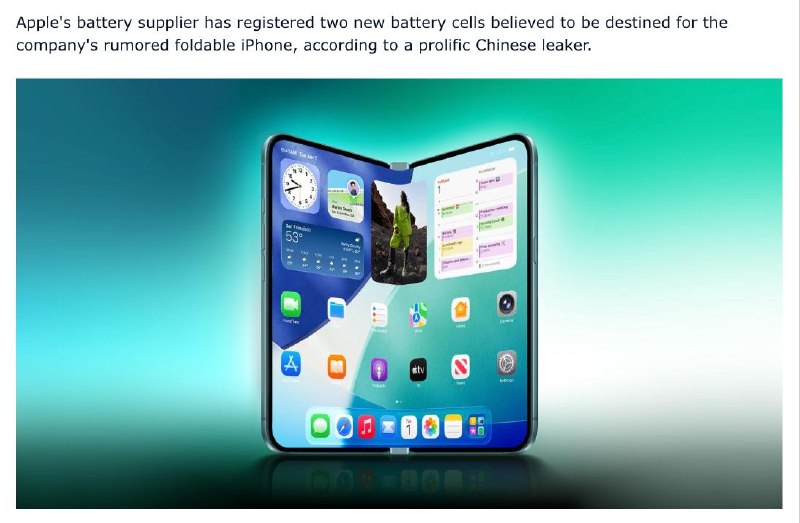
Foldable iPhone Ultra Battery Specifications Leaked by Apple Supplier
Apple's highly anticipated foldable iPhone Ultra has taken another step toward reality as a key supplier has registered two new battery cells for the device, offering the first concrete details about its power capacity. According to industry sources, the upcoming foldable device will feature a dual-battery configuration totaling at least 4,883 mAh, positioning it competitively against existing foldable smartphones from rivals Samsung and Google.
Battery Details Emerge from Supply Chain
According to Digital Chat Station, as reported by MacRumors, Apple has registered two distinct battery cells for its foldable iPhone Ultra. The individual capacities are 1,921 mAh and 2,962 mAh, which combine to provide a total minimum capacity of 4,883 mAh. This information comes directly from Apple's supply chain, lending credibility to the specifications.
The dual-battery approach is likely necessary to accommodate the unique form factor of a foldable device, which requires power sources for both the inner and outer displays while maintaining a slim profile. Apple's decision to use two separate cells rather than a single large battery suggests careful engineering considerations for the device's internal space utilization.
Competitive Landscape in Foldable Battery Capacity
When compared to existing foldable smartphones, Apple's battery capacity appears to be competitive but not leading the market. The following table provides a comparison between the foldable iPhone Ultra and its closest competitors:
| Device | Battery Capacity (mAh) | Manufacturer |
|---|---|---|
| Foldable iPhone Ultra (leaked) | 4,883 | Apple |
| Pixel 10 Pro Fold | 5,015 | |
| Galaxy Z Fold 7 | 4,400 | Samsung |
The foldable iPhone Ultra's battery capacity is slightly lower than Google's upcoming Pixel 10 Pro Fold but exceeds Samsung's Galaxy Z Fold 7. This positioning suggests Apple is aiming for a balance between battery life and device thinness, which has been a challenge for foldable smartphone manufacturers.
High-Density Battery Technology
Renowned Apple analyst Ming-Chi Kuo has provided additional context about the foldable iPhone Ultra's battery technology, indicating that Apple will utilize high-density battery cells. This approach allows for greater energy storage within a smaller physical footprint, addressing one of the primary challenges in foldable device design.
High-density batteries are particularly important for foldable devices, where space constraints are more pronounced than in traditional smartphones. By maximizing energy density, Apple can potentially offer competitive battery life despite the total capacity being slightly lower than some competitors.
Earlier Rumors vs. Current Information
The leaked battery specifications differ from earlier reports that suggested capacities between 5,400-5,800 mAh. Industry sources now indicate that those higher figures were based on engineering samples that may not have reflected the final design considerations.
The discrepancy between earlier rumors and the current information highlights the iterative nature of product development, particularly for a new form factor like a foldable smartphone. Apple's engineering team likely refined the design, potentially prioritizing factors like device thinness, weight distribution, and internal component layout over maximizing raw battery capacity.
Expected Specifications and Features
Beyond the battery details, several other specifications for the foldable iPhone Ultra have been circulating in the supply chain:
- Display: 7.8-inch inner display and 5.5-inch outer display
- Biometric Security: Touch ID integration (potentially alongside Face ID)
- Processor: A20 chip (likely Apple's next-generation system-on-chip)
- Connectivity: C2 modem (Apple's proprietary modem technology)
The inclusion of Touch ID is particularly interesting, as Apple has increasingly relied on Face ID as its primary biometric authentication method. The decision to include Touch ID in the foldable iPhone Ultra suggests that the company recognizes the practical benefits of having fingerprint authentication available, especially when the device is in a partially folded state or when Face ID might be less accessible.
Launch Timeline and Pricing Strategy
Industry insiders suggest that Apple plans to launch the foldable iPhone Ultra in September 2025, alongside the iPhone 18 Pro. This timing would position the device as Apple's premium offering for the fall season, potentially helping to drive significant upgrades among Apple's user base.
Pricing for the foldable iPhone Ultra is expected to be premium, with a base price around $2,500. Top configurations with additional storage or special features could reach up to $3,000, placing it in the ultra-premium segment of the smartphone market.
This pricing strategy reflects Apple's approach to new product categories, where the company typically positions its initial offerings at the higher end of the market. The premium pricing also acknowledges the additional engineering complexity and materials required for a foldable design compared to traditional smartphones.
Implications for the Foldable Smartphone Market
The entry of Apple into the foldable smartphone market represents a significant development for the industry. While Samsung has dominated the foldable space since its inception, and Google has established itself as a strong competitor, Apple's arrival could accelerate innovation and potentially drive mainstream adoption of foldable technology.
The battery specifications leaked so far suggest that Apple is taking a measured approach to its foldable debut, focusing on quality and user experience rather than simply competing on specifications. The company's emphasis on high-density battery technology indicates a commitment to overcoming one of the primary challenges facing foldable devices: balancing functionality with portability.
As Apple continues to refine its foldable iPhone Ultra in the coming months, consumers and industry observers will be watching closely to see how the company's approach compares to existing solutions from competitors and whether it can successfully introduce a new form factor to the mass market.
The foldable iPhone Ultra represents Apple's most significant hardware innovation in years, and its battery specifications are just one piece of a complex puzzle that will determine the device's success in the marketplace. With supply chain details continuing to emerge, the picture of Apple's foldable future is becoming increasingly clear.
🔋 Foldable iPhone Ultra battery leaked 📰 Apple supplier registered two new battery cells for the foldable iPhone Ultra – 1,921 mAh and 2,962 mAh, totaling at least 4,883 mAh combined. That's per Digital Chat Station via MacRumors. For comparison: 📱 Pixel 10 Pro Fold – 5,015 mAh 📱 Galaxy Z Fold 7 – 4,400 mAh This is lower than earlier rumors of 5,400–5,800 mAh, though those reportedly described just an engineering sample. Ming-Chi Kuo says the device will use high-density cells. 😐 Expected specs: 7.8" inner / 5.5" outer display, Touch ID, A20 chip, C2 modem. Launch possibly in September with iPhone 18 Pro. 💸 Price: ~$2,500, up to $3,000 for top configs. @iPhone 🔋 Foldable iPhone Ultra battery leaked 📰 Apple supplier registered two new battery cells for the foldable iPhone Ultra – 1,921 mAh and 2,962 mAh, totaling at least 4,883 mAh combined. That's per Digital Chat Station via MacRumors. For comparison: 📱 Pixel 10 Pro Fold – 5,015 mAh 📱 Galaxy Z Fold 7 – 4,400 mAh This is lower than earlier rumors of 5,400–5,800 mAh, though those reportedly described just an engineering sample. Ming-Chi Kuo says the device will use high-density cells. 😐 Expected specs: 7.8" inner / 5.5" outer display, Touch ID, A20 chip, C2 modem. Launch possibly in September with iPhone 18 Pro. 💸 Price: ~$2,500, up to $3,000 for top configs. @iPhone


