 TechOffice
iPhone 18 Pro: 느린 저장 속도를 충족하는 프리미엄 가격
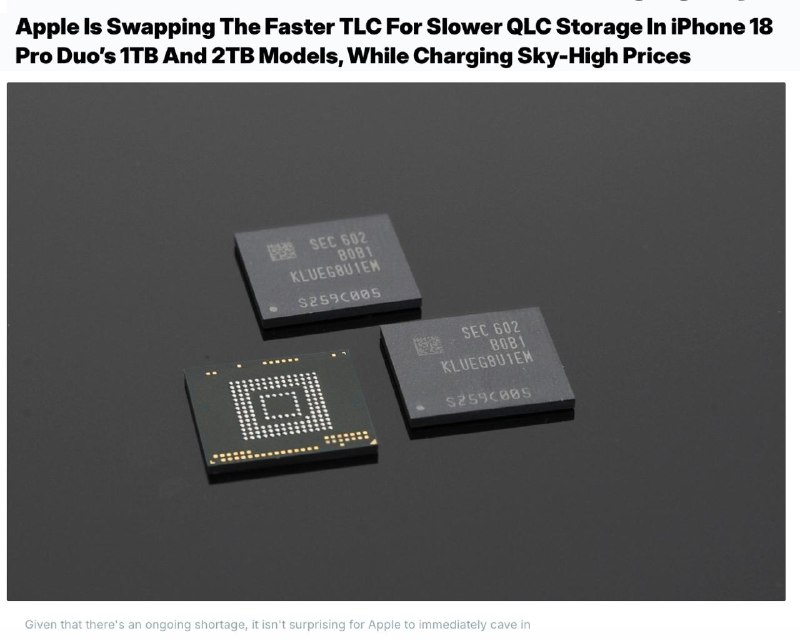
iPhone 18 Pro Storage Downgrade: Premium Pricing Meets Reduced Performance
In a move that has surprised industry analysts and potential customers alike, Apple is reportedly planning to downgrade the flash storage technology in its upcoming iPhone 18 Pro and Pro Max models, particularly for higher capacity configurations. According to technology news outlet Wccftech citing leaker Reptalicant, the flagship smartphones will transition from faster, more durable Triple-Level Cell (TLC) storage to slower Quad-Level Cell (QLC) storage in their 1TB and 2TB variants, potentially compromising user experience despite significant price increases.
Understanding the Storage Technology Shift
The reported downgrade represents a significant technical change that could impact device performance, especially for power users who rely on high-capacity iPhones for professional work, gaming, or media creation. To fully grasp the implications, it's essential to understand the fundamental differences between TLC and QLC storage technologies.
| TLC vs QLC Storage Technology Comparison | |
|---|---|
| TLC (Triple-Level Cell) | QLC (Quad-Level Cell) |
| Stores 3 bits per cell | Stores 4 bits per cell |
| Faster read/write speeds | Slower read/write speeds |
| Better endurance (longer lifespan) | Reduced endurance |
| Higher performance in random operations | Poorer random 4K performance |
| Currently used in iPhone 17 Pro models | Reportedly coming to iPhone 18 Pro high-capacity models |
Model-by-Model Storage Breakdown
According to the leaked information, Apple's storage strategy for the iPhone 18 Pro series will vary significantly across different capacity models:
- 256GB and 512GB models: These configurations will retain the faster TLC storage technology from suppliers including SK hynix, Kioxia, and SanDisk. The technology remains consistent with previous iPhone models, maintaining three bits per cell for optimal performance and durability.
- 1TB model: This capacity will reportedly transition primarily to SK hynix's BC8Q-1T QLC chip, which packs four bits per cell but offers slower speeds and reduced durability compared to TLC. Samsung's TLC chip may appear as a rare alternative, but the primary implementation will be QLC.
- 2TB model: This premium configuration faces the most significant downgrade, utilizing SK hynix's BC8Q-2T QLC chip, which was originally designed for server workloads. The leaker specifically notes that this chip suffers noticeably in random 4K performance, which could impact everyday usability for intensive applications.
Performance Implications for Users
The shift to QLC storage, particularly in the 1TB and 2TB models, could have several noticeable effects on user experience:
- Slower app loading times: QLC technology typically has slower read speeds, which could result in longer loading times for applications and games.
- Reduced file transfer speeds: Large file transfers, such as 4K video editing projects or high-resolution photo libraries, may take longer to complete.
- Diminished multitasking performance: The slower random 4K performance could impact the device's ability to handle multiple concurrent applications smoothly.
- Potentially shorter lifespan: QLC storage generally has fewer program-erase cycles than TLC, which could lead to reduced long-term durability with heavy usage.
It's worth noting that the iPhone 17 Pro Max's 2TB configuration continues to use proper TLC storage, maintaining the performance expectations that customers associate with Apple's premium flagship devices.
Cost Analysis and Apple's Margins
The reported storage downgrade comes at a time when Apple is significantly increasing the base prices for its iPhone 18 Pro models. While rising memory costs have been cited as a potential factor, the financial data suggests a more complex picture:
| Storage Configuration | iPhone 17 Pro Cost | iPhone 18 Pro Cost | 비율 증가 |
|---|---|---|---|
| 256GB Flash Module | $13 | $51 | 292% |
| Base iPhone 18 Pro | ~$1,099 | $1,399 | 27% |
| Base iPhone 18 Pro Max | ~$1,199 | $1,499 | 25% |
While the cost of flash memory components has indeed increased substantially—nearly quadrupling for the 256GB module—the overall price increase for the base iPhone 18 Pro models is approximately 25-27%. This discrepancy suggests that the storage downgrade may be driven more by margin protection than by necessity.
Industry Context and Consumer Impact
This potential storage change comes amid broader industry trends and consumer expectations in the premium smartphone market:
- Apple has historically positioned its Pro models as the pinnacle of mobile technology, with no compromises in performance or quality.
- Professional users who rely on iPhones for content creation, photography, and videography may be particularly affected by reduced storage performance.
- The timing of this potential change is notable, as it coincides with Apple's reported efforts to increase profit margins across its product lineup.
- Competitors in the premium Android space continue to advance storage technology, potentially narrowing Apple's performance advantage.
Conclusion: A Question of Value Proposition
If the reported storage downgrade materializes in the iPhone 18 Pro and Pro Max models, it would represent a significant departure from Apple's traditional value proposition for its premium devices. Customers paying premium prices—potentially exceeding $1,500 for a fully configured iPhone 18 Pro Max—would receive slower storage technology in the highest capacity models, contradicting expectations of uncompromising performance.
As Apple continues to push pricing higher in the premium smartphone segment, the company faces increasing scrutiny to justify these costs with tangible benefits. The potential transition to QLC storage in high-capacity models raises questions about whether Apple is maintaining its commitment to excellence or prioritizing profit margins over user experience.
Industry observers will be watching closely for official confirmation of these specifications when Apple unveils the iPhone 18 series later this year. The company may choose to address these concerns directly or adjust its storage strategy before launch, but the reported changes highlight an important tension between premium pricing and technological compromise in the current market climate.
😰 iPhone 18 Pro: paying more, getting slower storage 📰 Apple is reportedly downgrading the flash storage in the high-capacity iPhone 18 Pro and Pro Max, according to Wccftech, citing leaker Reptalicant. 1️⃣ The 256GB and 512GB models will keep fast TLC (Triple-Level Cell) storage from SK hynix, Kioxia, and SanDisk – same tech as before, three bits per cell, quick and durable. But the 1TB model will mostly switch to a QLC (Quad-Level Cell) chip – SK hynix's BC8Q-1T – which packs four bits per cell but is slower and less durable. A Samsung TLC chip will only appear as a rare alternative. 2️⃣ The 2TB version gets it worse: it'll use SK hynix's BC8Q-2T, a QLC chip originally built for server workloads. The leaker claims this chip suffers noticeably in random 4K performance. For comparison, the 2TB iPhone 17 Pro Max still uses proper TLC storage, as you'd expect from a flagship. 💸 다운그레이드하는 이유는 무엇인가요? Wccftech points to rising memory costs — earlier reports suggested a 256GB flash module now costs Apple around $51 per unit, up from $13 for the iPhone 17 Pro. Meanwhile, base prices for the 18 Pro and Pro Max are expected to hit $1399 and $1499. The math doesn't add up in customers' favor – this looks less like a cost-driven necessity and more like Apple protecting its margins at the expense of top-tier buyers. @데일리애플 😰 iPhone 18 Pro: paying more, getting slower storage 📰 Apple is reportedly downgrading the flash storage in the high-capacity iPhone 18 Pro and Pro Max, according to Wccftech, citing leaker Reptalicant. 1️⃣ The 256GB and 512GB models will keep fast TLC (Triple-Level Cell) storage from SK hynix, Kioxia, and SanDisk – same tech as before, three bits per cell, quick and durable. But the 1TB model will mostly switch to a QLC (Quad-Level Cell) chip – SK hynix's BC8Q-1T – which packs four bits per cell but is slower and less durable. A Samsung TLC chip will only appear as a rare alternative. 2️⃣ The 2TB version gets it worse: it'll use SK hynix's BC8Q-2T, a QLC chip originally built for server workloads. The leaker claims this chip suffers noticeably in random 4K performance. For comparison, the 2TB iPhone 17 Pro Max still uses proper TLC storage, as you'd expect from a flagship. 💸 다운그레이드하는 이유는 무엇인가요? Wccftech points to rising memory costs — earlier reports suggested a 256GB flash module now costs Apple around $51 per unit, up from $13 for the iPhone 17 Pro. Meanwhile, base prices for the 18 Pro and Pro Max are expected to hit $1399 and $1499. The math doesn't add up in customers' favor – this looks less like a cost-driven necessity and more like Apple protecting its margins at the expense of top-tier buyers. @데일리애플


