 TechOffice
Apple vs. OpenAI: Major Lawsuit Filed Over Alleged Trade Secret Theft
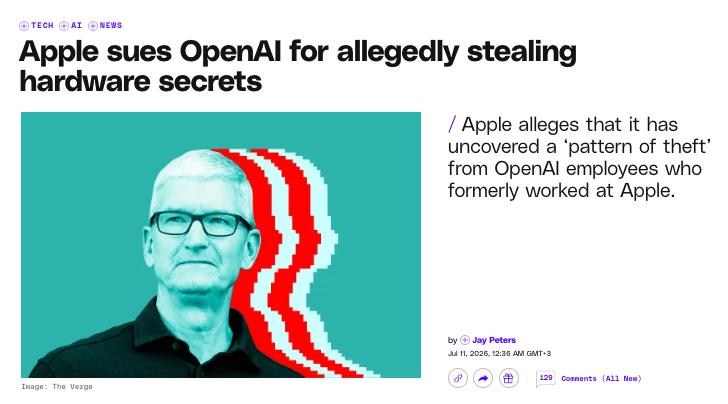
Apple Files Lawsuit Against OpenAI, Alleging Systematic Theft of Trade Secrets
In a dramatic escalation in the competitive landscape of artificial intelligence and hardware development, Apple Inc. has initiated legal proceedings against OpenAI, alleging that the AI company engaged in a coordinated scheme to steal confidential trade secrets. The lawsuit specifically names two former Apple employees who now work at OpenAI: designer Tang Tan and engineer Chang Liu.
The complaint, filed in a California state court, portrays what Apple describes as a systemic pattern of intellectual property theft rather than isolated incidents. The tech giant claims that these actions have provided OpenAI with unfair advantages in developing its own AI hardware products.
Allegations of Systematic Information Theft
According to Apple's lawsuit, the alleged misconduct extends beyond simple negligence to what the company characterizes as deliberate efforts to exfiltrate proprietary information. The most serious allegations involve a former iPhone engineer who, upon leaving Apple for OpenAI, retained possession of his work laptop and continued to access Apple's internal databases.
The engineer reportedly made flippant remarks to former colleagues, including statements like "lol, I still have access, this'll be fun," suggesting a casual attitude toward what Apple considers serious security violations. Furthermore, the individual allegedly created guides detailing how to copy work files without triggering security alerts, effectively teaching others how to circumvent Apple's data protection measures.
Specific Allegations Against Former Employees
The lawsuit outlines several specific instances of alleged misconduct:
- Retention of company property (work laptop) post-employment
- Unauthorized access to Apple's internal databases after joining OpenAI
- Creation of guides on circumventing security protocols
- Poaching of Apple employees with the expectation they would bring confidential materials
- Requesting interview candidates to bring mockups and schematics from Apple
Background on Key Individuals
The central figures in this legal dispute are Tang Tan and Chang Liu, both of whom made significant career moves from Apple to OpenAI.
| Individual | Role at Apple | Role at OpenAI | Duration at Apple |
|---|---|---|---|
| Tang Tan | Senior Designer | Head of Hardware | Nearly 25 years (primarily on iPhone) |
| Chang Liu | iPhone Engineer | Engineering Position | Specific duration not disclosed |
Tang Tan's departure from Apple was particularly notable given his extensive tenure with the company and his prominent role in the development of the iPhone, Apple's flagship product. His move to OpenAI to lead hardware development represents a significant talent acquisition for the AI company.
Apple's Legal Claims and Remedies Sought
In its complaint, Apple asserts that the stolen trade secrets have directly contributed to OpenAI's development of AI hardware products. The company is seeking several forms of relief:
- A permanent injunction prohibiting OpenAI from using Apple's trade secrets
- Compensatory damages for the misappropriation of confidential information
- Punitive damages to deter similar conduct in the future
- Disgorgement of any profits obtained through the use of stolen information
"The theft of trade secrets is not just illegal—it undermines the very foundation of innovation that drives our industry," stated Apple's general counsel in a press release accompanying the lawsuit filing.
OpenAI's Response
OpenAI has vehemently denied Apple's allegations, characterizing the lawsuit as an attempt to transform a routine hiring dispute into a "systematic scheme." In an official statement, the company emphasized its commitment to ethical business practices:
"OpenAI has no interest in other companies' trade secrets. We take intellectual property protection extremely seriously and have robust systems in place to ensure compliance with all applicable laws. This appears to be nothing more than Apple's attempt to spin a normal hiring dispute into something more dramatic."
The company further noted that it conducts thorough reviews of all materials brought by new employees to ensure compliance with intellectual property laws and that it has not benefited from any proprietary information belonging to Apple.
Industry Context and Precedents
This lawsuit emerges against a backdrop of increasing competition in the AI and hardware sectors, where companies like Apple, OpenAI, Google, Microsoft, and others are racing to develop next-generation technologies. The protection of trade secrets has become a critical concern as boundaries between companies blur through employee movements and collaborations.
Legal experts note that this case bears resemblance to other high-profile tech industry disputes, such as the 2014 lawsuit between Apple and Samsung over smartphone patents, and the 2018 case where Google was accused of poaching Apple's self-driving car team. However, the current case focuses specifically on trade secret theft rather than patent infringement or employee non-solicitation.
Legal Standards in Trade Secret Cases
For Apple to succeed in its claim, it must demonstrate several key elements under the California Uniform Trade Secrets Act (CUTSA) and federal law:
- The existence of a trade secret
- That reasonable measures were taken to maintain its secrecy
- That the trade secret was acquired through improper means
- That there was actual or threatened misappropriation
- That the trade secret possesses independent economic value
The burden of proof in such cases can be substantial, particularly when the alleged misappropriation involves former employees who may have legitimately possessed some of the information in question.
Potential Implications for the Tech Industry
Regardless of the outcome, this lawsuit is likely to have far-reaching implications for the tech industry:
- Increased scrutiny of employee transitions between competing companies
- More stringent enforcement of non-disclosure agreements and intellectual property protections
- Potential changes in how companies conduct background checks and onboarding processes
- Possible chilling effect on legitimate knowledge sharing and industry collaboration
"This case serves as a reminder that in the hyper-competitive tech landscape, protecting intellectual property has never been more critical," said legal analyst Dr. Michael Reynolds. "However, companies must also be careful not to overreach and inadvertently stifle the natural movement of talent and ideas that fuels innovation."
Conclusion
The lawsuit between Apple and OpenAI represents a significant development in the ongoing battle for technological supremacy in the AI and hardware sectors. As both companies continue to invest heavily in innovation, the protection of trade secrets has become a paramount concern.
While the legal process will unfold over months or potentially years, the case highlights the increasingly complex challenges faced by tech companies in balancing the need to protect proprietary information with the reality of a fluid talent market. The outcome of this dispute may set important precedents for how similar cases are handled in the future and could influence the strategies companies employ when hiring employees from competitors.
As the tech industry continues to evolve, the boundaries between ethical competition and intellectual property theft will likely remain a contentious issue, with this lawsuit serving as a prominent example of the tensions that can arise in the pursuit of innovation.
🧑⚖️ Apple sues OpenAI over alleged theft of trade secrets 📰 Apple is accusing OpenAI and two former employees – designer Tang Tan and engineer Chang Liu – of running a coordinated scheme to leak confidential data. According to Apple, this wasn't an isolated incident but a systemic practice. What came out: • One former iPhone engineer refused to hand back his work laptop when he left – and kept using it to pull data from Apple's internal databases while already working at OpenAI. • He reportedly told former colleagues things like "lol, I still have access, this'll be fun," and even wrote guides on how to quietly copy work files without tripping security. • Tang Tan, who spent nearly 25 years working on the iPhone before becoming OpenAI's head of hardware, allegedly poached people from Apple and asked them to bring mockups and schematics to interviews. 😤 Apple claims the stolen data helped OpenAI in developing its own AI hardware, and is seeking an injunction against its use plus damages. OpenAI has responded by saying it has "no interest in other companies' trade secrets" and that Apple's lawsuit is an attempt to spin an ordinary hiring dispute into a "systematic scheme." @DailyApple 🧑⚖️ Apple sues OpenAI over alleged theft of trade secrets 📰 Apple is accusing OpenAI and two former employees – designer Tang Tan and engineer Chang Liu – of running a coordinated scheme to leak confidential data. According to Apple, this wasn't an isolated incident but a systemic practice. What came out: • One former iPhone engineer refused to hand back his work laptop when he left – and kept using it to pull data from Apple's internal databases while already working at OpenAI. • He reportedly told former colleagues things like "lol, I still have access, this'll be fun," and even wrote guides on how to quietly copy work files without tripping security. • Tang Tan, who spent nearly 25 years working on the iPhone before becoming OpenAI's head of hardware, allegedly poached people from Apple and asked them to bring mockups and schematics to interviews. 😤 Apple claims the stolen data helped OpenAI in developing its own AI hardware, and is seeking an injunction against its use plus damages. OpenAI has responded by saying it has "no interest in other companies' trade secrets" and that Apple's lawsuit is an attempt to spin an ordinary hiring dispute into a "systematic scheme." @DailyApple


