 TechOffice
iPhone Embarks on 250-Year Journey to 2276 in Time Capsule
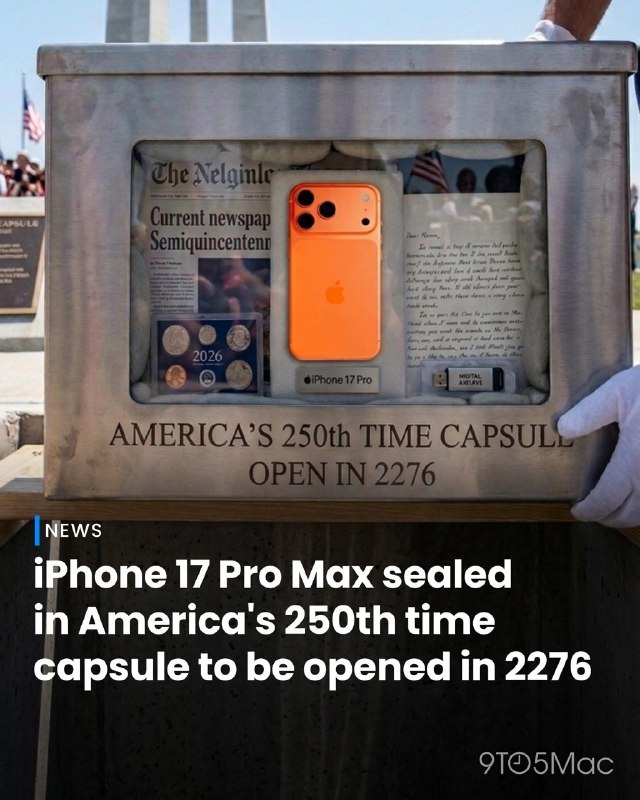
Time Capsule for the Future: An iPhone's Journey to 2276
In a remarkable blend of historical preservation and modern technology, a massive time capsule has been sealed in Philadelphia to commemorate America's 250th anniversary. This nearly 900-pound stainless steel container, designed to withstand the test of time, holds hundreds of artifacts from all 50 states, Washington D.C., and five U.S. territories. The capsule remains sealed until 2276, when it will be opened during the nation's 500th anniversary celebration.
A Nation's Story Preserved
The time capsule represents a comprehensive snapshot of American culture, technology, and daily life in the early 21st century. Curators from across the country contributed items that best represent their regions, creating a diverse collection that will give future generations insight into our time.
Among these carefully selected artifacts is an iPhone 17 Pro Max in Cosmic Orange—a device that exemplifies the technological sophistication of our era. The smartphone contains "digital artifacts" saved in its Notes app, intended to provide future historians with a window into contemporary life.
The Digital Preservation Challenge
While the physical preservation of traditional artifacts presents its own challenges, digital technology like smartphones introduces unprecedented complications for time capsules.
The inclusion of an iPhone raises several critical questions about long-term digital preservation:
- Will the device even power on after 250 years?
- Can the data stored within remain accessible?
- What technologies will be required to access this information in the future?
Battery Degradation: A Fundamental Hurdle
One of the most immediate challenges is the iPhone's lithium-ion battery. These power sources have a limited lifespan, typically degrading significantly after 2-3 years of regular use. Even in optimal storage conditions, chemical processes within the battery will continue over time.
| Lithium-ion Battery Degradation Timeline | |
|---|---|
| Time Period | Battery Capacity |
| Manufacture | 100% |
| 1 year (ideal storage) | 80-90% |
| 5 years (ideal storage) | 60-70% |
| 10+ years (ideal storage) | 30-50% |
| 250 years (estimated) | Essentially 0% |
Even under ideal conditions—cool temperatures, partial charge, and no physical stress—the battery would likely be completely non-functional after 250 years. The chemical compounds would have broken down, and the internal structure would have deteriorated beyond recovery.
The Server Dependency Dilemma
Even if by some miracle the iPhone's battery retains a charge after 250 years, a more significant obstacle emerges: the device's dependency on Apple's servers for activation and data access.
Modern iPhones implement robust security measures that require authentication through Apple's servers. This "activation lock" prevents unauthorized use but creates a critical vulnerability for long-term preservation:
- Apple's servers may not exist in 250 years
- The authentication protocols used today will likely be obsolete
- The cryptographic keys securing the device may be lost or irrecoverable
Digital Preservation Through History
The challenge of preserving digital information is relatively new in human history. Earlier time capsules primarily contained physical objects—documents, photographs, and artifacts—that could theoretically last for centuries under proper conditions.
The digital revolution of the late 20th and early 21st centuries has created a preservation paradox: we create more information than ever before, but much of it is stored on media with limited lifespans and dependent on technologies that become obsolete rapidly.
Expert Perspectives on Digital Time Capsules
Digital preservation experts have long warned about these challenges. Dr. Eleanor Vance, a digital archivist at the Smithsonian Institution, explains: "Including a smartphone in a time capsule is symbolically powerful, but practically problematic. We're essentially asking future generations to solve technological puzzles we can't yet imagine."
Some have suggested alternative approaches for preserving digital content:
- Converting digital files to analog formats (such as microfilm)
- Creating multiple backups on various media types
- Including detailed documentation of file formats and access methods
- Designating "digital archaeologists" to develop future retrieval methods
The iPhone's Place in History
Despite these challenges, the iPhone's inclusion in the time capsule represents an important statement about our era's technological achievements. The iPhone 17 Pro Max, when sealed, represented the pinnacle of consumer technology—a device more powerful than the computers that guided the Apollo missions to the moon.
The "digital artifacts" saved in the Notes app likely include:
- Personal messages and reflections from 21st century Americans
- Descriptions of daily life and cultural touchstones
- Photographs and videos of significant events
- Scientific data and artistic expressions
Lessons for Future Time Capsules
The inclusion of this iPhone in America's 250th anniversary time capsule serves as both a technological milestone and a cautionary tale. Future generations may look back and marvel at our audacity in including such a device, while simultaneously grappling with the challenge of accessing its contents.
This experiment raises important questions for future time capsule creators:
- How should we balance technological representation with preservation feasibility?
- What methods can we develop to bridge technological gaps between eras?
- How do we preserve intangible cultural elements that depend on specific technologies?
Looking Forward to 2276
When the time capsule is opened in 2276, the contents will undoubtedly reveal much about early 21st century America. The physical artifacts will provide tangible connections to our time, while the digital elements—assuming they can be accessed—will offer a window into our technological capabilities and cultural mindset.
The iPhone, regardless of whether it can be powered on, stands as a symbol of our era's technological optimism. It represents our belief in progress, our fascination with the future, and our desire to leave a mark on history—even if the methods we use to do so may prove as transient as the technology itself.
As we look toward the nation's 500th anniversary, we must acknowledge both the ambition and the limitations of our preservation efforts. The time capsule is not merely a container of objects, but a dialogue between past and future—a conversation that will continue long after those who sealed it have passed into history.
🙂 Time capsule: an iPhone bound for the year 2276 🇺🇸 To mark America's 250th anniversary, a massive time capsule was buried in Philadelphia — a nearly 900-pound stainless steel container holding hundreds of artifacts from all 50 states, Washington D.C., and five U.S. territories. It won't be opened until 2276, for the nation's 500th anniversary. 📱 Among the items is the iPhone 17 Pro Max in Cosmic Orange. The phone has "digital artifacts" saved in the Notes app for future generations to look through – assuming the device even turns on. But that's the real problem: 🔋 Lithium-ion batteries degrade over time, so the odds of the phone powering on in 250 years are basically zero. 🔒 But even if the battery somehow survives, there's a bigger catch – unlocking an iPhone depends on Apple's servers, which may not even exist 250 years from now. @iPhone 🙂 Time capsule: an iPhone bound for the year 2276 🇺🇸 To mark America's 250th anniversary, a massive time capsule was buried in Philadelphia — a nearly 900-pound stainless steel container holding hundreds of artifacts from all 50 states, Washington D.C., and five U.S. territories. It won't be opened until 2276, for the nation's 500th anniversary. 📱 Among the items is the iPhone 17 Pro Max in Cosmic Orange. The phone has "digital artifacts" saved in the Notes app for future generations to look through – assuming the device even turns on. But that's the real problem: 🔋 Lithium-ion batteries degrade over time, so the odds of the phone powering on in 250 years are basically zero. 🔒 But even if the battery somehow survives, there's a bigger catch – unlocking an iPhone depends on Apple's servers, which may not even exist 250 years from now. @iPhone


