 TechOffice
Apple's Personalized App Store Draws Fresh Privacy Scrutiny
Apple Faces Privacy Backlash Over Detailed App Store Data Collection for Personalized Recommendations
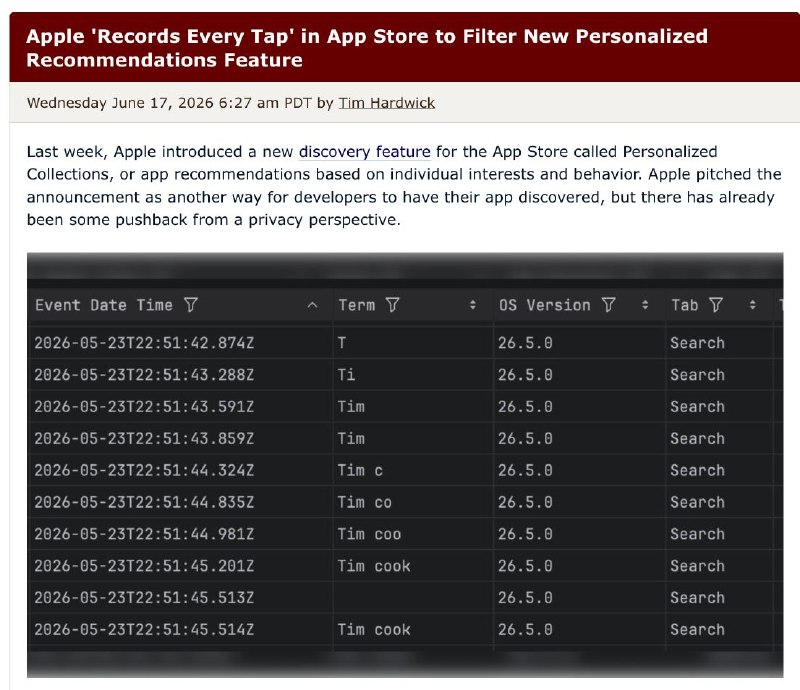
Apple, the tech giant renowned for its strong stance on user privacy, is facing mounting criticism over its new personalized App Store recommendations feature. The controversy centers on revelations that the company collects extensive user interaction data—including every screen tap and typing speed—to power these suggestions, without obtaining explicit user consent beforehand.
The Genesis of the Controversy
Apple's personalized App Store recommendations, designed to enhance user experience by suggesting apps based on individual behavior patterns, have been marketed as a value-added feature. However, recent discoveries through Apple's privacy portal have revealed the extent of data collection involved in powering these recommendations.
Researchers discovered that Apple gathers granular details of users' App Store interactions, including precise timing of screen taps, scrolling behavior, and even typing speed. This level of behavioral tracking goes significantly beyond what most users would reasonably expect for a recommendation system.
Understanding the Data Collection Mechanism
The data collection is enabled by default on Apple devices and cannot be disabled through standard privacy settings. Users can only access this information through Apple's privacy portal, where they can request a copy of their data—a process that many users may not be aware of or understand.
The collected data forms the foundation for Apple's machine learning algorithms that power the App Store recommendations. By analyzing detailed interaction patterns, Apple aims to predict which apps a user might be interested in, potentially increasing app discovery and engagement.
Key Data Points Collected:
- Timestamps of every screen tap within the App Store
- Scrolling speed and direction
- Time spent on different app pages
- Typing speed and patterns in search queries
- Sequence of actions taken before installing or purchasing an app
Privacy Concerns Emerge
The primary criticism stems from the disconnect between Apple's public privacy promises and its actual practices. The company has built its brand identity around protecting user privacy, often positioning itself as a privacy-first alternative to competitors like Google and Facebook.
"What we're seeing is a fundamental betrayal of user trust," commented Dr. Eleanor Vance, a privacy researcher at the Digital Rights Foundation. "Apple is collecting behavioral data at a level that would make even some social media platforms blush, yet they're doing it under the guise of improving app recommendations."
Privacy advocates highlight several specific concerns:
- Lack of Transparency: Users are not adequately informed about the extent of data collection.
- Default Enablement: The feature cannot be easily disabled, creating an opt-out rather than opt-in model.
- Scope of Collection: The granularity of data collection exceeds what's necessary for effective recommendations.
- Potential for Abuse: Such detailed behavioral data could potentially be repurposed for advertising or other commercial uses.
Apple's Response and Justification
In response to inquiries, Apple representatives have defended the practice, stating that the data collection is designed to improve user experience and that all information is processed on-device where possible. The company emphasizes that the data is anonymized and aggregated for analysis purposes.
"Our personalized recommendations are designed to help users discover apps they'll love," said an Apple spokesperson in an official statement. "We employ industry-standard privacy protections and are committed to being transparent with our users about how their data is used."
Apple's Privacy Principles vs. Current Practices:
| Apple's Stated Privacy Principles | Current App Store Data Collection |
|---|---|
| Transparency and control | Collection enabled by default with limited opt-out options |
| Data minimization | Collection of highly granular behavioral data |
| On-device processing where possible | Some data may be transmitted to Apple servers |
| Explicit user consent | No explicit opt-in for this specific feature |
Industry Comparison and Context
To understand the significance of this controversy, it's helpful to compare Apple's practices with those of other major tech companies in the app ecosystem:
| Company | App Recommendation Data Collection | User Control Options |
|---|---|---|
| Apple | Detailed behavioral data including taps and typing speed | Cannot be disabled; data accessible only through privacy portal |
| Google Play | Download history and app category preferences | Can be disabled through account settings |
| Amazon Appstore | Purchase history and browsing behavior | Opt-out available in privacy dashboard |
| Microsoft Store | Device and usage statistics | Configurable through Windows privacy settings |
Regulatory and Legal Implications
The issue arises amid increasing global scrutiny of tech companies' data practices. Regulations like Europe's GDPR and California's CCPA require explicit consent for certain types of data collection, particularly when it involves detailed behavioral information.
Legal experts suggest that Apple's current approach could potentially violate these regulations depending on how the collected data is classified and used. "If Apple is using detailed interaction data for purposes beyond app recommendations without proper consent, they could be facing significant legal exposure," noted James Peterson, a technology law specialist.
User Reactions and Market Impact
The revelation has sparked varied reactions among Apple's user base. While some appreciate more relevant app suggestions, others express concern about the privacy implications.
"I had no idea Apple was tracking my every tap in the App Store," said Sarah Chen, an iPhone user in San Francisco. "It feels invasive, especially when I thought I was making a privacy-conscious choice by using Apple products."
Market analysts suggest that while the immediate impact on Apple's business may be limited, the long-term reputational damage could be significant if the company fails to address user concerns adequately.
Future Outlook and Potential Solutions
Industry observers suggest several potential paths forward for Apple:
- Implementing a proper opt-in mechanism with clear explanations of data collection
- Reducing the granularity of data collected to what's necessary for effective recommendations
- Enhancing transparency through in-app notifications about data usage
- Providing more granular controls within Settings rather than requiring users to navigate the privacy portal
Apple has not indicated whether it plans to modify its approach, but the growing chorus of criticism suggests that changes may be necessary to align with the company's stated privacy values.
Conclusion
The controversy over Apple's App Store data collection represents a significant moment in the ongoing conversation about tech privacy. As users become increasingly aware of how their data is collected and used, companies face greater pressure to align their practices with their stated values.
For Apple, which has staked much of its brand identity on privacy leadership, this situation presents both a challenge and an opportunity. Addressing the concerns transparently and implementing meaningful changes could reinforce user trust, while ignoring them risks undermining the very brand positioning that has set Apple apart in an increasingly privacy-conscious market.
As the digital landscape continues to evolve, the balance between personalization and privacy will remain a critical issue for all technology companies—none more so than Apple, which now finds itself at the center of this particular debate.
🅰️ Apple is facing fresh privacy criticism over its new personalized App Store recommendations 🤔 The feature suggests apps based on user behavior, but reports reveal that Apple collects detailed App Store interaction data to power these recommendations — including every screen tap and even typing speed. The findings come from data users can request through Apple's privacy portal. 📰 According to researchers, this data collection is enabled by default and cannot be turned off, raising concerns about transparency and user consent. 🤨 The biggest criticism? Apple has built its brand around protecting user privacy, yet users aren't explicitly asked to opt in before this level of behavioral data is collected. @DailyApple 🅰️ Apple is facing fresh privacy criticism over its new personalized App Store recommendations 🤔 The feature suggests apps based on user behavior, but reports reveal that Apple collects detailed App Store interaction data to power these recommendations — including every screen tap and even typing speed. The findings come from data users can request through Apple's privacy portal. 📰 According to researchers, this data collection is enabled by default and cannot be turned off, raising concerns about transparency and user consent. 🤨 The biggest criticism? Apple has built its brand around protecting user privacy, yet users aren't explicitly asked to opt in before this level of behavioral data is collected. @DailyApple


