 TechOffice
Apple's First Touchscreen MacBook Pro to Feature M5 Pro and Max Processors
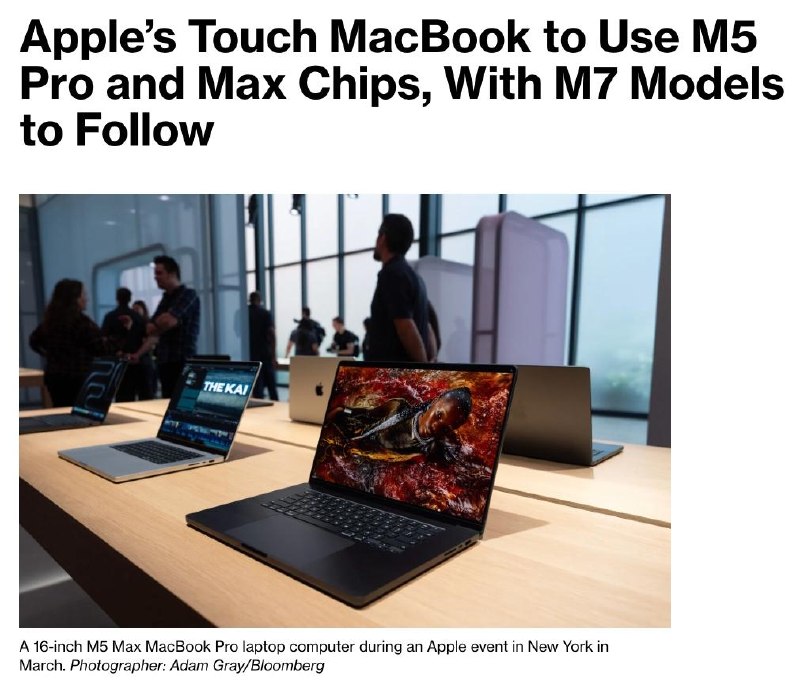
Apple's Revolutionary Touchscreen MacBook Pro: M5 Chips, OLED Displays, and a Major Strategic Shift
In a move that could redefine the laptop market, Apple is reportedly preparing to launch the first-ever touchscreen MacBook Pro models, powered by existing M5 Pro and M5 Max chips rather than the anticipated next-generation M6 silicon. According to Bloomberg's highly reliable tech journalist Mark Gurman, this significant product line expansion represents Apple's most dramatic departure from traditional Mac design philosophy in recent years.
A New Era for MacBooks
The transition to touchscreen technology marks a fundamental shift in Apple's approach to its professional laptop lineup. For decades, Apple has maintained a strict separation between its touch-based iOS devices and mouse/keyboard controlled Macs. This strategic decision to introduce touch capabilities to the MacBook Pro series indicates Apple's recognition of evolving user workflows and the increasing blurring of lines between tablets and laptops.
The new models, codenamed K114 (14-inch) and K116 (16-inch), are expected to launch between late 2026 and early 2027, positioning Apple at the forefront of professional computing innovation.
Key Specifications and Features
The upcoming touchscreen MacBook Pro models will introduce several groundbreaking features to Apple's laptop lineup:
- OLED Display with Touch Support: The first implementation of OLED technology in a Mac laptop, combined with multi-touch capabilities, promising superior color accuracy, deeper blacks, and reduced power consumption
- Dynamic Island: Borrowing from iPhone design language, the Dynamic Island will replace the traditional notch, providing an interactive area for system notifications and alerts
- Redesigned Chassis: A thinner and lighter design compared to current MacBook Pro models, though maintaining the premium build quality Apple is known for
- Enhanced Thermal Management: New cooling solutions to handle the increased power demands of both the M5 chips and the OLED display
Processor Strategy: Skipping a Generation
Perhaps the most surprising aspect of this leak is Apple's decision to utilize existing M5 Pro and M5 Max chips rather than the anticipated M6 generation. This strategic choice suggests several possibilities:
| Chip Generation | Status | Expected Timeline |
|---|---|---|
| M5 Pro/M5 Max | Confirmed for touchscreen MacBook Pro | Late 2026 - Early 2027 |
| M6 Pro/M6 Max | Skipped entirely | Not applicable |
| M7 Pro/M7 Max | In development for second-gen touch MacBook | Late 2027 |
This chip strategy indicates that Apple may be accelerating its development cycle or realigning resources to prioritize AI capabilities and touch integration. The M7 generation is expected to feature enhanced neural engines specifically optimized for AI workloads, suggesting Apple's focus on artificial intelligence integration in its professional computing products.
Pricing and Market Positioning
With an expected starting price of approximately $4,000, these new touchscreen MacBook Pro models will firmly establish themselves in the premium laptop segment. This pricing strategy aligns with Apple's position as a luxury brand but may also reflect the increased costs associated with OLED displays and touch-enabled interfaces.
The market positioning suggests Apple is targeting creative professionals, software developers, and enterprise customers who would benefit most from the combination of high-performance computing and direct interaction capabilities. This demographic has traditionally been Mac's core user base, but the addition of touch functionality may appeal to a broader audience of power users.
Industry Implications and Competitive Landscape
The introduction of touchscreen MacBook Pro models could significantly impact the laptop market, potentially forcing competitors to accelerate their own touch-enabled laptop offerings. Currently, Windows-based touchscreen laptops have struggled to gain significant market share among professionals, largely due to software optimization issues.
Apple's entry into this space could validate touch computing as a viable input method for professional workflows, potentially leading to a wave of innovation across the industry. The company's history of successfully introducing new technologies (such as the transition from PowerPC to Intel chips and later to Apple Silicon) suggests it may overcome the traditional challenges of touch-based computing on larger screens.
Comparison with Current MacBook Pro Lineup
To better understand the significance of these rumored changes, let's compare the expected specifications of the new touchscreen MacBook Pro with current models:
| Feature | Current MacBook Pro (M3 Series) | Rumored Touchscreen MacBook Pro (M5 Series) |
|---|---|---|
| Display Technology | Mini-LED LCD | OLED with Touch Support |
| Input Methods | Trackpad, Keyboard, Touch Bar (select models) | Trackpad, Keyboard, Multi-touch Display |
| Design | Aluminum unibody, traditional form factor | Thinner chassis, possibly new form factor |
| Special Features | Touch Bar (select models), Touch ID | Dynamic Island, enhanced touch gestures |
| Starting Price | ~$1,999 | ~$4,000 |
The Future of Apple's Mac Ecosystem
The development of touchscreen MacBook Pro models is just one piece of Apple's broader strategy for its Mac ecosystem. The company is reportedly planning a second generation of these devices, expected in late 2027 and powered by M7 Pro and M7 Max chips with enhanced neural engines specifically designed for AI workloads.
This roadmap suggests Apple is committed to touch computing as a long-term direction for its professional laptops, rather than a one-off experiment. The company's decision to skip the M6 generation entirely indicates a significant realignment of its chip development priorities, likely focusing resources on AI capabilities and touch integration.
Software Ecosystem Considerations
One of the most critical challenges for Apple will be ensuring that its software ecosystem is optimized for touch interaction on a laptop form factor. While iOS and iPadOS applications are designed primarily for touch, macOS has traditionally relied on mouse and keyboard input.
Apple will need to carefully consider how to transition existing professional applications to touch-friendly interfaces without compromising functionality. The company may introduce new touch-specific interface elements, gesture controls, and hybrid input methods that combine traditional trackpad usage with direct touch interaction.
Expert Analysis and Industry Reaction
Industry analysts have mixed reactions to the rumored touchscreen MacBook Pro. Some view it as a necessary evolution in response to changing user habits and the increasing prevalence of touch interfaces across computing devices. Others express concern about potential compromises in productivity and the challenges of implementing touch on a laptop screen.
"Apple's decision to introduce touch to the MacBook Pro is a significant gamble," noted technology analyst Sarah Johnson. "While it could open new possibilities for creative workflows, it also risks alienating professionals who have grown accustomed to the precision of mouse and keyboard input."
Despite these concerns, most experts agree that if anyone can successfully implement touch on a professional laptop, it would be Apple, given its history of hardware-software integration and user interface innovation.
Conclusion: A Defining Moment for Apple's Laptop Lineup
The rumored introduction of touchscreen MacBook Pro models represents a pivotal moment in Apple's product strategy. By combining OLED technology, touch input, and powerful M5 chips, the company appears poised to redefine what users can expect from professional laptops.
While the high price point and potential learning curve for new interaction methods may limit initial adoption, the long-term implications could be profound. If successful, these devices could establish touch computing as a viable input method for professional work, potentially leading to a new era of innovation in laptop design and functionality.
As Apple continues to develop these products, the tech industry and potential customers will be watching closely to see whether the company can successfully bridge the gap between traditional laptop computing and the touch-first interfaces that have defined mobile devices for over a decade.
💻 First touchscreen MacBook Pro will run on M5 Pro and M5 Max Chips 📰 According to Bloomberg's Mark Gurman, Apple will release the first-ever touchscreen Mac laptops powered by the existing M5 Pro and M5 Max chips – skipping the next-gen M6 entirely. 📆 The new models will launch between late 2026 and early 2027, available in 14-inch and 16-inch sizes (codenamed K114 and K116). What's new: • OLED display with touch support (a first for Mac) • Dynamic Island, iPhone-style • Redesigned, thinner chassis • Pricing expected to start at ~$4,000+ 🔮 What's next: Apple is already testing a second generation of touchscreen MacBooks – powered by M7 Pro and M7 Max chips with enhanced neural engines for AI workloads. Those are expected in late 2027. Notably, Apple has decided to skip M6 Pro and M6 Max altogether. #rumors #macbook @DailyApple 💻 First touchscreen MacBook Pro will run on M5 Pro and M5 Max Chips 📰 According to Bloomberg's Mark Gurman, Apple will release the first-ever touchscreen Mac laptops powered by the existing M5 Pro and M5 Max chips – skipping the next-gen M6 entirely. 📆 The new models will launch between late 2026 and early 2027, available in 14-inch and 16-inch sizes (codenamed K114 and K116). What's new: • OLED display with touch support (a first for Mac) • Dynamic Island, iPhone-style • Redesigned, thinner chassis • Pricing expected to start at ~$4,000+ 🔮 What's next: Apple is already testing a second generation of touchscreen MacBooks – powered by M7 Pro and M7 Max chips with enhanced neural engines for AI workloads. Those are expected in late 2027. Notably, Apple has decided to skip M6 Pro and M6 Max altogether. #rumors #macbook @DailyApple


