 TechOffice
iPhone 18 Pro: Increased Costs with Downgraded Storage Performance
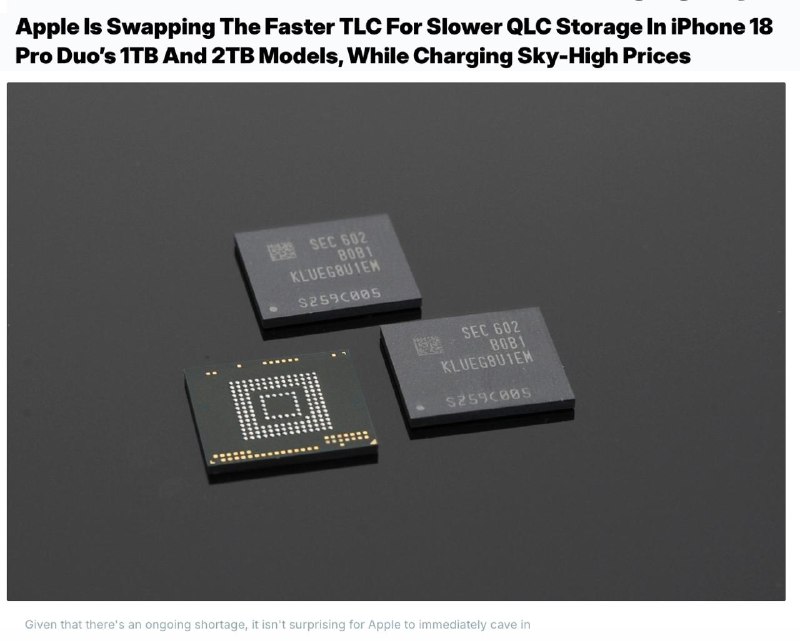
The Impending iPhone 18 Pro: A Shift Towards Slower Storage Solutions
In a move that has raised eyebrows among tech enthusiasts and loyal Apple consumers alike, reports have emerged that the upcoming iPhone 18 Pro and Pro Max will feature a downgrade in flash storage options. This revelation comes from Wccftech, citing a leak from Reptalicant, and signals a significant shift in Apple's approach to storage configurations in its flagship devices.
Storage Specifications: What to Expect
Apple's iPhone 18 Pro series will continue to offer varying storage options, with significant differences noted particularly at the higher capacities. Here’s a comprehensive breakdown:
| Storage Model | Type | Chip Manufacturer | Performance Characteristics |
|---|---|---|---|
| 256GB | TLC (Triple-Level Cell) | SK hynix, Kioxia, SanDisk | Fast and durable |
| 512GB | TLC (Triple-Level Cell) | SK hynix, Kioxia, SanDisk | Fast and durable |
| 1TB | QLC (Quad-Level Cell) | SK hynix BC8Q-1T (primarily) | Slower, less durable; Samsung TLC as rare alternative |
| 2TB | QLC (Quad-Level Cell) | SK hynix BC8Q-2T | Notably impaired random 4K performance, intended for server workloads |
For both the 256GB and 512GB models, Apple plans to maintain high-quality TLC storage, a standard in previous iterations. However, the significant downgrade comes into play with the 1TB and 2TB variants, which will primarily feature QLC storage solutions. While QLC chips can increase storage density, they typically compromise on speed and durability, particularly in data-intensive scenarios.
Why the Downgrade?
The discernible decline in storage quality seems to be a strategic decision made in light of rising memory costs. Recent reports indicate that the cost of a 256GB flash module has ballooned to approximately $51 per unit, a stark increase from about $13 during the production of the iPhone 17 Pro. This rise in costs poses compelling questions regarding Apple's pricing strategies for the iPhone 18 Pro models, which are anticipated to debut at base prices of $1,399 for the Pro model and $1,499 for the Pro Max.
Comparison of Price and Storage Changes:
| Model | Expected Base Price | Previous Average Cost of Storage (iPhone 17 Pro) | Current Average Cost of Storage (iPhone 18 Pro) |
|---|---|---|---|
| iPhone 17 Pro | N/A | $13 (256GB) | N/A |
| iPhone 18 Pro | $1,399 | N/A | $51 (256GB) |
This disparity indicates a troubling trend in which flagship devices are being marketed at premium prices while simultaneously featuring components that could be viewed as subpar, particularly for consumers who expect top-tier performance. As leaks and reports circulate, this scenario calls into question Apple's commitment to maintaining quality in its premium offerings.
Conclusion
As anticipation builds for the iPhone 18 Pro and Pro Max, the decision to downgrade storage quality—especially in high-capacity models—raises concerns about the overall value offered to customers. While companies often face challenges associated with rising production costs, this approach may negatively impact user satisfaction and brand loyalty among high-tier buyers. Only time will reveal how consumers will respond to these changes in a market that increasingly prioritizes performance and storage capabilities.
😰 iPhone 18 Pro: paying more, getting slower storage 📰 Apple is reportedly downgrading the flash storage in the high-capacity iPhone 18 Pro and Pro Max, according to Wccftech, citing leaker Reptalicant. 1️⃣ The 256GB and 512GB models will keep fast TLC (Triple-Level Cell) storage from SK hynix, Kioxia, and SanDisk – same tech as before, three bits per cell, quick and durable. But the 1TB model will mostly switch to a QLC (Quad-Level Cell) chip – SK hynix's BC8Q-1T – which packs four bits per cell but is slower and less durable. A Samsung TLC chip will only appear as a rare alternative. 2️⃣ The 2TB version gets it worse: it'll use SK hynix's BC8Q-2T, a QLC chip originally built for server workloads. The leaker claims this chip suffers noticeably in random 4K performance. For comparison, the 2TB iPhone 17 Pro Max still uses proper TLC storage, as you'd expect from a flagship. 💸 Why the downgrade? Wccftech points to rising memory costs — earlier reports suggested a 256GB flash module now costs Apple around $51 per unit, up from $13 for the iPhone 17 Pro. Meanwhile, base prices for the 18 Pro and Pro Max are expected to hit $1399 and $1499. The math doesn't add up in customers' favor – this looks less like a cost-driven necessity and more like Apple protecting its margins at the expense of top-tier buyers. @DailyApple 😰 iPhone 18 Pro: paying more, getting slower storage 📰 Apple is reportedly downgrading the flash storage in the high-capacity iPhone 18 Pro and Pro Max, according to Wccftech, citing leaker Reptalicant. 1️⃣ The 256GB and 512GB models will keep fast TLC (Triple-Level Cell) storage from SK hynix, Kioxia, and SanDisk – same tech as before, three bits per cell, quick and durable. But the 1TB model will mostly switch to a QLC (Quad-Level Cell) chip – SK hynix's BC8Q-1T – which packs four bits per cell but is slower and less durable. A Samsung TLC chip will only appear as a rare alternative. 2️⃣ The 2TB version gets it worse: it'll use SK hynix's BC8Q-2T, a QLC chip originally built for server workloads. The leaker claims this chip suffers noticeably in random 4K performance. For comparison, the 2TB iPhone 17 Pro Max still uses proper TLC storage, as you'd expect from a flagship. 💸 Why the downgrade? Wccftech points to rising memory costs — earlier reports suggested a 256GB flash module now costs Apple around $51 per unit, up from $13 for the iPhone 17 Pro. Meanwhile, base prices for the 18 Pro and Pro Max are expected to hit $1399 and $1499. The math doesn't add up in customers' favor – this looks less like a cost-driven necessity and more like Apple protecting its margins at the expense of top-tier buyers. @DailyApple


