 TechOffice
Apple's Historic Time Capsule: An iPhone's Journey to the 23rd Century
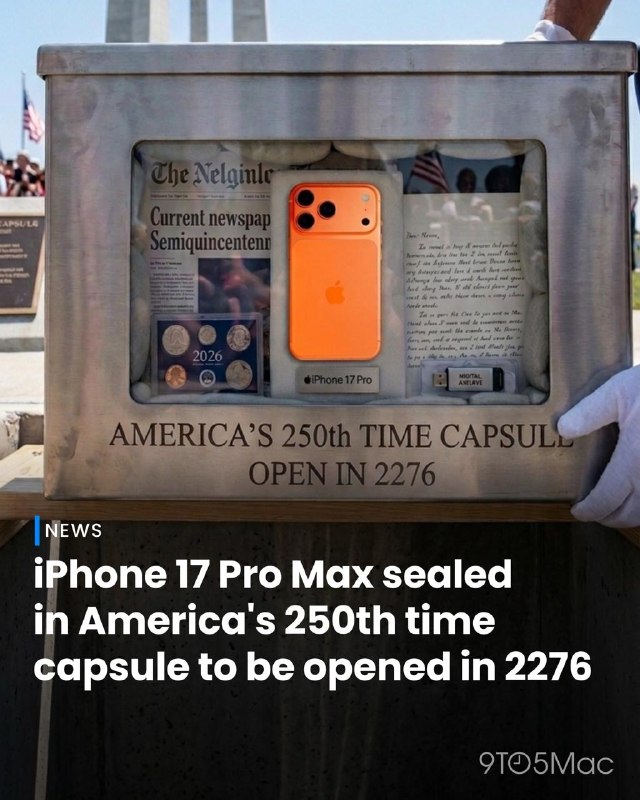
Time Capsule: An iPhone Bound for the Year 2276
In a fascinating blend of technology and history, a massive time capsule has been buried in Philadelphia to commemorate America's 250th anniversary. This nearly 900-pound stainless steel container holds hundreds of artifacts from all 50 states, Washington D.C., and five U.S. territories, creating a comprehensive snapshot of American culture in 2024. The capsule is sealed with instructions not to be opened until 2276, when the nation celebrates its 500th anniversary.
A Digital Artifact Among Historical Treasures
Among the traditional items one might expect in a time capsule—documents, photographs, and memorabilia—lies a piece of cutting-edge technology: an iPhone 17 Pro Max in Cosmic Orange. This modern smartphone contains "digital artifacts" saved in the Notes app, intended to give future generations insight into early 21st-century digital life.
The inclusion of such a technologically advanced device raises interesting questions about preservation and accessibility. While the intention is noble—preserving our digital heritage for future generations—significant technical challenges may prevent the iPhone from being functional when the time capsule is opened 250 years from now.
The Technical Challenges of Digital Preservation
Preserving digital technology for centuries presents unique obstacles that don't affect physical artifacts. Unlike a book or a photograph that can remain readable for centuries under proper conditions, electronic devices rely on multiple components that degrade over time.
| Component | Estimated Lifespan | Preservation Challenge |
|---|---|---|
| Lithium-ion Battery | 2-5 years (typical usage) | Degradation even when unused |
| Flash Memory | 10-30 years | Data retention issues |
| Software & Operating System | 5-15 years | Compatibility with future systems |
| Server Dependencies | Unknown | Company may not exist in future |
The Battery Degradation Problem
One of the most immediate concerns is the iPhone's lithium-ion battery. These batteries have a limited lifespan, typically lasting 2-5 years under normal usage conditions. Even when stored unused, lithium-ion batteries degrade over time due to chemical processes within the battery.
After 250 years, the odds of the battery retaining any charge are virtually zero. The electrolyte would likely have decomposed, and the internal structure of the battery would have deteriorated beyond functionality. Even if the battery were somehow preserved, the other electronic components would face similar degradation challenges.
The Server Dependency Catch
Perhaps an even more significant challenge is the iPhone's dependency on Apple's servers for activation and unlocking. Modern iPhones require authentication through Apple's servers to function properly, even for basic operations. This creates a fundamental problem: if Apple no longer exists or its servers are not operational in 2276, the iPhone would essentially be a brick regardless of its physical condition.
This dependency on external infrastructure highlights a critical issue with digital preservation. Unlike a physical book that can be read directly, digital devices often require supporting infrastructure that may not survive over centuries.
Alternative Approaches to Digital Preservation
The inclusion of the iPhone raises questions about how best to preserve digital heritage for future generations. Several alternatives might have been more effective:
- Physical Documentation: Printing screenshots, documents, and images on archival-quality paper that can last for centuries.
- Multiple Formats: Creating copies of digital data in various formats to increase the chances of compatibility with future technology.
- Open Standards: Using open, documented file formats rather than proprietary formats that may become obsolete.
- Analog Backup: Including instructions for recreating digital content using analog methods.
The Symbolism of Including Technology
Despite the technical challenges, the inclusion of an iPhone in the time capsule is significant symbolically. It represents the importance of technology in contemporary American life and our dependence on digital devices for communication, information storage, and daily activities.
Future generations may view this iPhone as a fascinating artifact of early 21st-century technology, even if they cannot power it on. The physical device itself—the materials, design, and construction—could provide valuable insights into technological development in the 2020s.
Reflection on Digital Legacy
The iPhone time capsule serves as a reminder of the challenges we face in preserving our digital legacy. As our lives become increasingly digital, ensuring that future generations can access and understand our digital heritage becomes more complex.
This situation highlights the need for more robust digital preservation strategies that consider long-term accessibility rather than simply preserving the physical medium. It also raises questions about what aspects of our digital culture are most worth preserving for centuries to come.
Conclusion
While the iPhone 17 Pro Max in Philadelphia's time capsule may not be functional when opened in 2276, its inclusion represents an ambitious attempt to capture our technological moment for posterity. The technical challenges are substantial, but the effort itself speaks to our desire to connect with future generations and share our digital experiences.
As we continue to advance technologically, the lessons learned from this experiment may help us develop better methods for preserving digital heritage. Perhaps future time capsules will include not just devices, but also the knowledge and tools needed to interpret them, ensuring that our digital legacy remains accessible for centuries to come.
🙂 Time capsule: an iPhone bound for the year 2276 🇺🇸 To mark America's 250th anniversary, a massive time capsule was buried in Philadelphia — a nearly 900-pound stainless steel container holding hundreds of artifacts from all 50 states, Washington D.C., and five U.S. territories. It won't be opened until 2276, for the nation's 500th anniversary. 📱 Among the items is the iPhone 17 Pro Max in Cosmic Orange. The phone has "digital artifacts" saved in the Notes app for future generations to look through – assuming the device even turns on. But that's the real problem: 🔋 Lithium-ion batteries degrade over time, so the odds of the phone powering on in 250 years are basically zero. 🔒 But even if the battery somehow survives, there's a bigger catch – unlocking an iPhone depends on Apple's servers, which may not even exist 250 years from now. @iPhone 🙂 Time capsule: an iPhone bound for the year 2276 🇺🇸 To mark America's 250th anniversary, a massive time capsule was buried in Philadelphia — a nearly 900-pound stainless steel container holding hundreds of artifacts from all 50 states, Washington D.C., and five U.S. territories. It won't be opened until 2276, for the nation's 500th anniversary. 📱 Among the items is the iPhone 17 Pro Max in Cosmic Orange. The phone has "digital artifacts" saved in the Notes app for future generations to look through – assuming the device even turns on. But that's the real problem: 🔋 Lithium-ion batteries degrade over time, so the odds of the phone powering on in 250 years are basically zero. 🔒 But even if the battery somehow survives, there's a bigger catch – unlocking an iPhone depends on Apple's servers, which may not even exist 250 years from now. @iPhone


