 TechOffice
Apple Overhauls Mac Chip Development Strategy
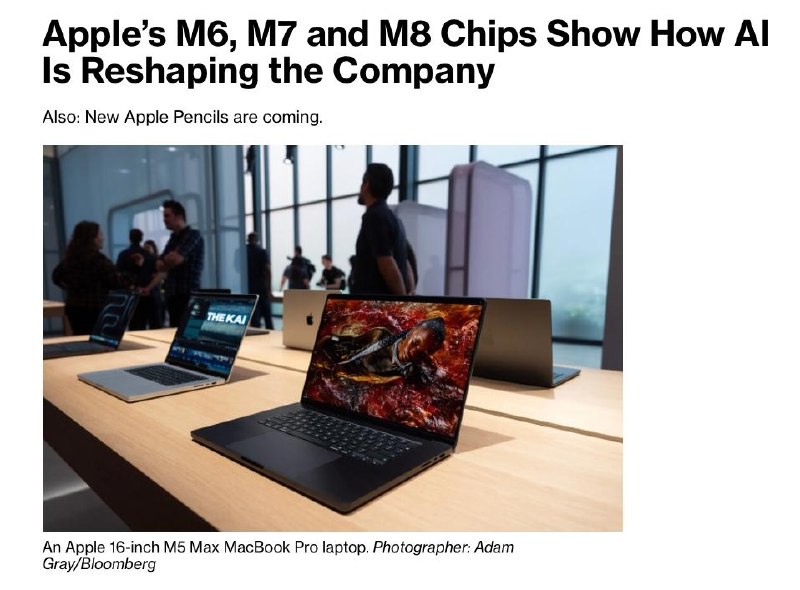
Apple Radically Restructures Mac Chip Roadmap, Prioritizing AI with M7 Generation
In a surprising strategic shift that has sent ripples through the tech industry, Apple is reportedly restructuring its Mac chip development roadmap, with plans to bypass traditional mid-tier and high-end M6 chips in favor of accelerating its next-generation M7 architecture focused on artificial intelligence capabilities.
According to renowned Apple analyst Mark Gurman, the company's silicon division is preparing to launch the M6 chip later this year, but with a significant departure from previous release patterns. The M6 will debut exclusively as a base-tier processor, destined for the entry-level 14-inch MacBook Pro model. This marks the first time in the M-series' history that Apple will reportedly skip the M6 Pro, M6 Max, and M6 Ultra variants entirely.
Strategic Pivot: The M7 as the Future of On-Device AI
The rationale behind this unconventional approach lies in Apple's aggressive push into on-device artificial intelligence. The company is reportedly betting heavily on the M7 architecture, which promises substantial advancements in AI processing capabilities that could redefine how Macs handle machine learning tasks locally.
According to Gurman's sources, the M7 timeline will unfold as follows:
- Base M7: Expected to launch in the first half of 2027
- M7 Pro and M7 Max: Slated for arrival by late 2027
- M7 Ultra: The flagship chip anticipated in 2028
Notably, the M7 Ultra may serve a dual purpose, potentially powering Apple's server infrastructure for Apple Intelligence starting in 2029, indicating Apple's intention to leverage its silicon expertise across its entire product ecosystem.
Impact on Product Roadmap
This chip strategy shift has significant implications for Apple's product development timeline. The long-anticipated touchscreen MacBook Pro, which has been the subject of numerous rumors and speculation, will reportedly launch with the existing M5 Pro and M5 Max chips rather than the newer M6 series.
The touchscreen MacBook Pro is now expected to arrive in late 2026 or early 2027, with an M7 Pro/Max-powered version not anticipated until late 2027 at the earliest. This delay suggests Apple may be waiting for its more advanced AI-capable chips before introducing what could be a significant new product category.
In the interim, Apple is preparing an updated M5 Ultra variant specifically for the Mac Studio, expected to launch later this year. This refresh would provide a performance boost for the professional desktop segment without requiring the full M6 architecture.
Table: Apple Silicon Mac Chip Roadmap (2024-2029)
| Year | Chip Generation | Variants | Target Products |
|---|---|---|---|
| 2024 | M6 | Base only | Entry-level 14" MacBook Pro |
| 2024 | M5 (Updated) | Ultra | Mac Studio |
| 2026/Early 2027 | M5 | Pro, Max | Touchscreen MacBook Pro |
| Mid-2027 | M7 | Base | Standard MacBook Air/Pro models |
| Late 2027 | M7 | Pro, Max | MacBook Pro, iMac, Mac Pro (possible) |
| 2028 | M7 | Ultra | Mac Studio, Mac Pro |
| 2029 | M7 Ultra (Server) | Server variant | Apple Intelligence servers |
Accessory Developments: New Apple Pencil Models
Beyond its Mac chip strategy, Apple is also reportedly preparing two new Apple Pencil models designed to accompany the next-generation iPad Pro. These updated styli are expected to feature more repairable batteries, likely developed in response to new European Union regulations that require longer product lifespans and easier repairability for electronic devices.
The emphasis on repairability aligns with Apple's increasing focus on sustainability and regulatory compliance in key markets. The EU's "Right to Repair" legislation has prompted several tech companies to redesign their products with easier maintenance and component replacement in mind.
Strategic Implications
This radical restructuring of Apple's chip roadmap represents a significant departure from the company's previous incremental approach to silicon development. By skipping the M6 Pro, Max, and Ultra variants, Apple is signaling that it believes the leap in AI capabilities offered by the M7 architecture will provide a more substantial competitive advantage than incremental improvements in the M6 generation.
The decision also reflects Apple's growing emphasis on artificial intelligence as a key differentiator in its product ecosystem. With AI becoming increasingly central to computing experiences across all platforms, Apple's focus on developing specialized silicon for on-device machine learning could position it ahead of competitors who rely more on cloud-based AI processing.
For consumers and professionals, this strategy means potentially longer wait times for updated high-end Mac models, but also the promise of more significant advancements when the M7 generation eventually arrives. The company's ability to execute this ambitious timeline will be closely watched as it seeks to maintain its leadership in both silicon design and AI integration.
As Apple continues to blur the lines between its Mac, iPad, and iPhone ecosystems through silicon innovation, this roadmap adjustment may ultimately prove to be a masterstroke in positioning the company for the next era of computing—one where on-device AI capabilities become as fundamental as processing power and memory.
🤔 Apple shakes up its Mac chip roadmap 📰 Mark Gurman revealed an updated Apple Silicon roadmap, and there's a surprising twist. M6 launches this year, but only as a base chip – for the entry-level 14" MacBook Pro. Apple is reportedly skipping M6 Pro, Max, and Ultra – a first for the M-series. Why: it's betting on M7, which promises a major leap in on-device AI. Base M7 arrives in H1 2027, M7 Pro/Max by late 2027, and the flagship M7 Ultra in 2028 (possibly powering Apple Intelligence servers from 2029). As a result, the long-rumored touchscreen MacBook Pro will ship on the older M5 Pro/Max chips (expected late 2026/early 2027), with an M7 Pro/Max version not before late 2027. An updated M5 Ultra for the Mac Studio is also expected this year. 🙂Apple is also prepping two new Apple Pencil models to launch alongside the next-gen iPad Pro – likely with more repairable batteries to meet EU rules. @iPhone 🤔 Apple shakes up its Mac chip roadmap 📰 Mark Gurman revealed an updated Apple Silicon roadmap, and there's a surprising twist. M6 launches this year, but only as a base chip – for the entry-level 14" MacBook Pro. Apple is reportedly skipping M6 Pro, Max, and Ultra – a first for the M-series. Why: it's betting on M7, which promises a major leap in on-device AI. Base M7 arrives in H1 2027, M7 Pro/Max by late 2027, and the flagship M7 Ultra in 2028 (possibly powering Apple Intelligence servers from 2029). As a result, the long-rumored touchscreen MacBook Pro will ship on the older M5 Pro/Max chips (expected late 2026/early 2027), with an M7 Pro/Max version not before late 2027. An updated M5 Ultra for the Mac Studio is also expected this year. 🙂Apple is also prepping two new Apple Pencil models to launch alongside the next-gen iPad Pro – likely with more repairable batteries to meet EU rules. @iPhone


