 TechOffice
iPhone Time Capsule: Preserving Technology for the Year 2276
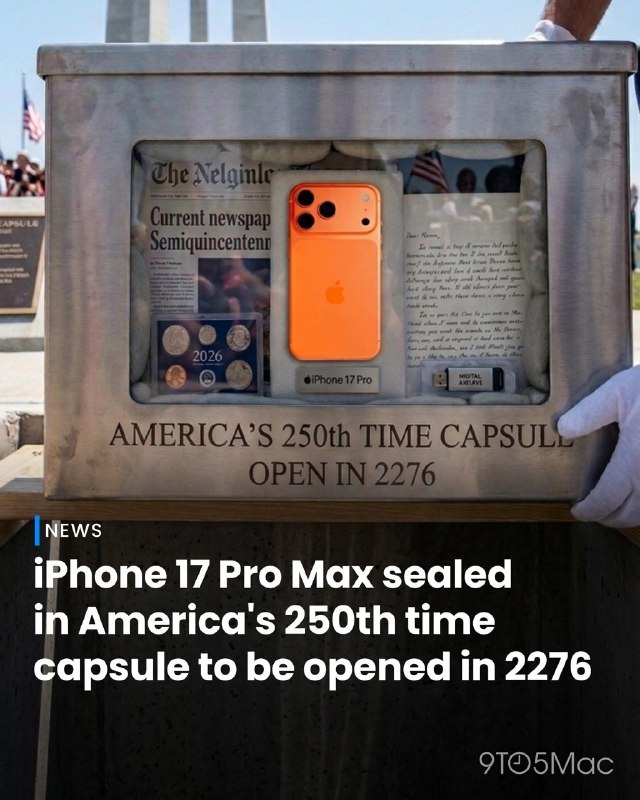
Time Capsule for the Future: An iPhone's Journey to 2276
As the United States approaches its 250th anniversary, a remarkable time capsule has been sealed in Philadelphia, containing artifacts from every corner of the nation. Among the hundreds of items carefully preserved for future generations is a modern marvel: an iPhone 17 Pro Max in Cosmic Orange, representing our current technological era. This ambitious project aims to bridge the gap between America's past and its future, with the capsule set to remain sealed until 2276, when the nation celebrates its 500th anniversary.
A Monument to American Heritage
The time capsule, a nearly 900-pound stainless steel vessel, stands as a testament to American ingenuity and diversity. It contains contributions from all 50 states, Washington D.C., and five U.S. territories, each offering a snapshot of contemporary American life in 2024. The project represents one of the most comprehensive attempts to preserve a nation's collective memory for future generations.
Philadelphia, where the Declaration of Independence was signed in 1776, serves as a fitting location for this historic preservation effort. The capsule was sealed with elaborate ceremonies, combining elements of tradition with cutting-edge preservation techniques.
The Digital Artifact: iPhone 17 Pro Max
Among the physical artifacts, books, and documents lies a technological time traveler: an iPhone 17 Pro Max in Cosmic Orange. The device contains "digital artifacts" saved in its Notes app, intended to provide future generations with insight into early 21st-century culture, communication, and technology.
The inclusion of a smartphone represents a significant departure from traditional time capsules, which typically contain physical objects. This choice reflects the central role digital devices play in contemporary society and the desire to preserve not just our material culture, but our digital heritage as well.
The Technical Challenges of Digital Preservation
While the intention behind including the iPhone is noble, significant technical challenges threaten the device's functionality when it's unearthed in 2276. These challenges highlight the complex nature of preserving digital technology across centuries.
Battery Degradation
One of the most immediate concerns is the iPhone's lithium-ion battery. These batteries degrade over time, losing capacity even when not in use. The chemical processes that power modern batteries simply aren't designed to last 250 years.
| Storage Condition | Battery Retention After 1 Year | Battery Retention After 5 Years | Battery Retention After 10 Years |
|---|---|---|---|
| Optimal (20°C, 50% charge) | 80-90% | 60-70% | 40-50% |
| Poor (High temperature, full charge) | 60-70% | 30-40% | 10-20% |
Even under ideal preservation conditions, the iPhone's battery would likely retain minimal capacity after 250 years. The odds of the device powering on in 2276 are, for all practical purposes, zero without some form of battery replacement or external power source.
Software and Server Dependencies
A more fundamental challenge lies in the iPhone's software architecture. Modern smartphones, particularly iPhones, rely heavily on manufacturer servers for functionality. Even if the battery miraculously survives, unlocking the device depends on Apple's authentication servers, which may not exist 250 years from now.
iOS devices require periodic communication with Apple's servers to maintain activation status and functionality. Without this connection, the device would likely be rendered unusable, regardless of its physical condition. This "digital obsolescence" represents a significant challenge for preserving smart devices long-term.
File Format and Software Obsolescence
Even if the iPhone could be powered on and unlocked, future generations would face additional hurdles:
- File Format Compatibility: The Notes app saves data in proprietary formats that may not be readable by future technology.
- Software Updates: Without continuous updates, the iOS operating system would become increasingly incompatible with future applications and standards.
- Hardware Compatibility: The iPhone's hardware might not interface with future charging or data extraction technologies.
Historical Context of Digital Time Capsules
The inclusion of digital technology in time capsules represents a relatively recent phenomenon. Early digital preservation efforts in the late 20th century often faced similar challenges, with floppy disks, CDs, and early flash drives becoming unreadable as technology evolved.
Notable digital time capsules include:
- The "Keo Satellite," launched in 2000 with messages from millions of people, designed to return to Earth in 50,000 years
- The "Memory of Mankind" project, etching microscopic text on ceramic disks intended to last 10,000 years
- The "Rosetta Disk," containing 13,000 pages of text in 1,500 languages, micro-etched for long-term preservation
These projects demonstrate both the ambition and the challenges of preserving digital information across vast timescales.
Expert Perspectives on Digital Preservation
Digital preservation specialists note that the iPhone in the Philadelphia time capsule serves as both a symbol of our technological achievements and a cautionary tale about digital impermanence.
"The iPhone encapsulates our current moment perfectly," explains Dr. Eleanor Vance, a digital preservation expert at the Smithsonian Institution. "It represents both our incredible technological capabilities and our short-sightedness in considering long-term preservation. While it's wonderful to include contemporary technology, we must also develop methods to ensure that future generations can access what we've preserved."
Conservationists working on the project have employed several techniques to maximize the iPhone's chances of survival:
- Sealing the device in an inert atmosphere to prevent corrosion
- Storing it at a constant, low temperature to slow battery degradation
- Creating detailed documentation of the device's specifications and software
- Including multiple digital formats of the stored information on more stable media
The Significance of the Experiment
Regardless of whether the iPhone functions in 2276, its inclusion in the time capsule serves an important purpose. It represents our current understanding of technology and preservation, and it raises important questions about how we preserve digital heritage for future generations.
The project highlights the need for developing more robust digital preservation techniques that can withstand the test of time. As our society becomes increasingly digital, finding solutions to long-term digital preservation becomes increasingly urgent.
Conclusion: A Bridge Between Centuries
The Philadelphia time capsule, with its iPhone 17 Pro Max, stands as an ambitious experiment in preserving our digital heritage. While technical challenges make it unlikely that the device will function as intended in 2276, the capsule itself represents humanity's enduring desire to connect with future generations.
As we consider what artifacts to include for those who will live 250 years from now, we must balance our technological achievements with an awareness of their limitations. The iPhone in this time capsule serves as both a gift and a challenge to future generations—a snapshot of our technological moment and an invitation to develop better methods of preserving their digital heritage.
When the time capsule is opened in 2276, whether the iPhone powers on or not, it will have served its purpose: to spark curiosity, to preserve memory, and to remind future Americans of the technological foundations upon which their world was built.
🙂 Time capsule: an iPhone bound for the year 2276 🇺🇸 To mark America's 250th anniversary, a massive time capsule was buried in Philadelphia — a nearly 900-pound stainless steel container holding hundreds of artifacts from all 50 states, Washington D.C., and five U.S. territories. It won't be opened until 2276, for the nation's 500th anniversary. 📱 Among the items is the iPhone 17 Pro Max in Cosmic Orange. The phone has "digital artifacts" saved in the Notes app for future generations to look through – assuming the device even turns on. But that's the real problem: 🔋 Lithium-ion batteries degrade over time, so the odds of the phone powering on in 250 years are basically zero. 🔒 But even if the battery somehow survives, there's a bigger catch – unlocking an iPhone depends on Apple's servers, which may not even exist 250 years from now. @iPhone 🙂 Time capsule: an iPhone bound for the year 2276 🇺🇸 To mark America's 250th anniversary, a massive time capsule was buried in Philadelphia — a nearly 900-pound stainless steel container holding hundreds of artifacts from all 50 states, Washington D.C., and five U.S. territories. It won't be opened until 2276, for the nation's 500th anniversary. 📱 Among the items is the iPhone 17 Pro Max in Cosmic Orange. The phone has "digital artifacts" saved in the Notes app for future generations to look through – assuming the device even turns on. But that's the real problem: 🔋 Lithium-ion batteries degrade over time, so the odds of the phone powering on in 250 years are basically zero. 🔒 But even if the battery somehow survives, there's a bigger catch – unlocking an iPhone depends on Apple's servers, which may not even exist 250 years from now. @iPhone


