 TechOffice
iPhone 18 Pro Under Fire: Higher Price Tag Paired with Slower Storage
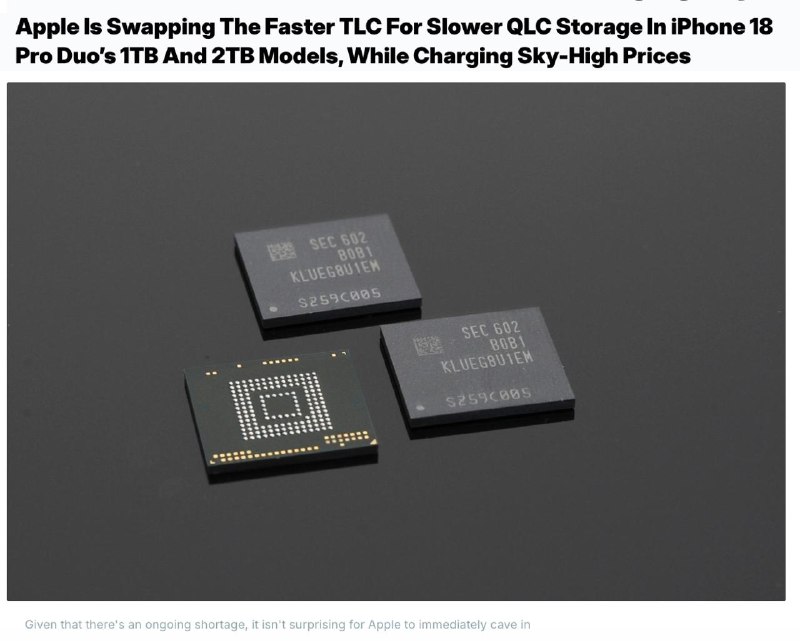
iPhone 18 Pro Reportedly Downgrades Storage Technology in High-Capacity Models
Apple's upcoming flagship devices may be introducing a controversial change in storage technology that could impact performance for high-capacity users. According to recent reports from Wccftech citing leaker Reptalicant, the iPhone 18 Pro and Pro Max will reportedly downgrade from faster TLC (Triple-Level Cell) storage to slower QLC (Quad-Level Cell) storage in their 1TB and 2TB configurations, while maintaining the premium technology in lower capacity models.
Storage Technology Changes Across Capacity Models
The reported changes represent a significant shift in Apple's storage strategy for its premium smartphone lineup. While the base and mid-tier storage options will maintain the expected quality, customers opting for high-capacity models may unknowingly receive inferior storage technology.
256GB and 512GB Models: Maintaining Premium Storage
The 256GB and 512GB configurations of the iPhone 18 Pro and Pro Max will reportedly retain the faster TLC (Triple-Level Cell) storage technology from established manufacturers including SK hynix, Kioxia, and SanDisk. This technology stores three bits per cell and has been the standard for Apple's flagship devices, offering both speed and durability that users expect from a premium product.
1TB Model: Downgrade to QLC Technology
The 1TB capacity variant is where the first significant change occurs. According to the leaks, this model will mostly switch to a QLC (Quad-Level Cell) chip specifically identified as SK hynix's BC8Q-1T. While QLC technology allows for higher storage density by packing four bits per cell, it comes at the cost of performance and durability compared to TLC.
Only in rare instances might users of the 1TB model receive a Samsung TLC chip as an alternative, suggesting the downgrade will be the standard rather than the exception.
2TB Model: Most Severe Downgrade
The 2TB configuration faces the most significant downgrade, with reports indicating it will use SK hynix's BC8Q-2T, a QLC chip originally designed for server workloads rather than consumer devices. The leaker specifically notes that this chip suffers noticeably in random 4K performance, which could impact everyday usage scenarios like app loading times and file transfers.
This represents a notable step back from the iPhone 17 Pro Max's 2TB model, which continues to use proper TLC storage as expected from a flagship device.
Understanding the Technical Differences: TLC vs QLC
To fully grasp the implications of this reported change, it's essential to understand the fundamental differences between TLC and QLC storage technologies:
| Feature | TLC (Triple-Level Cell) | QLC (Quad-Level Cell) |
|---|---|---|
| Bits per Cell | 3 bits | 4 bits |
| Write Speed | Faster | Slower |
| Durability | Higher (1,000-3,000 program/erase cycles) | Lower (500-1,000 program/erase cycles) |
| Random Read Performance | Better | Reduced |
| Random Write Performance | Superior | Noticeably slower |
| Latency | Lower | Higher |
Performance Implications for Users
The shift to QLC storage in high-capacity models could have several noticeable effects on user experience:
- Slower App Loading: The reduced random read performance could result in longer loading times for applications and games.
- File Transfer Speeds: Transferring large files between the iPhone and other devices may take longer.
- Reduced Longevity: QLC storage has a lower program/erase cycle count, potentially leading to earlier degradation of storage performance over time.
- 4K Video Handling: The reported issues with random 4K performance could impact video editing and playback capabilities.
Cost Analysis: Rising Prices vs. Potentially Inferior Components
The motivation behind this apparent downgrade appears to be financially driven, though the exact reasoning remains complex. According to industry reports, the cost of flash memory has increased significantly, with a 256GB flash module now reportedly costing Apple around $51 per unit, up from approximately $13 for the iPhone 17 Pro.
Meanwhile, Apple is expected to increase base prices for the iPhone 18 Pro and Pro Max to $1,399 and $1,499 respectively, representing a substantial increase over previous generations.
| Storage Configuration | iPhone 17 Pro Max | iPhone 18 Pro Max (Reported) |
|---|---|---|
| 256GB | TLC Storage | TLC Storage |
| 512GB | TLC Storage | TLC Storage |
| 1TB | TLC Storage | QLC Storage (primary) |
| 2TB | TLC Storage | QLC Storage (server-grade) |
This creates a concerning scenario where customers are paying significantly more for devices that may include lower-quality components in their most expensive configurations. The math doesn't appear to add up in customers' favor, suggesting this change may be more about protecting profit margins than addressing genuine cost constraints.
Industry Context and Precedent
This potential move follows a pattern of component downgrades in premium products across the tech industry. Apple has previously faced criticism for downgrading charging adapters and removing accessories from the box while maintaining or increasing prices.
The storage technology shift is particularly notable because it directly impacts core performance aspects that users expect from premium devices. Unlike removable accessories, storage technology is integral to the daily user experience and cannot be easily upgraded or replaced.
What This Means for Consumers
If these reports prove accurate, potential buyers of the iPhone 18 Pro and Pro Max should consider several factors:
- Capacity Needs: Users who require extensive storage may need to carefully evaluate whether the performance trade-offs of QLC storage align with their usage patterns.
- Price Considerations: The increased base price combined with potential storage downgrades may affect the value proposition of the high-capacity models.
- Future-Proofing: The reduced durability of QLC storage could impact the long-term usability of the device, particularly for users who frequently write large amounts of data.
- Waiting for Confirmation: As with any leak, these details should be treated as preliminary until officially confirmed by Apple.
Conclusion
The reported storage technology changes in the iPhone 18 Pro and Pro Max represent a potential departure from Apple's traditional approach of maintaining consistent quality across its product lineup. If confirmed, this would mark a significant shift that could impact the user experience for customers who invest in the highest capacity models.
As Apple continues to push premium pricing for its devices, consumers may rightfully question whether they're receiving commensurate value. The potential introduction of slower, less durable storage technology in the most expensive configurations could further strain the relationship between Apple and its most loyal customers.
Only time will tell if these leaks prove accurate, but they certainly raise important questions about the direction Apple is taking with its component selection and pricing strategy for its flagship devices.
😰 iPhone 18 Pro: paying more, getting slower storage 📰 Apple is reportedly downgrading the flash storage in the high-capacity iPhone 18 Pro and Pro Max, according to Wccftech, citing leaker Reptalicant. 1️⃣ The 256GB and 512GB models will keep fast TLC (Triple-Level Cell) storage from SK hynix, Kioxia, and SanDisk – same tech as before, three bits per cell, quick and durable. But the 1TB model will mostly switch to a QLC (Quad-Level Cell) chip – SK hynix's BC8Q-1T – which packs four bits per cell but is slower and less durable. A Samsung TLC chip will only appear as a rare alternative. 2️⃣ The 2TB version gets it worse: it'll use SK hynix's BC8Q-2T, a QLC chip originally built for server workloads. The leaker claims this chip suffers noticeably in random 4K performance. For comparison, the 2TB iPhone 17 Pro Max still uses proper TLC storage, as you'd expect from a flagship. 💸 Why the downgrade? Wccftech points to rising memory costs — earlier reports suggested a 256GB flash module now costs Apple around $51 per unit, up from $13 for the iPhone 17 Pro. Meanwhile, base prices for the 18 Pro and Pro Max are expected to hit $1399 and $1499. The math doesn't add up in customers' favor – this looks less like a cost-driven necessity and more like Apple protecting its margins at the expense of top-tier buyers. @DailyApple 😰 iPhone 18 Pro: paying more, getting slower storage 📰 Apple is reportedly downgrading the flash storage in the high-capacity iPhone 18 Pro and Pro Max, according to Wccftech, citing leaker Reptalicant. 1️⃣ The 256GB and 512GB models will keep fast TLC (Triple-Level Cell) storage from SK hynix, Kioxia, and SanDisk – same tech as before, three bits per cell, quick and durable. But the 1TB model will mostly switch to a QLC (Quad-Level Cell) chip – SK hynix's BC8Q-1T – which packs four bits per cell but is slower and less durable. A Samsung TLC chip will only appear as a rare alternative. 2️⃣ The 2TB version gets it worse: it'll use SK hynix's BC8Q-2T, a QLC chip originally built for server workloads. The leaker claims this chip suffers noticeably in random 4K performance. For comparison, the 2TB iPhone 17 Pro Max still uses proper TLC storage, as you'd expect from a flagship. 💸 Why the downgrade? Wccftech points to rising memory costs — earlier reports suggested a 256GB flash module now costs Apple around $51 per unit, up from $13 for the iPhone 17 Pro. Meanwhile, base prices for the 18 Pro and Pro Max are expected to hit $1399 and $1499. The math doesn't add up in customers' favor – this looks less like a cost-driven necessity and more like Apple protecting its margins at the expense of top-tier buyers. @DailyApple


