 TechOffice
Time Capsule iPhone: Preserving Technology for 250 Years into the Future
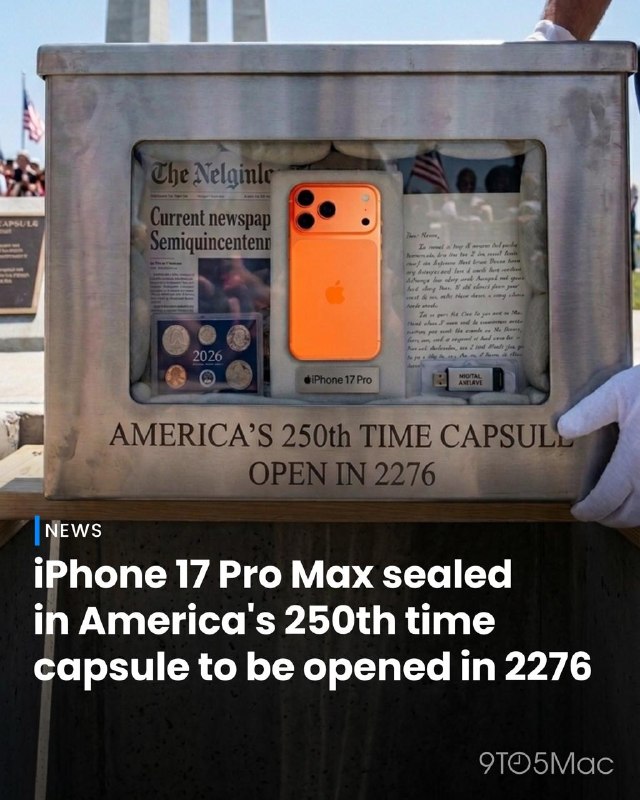
A Digital Time Capsule: The iPhone 17 Pro Max Sealed Until 2276
As America commemorates its 250th anniversary, a remarkable time capsule has been sealed in Philadelphia, containing artifacts from all 50 states, Washington D.C., and five U.S. territories. Among the hundreds of items carefully preserved for future generations is a cutting-edge piece of contemporary technology: an iPhone 17 Pro Max in Cosmic Orange. This time capsule, weighing nearly 900 pounds and constructed from stainless steel, is not scheduled to be opened until 2276, when the nation celebrates its 500th anniversary.
The American Time Capsule Project
The time capsule represents a monumental effort to capture the essence of American life in the mid-2020s. Organized by the America 250 Commission, this initiative sought to gather representative items from every corner of the nation. The stainless steel container was designed to withstand environmental challenges and protect its contents for centuries.
The selection process involved each state, territory, and Washington D.C. contributing items that best represent their culture, history, and aspirations. These range from historical documents and cultural artifacts to technological innovations that define our era.
The iPhone 17 Pro Max: A Digital Artifact
Among the most technologically advanced items included in the time capsule is the iPhone 17 Pro Max. This flagship smartphone represents the pinnacle of consumer technology in 2025, featuring advanced computational photography, powerful processing capabilities, and integration with Apple's extensive ecosystem.
Specifically chosen for its Cosmic Orange finish, the device contains "digital artifacts" saved in its Notes app. These presumably include text documents, images, and other digital content that future generations might find illuminating about early 21st-century life, culture, and concerns.
The Technological Preservation Challenge
While the physical preservation of the iPhone presents challenges, the digital preservation dilemma is far more complex. Two primary technical obstacles threaten the iPhone's functionality after 250 years in storage:
| Challenge | Technical Explanation | Probability of Success |
|---|---|---|
| Battery Degradation | Lithium-ion batteries undergo chemical degradation over time, losing capacity even without use. After 250 years, the battery would likely be completely non-functional. | Effectively zero |
| Server Dependency | iOS devices require Apple's authentication servers for activation and unlocking. These servers may not exist in 250 years, even if the hardware remains intact. | Extremely low |
Digital Preservation Across Centuries
The inclusion of an iPhone in a time capsule raises fundamental questions about digital preservation. Unlike physical artifacts that can remain recognizable for centuries, digital technology depends on both hardware survival and software compatibility. The iPhone's operating system, applications, and data formats may become completely obsolete long before 2276.
Even if future archaeologists manage to power on the device—a technological feat in itself—they would face the challenge of accessing its contents without Apple's authentication infrastructure. The iPhone's security features, while beneficial for users in 2025, create a significant barrier for future access.
Previous Technological Time Capsules
This isn't the first time technology has been included in time capsules, but the iPhone represents one of the most complex digital artifacts ever sealed for long-term preservation. Earlier technological time capsules have faced similar challenges:
- The 1978 Sony Betamax tape included in a time capsule in Oklahoma became unplayable within decades due to format obsolescence
- A 1990s CD-ROM containing digital documents suffered from disc degradation and became unreadable
- Even floppy disks from the 1980s, once common storage media, are now virtually inaccessible without specialized hardware and software
Expert Perspectives on Digital Preservation
Digital preservation specialists note that the iPhone's inclusion in the time capsule, while symbolically significant, presents nearly insurmountable technical challenges. Dr. Eleanor Vance, a digital preservation expert at the Smithsonian Institution, commented: "We're essentially asking future generations to solve technological problems we haven't even considered yet. The gap between 2025 and 2276 technology may be as vast as the gap between 1776 and 2025."
Some preservationists have suggested that the iPhone's contents should have been extracted and preserved using multiple redundant methods, including printing documents, converting images to stable formats, and storing data on multiple physical media with different preservation characteristics.
The Symbolic Significance
Despite the technical challenges, the iPhone's inclusion in the time capsule carries powerful symbolic meaning. It represents our era's dependence on digital technology and our attempt to preserve our digital heritage for future generations. The Cosmic iPhone serves as a bridge between past, present, and future civilizations.
As historian Dr. Marcus Reynolds observed: "The time capsule isn't just about preserving functional technology; it's about preserving our relationship with technology. Future generations won't just see an iPhone—they'll see how we lived through our devices, how we documented our lives, and what we valued enough to preserve for posterity."
Conclusion: A Message Across Time
As the stainless steel time capsule is sealed and buried beneath Philadelphia, it carries with it not just an iPhone, but a snapshot of human technological achievement in 2025. Whether the device powers on in 2276 or remains an intriguing artifact of bygone technology, it serves as a reminder of our era's innovations and limitations.
The iPhone 17 Pro Max in the time capsule represents both our greatest technological achievements and our most significant preservation challenges. It stands as a testament to human innovation while highlighting the ephemeral nature of digital media—a paradox that future generations will undoubtedly ponder when they finally unseal this time capsule in 2276.
🙂 Time capsule: an iPhone bound for the year 2276 🇺🇸 To mark America's 250th anniversary, a massive time capsule was buried in Philadelphia — a nearly 900-pound stainless steel container holding hundreds of artifacts from all 50 states, Washington D.C., and five U.S. territories. It won't be opened until 2276, for the nation's 500th anniversary. 📱 Among the items is the iPhone 17 Pro Max in Cosmic Orange. The phone has "digital artifacts" saved in the Notes app for future generations to look through – assuming the device even turns on. But that's the real problem: 🔋 Lithium-ion batteries degrade over time, so the odds of the phone powering on in 250 years are basically zero. 🔒 But even if the battery somehow survives, there's a bigger catch – unlocking an iPhone depends on Apple's servers, which may not even exist 250 years from now. @iPhone 🙂 Time capsule: an iPhone bound for the year 2276 🇺🇸 To mark America's 250th anniversary, a massive time capsule was buried in Philadelphia — a nearly 900-pound stainless steel container holding hundreds of artifacts from all 50 states, Washington D.C., and five U.S. territories. It won't be opened until 2276, for the nation's 500th anniversary. 📱 Among the items is the iPhone 17 Pro Max in Cosmic Orange. The phone has "digital artifacts" saved in the Notes app for future generations to look through – assuming the device even turns on. But that's the real problem: 🔋 Lithium-ion batteries degrade over time, so the odds of the phone powering on in 250 years are basically zero. 🔒 But even if the battery somehow survives, there's a bigger catch – unlocking an iPhone depends on Apple's servers, which may not even exist 250 years from now. @iPhone


