 TechOffice
Apple's iPhone Time Capsula Sealed for 2276
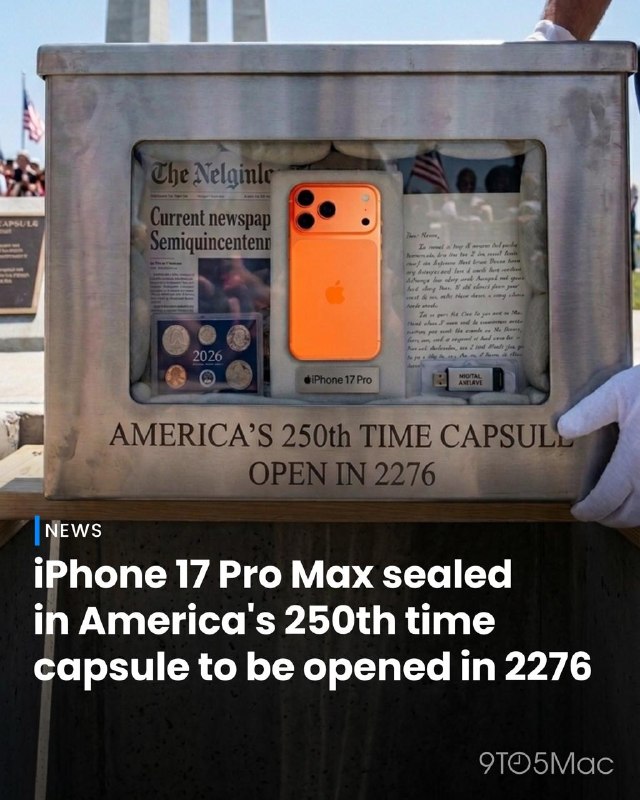
Time Capsule: A Modern iPhone Bound for the Year 2276
In a fascinating blend of contemporary technology and historical preservation, an iPhone 17 Pro Max has been sealed within a massive time capsule destined for the year 2276. This modern artifact, carefully selected to represent 21st-century America, joins hundreds of other items in a nearly 900-pound stainless steel container that was recently buried in Philadelphia.
A Nation's Time Capsule
The time capsule marks America's 250th anniversary and represents a unique collaborative effort across all 50 states, Washington D.C., and five U.S. territories. Each jurisdiction contributed artifacts that capture the essence of American life in the early 21st century. The capsule is designed to remain sealed until 2276, when it will be opened for the nation's 500th anniversary.
The stainless steel container was constructed with preservation in mind, utilizing advanced sealing techniques to protect its contents from environmental factors over the next 250 years. However, the inclusion of a sophisticated electronic device like an iPhone presents unprecedented challenges for future preservation efforts.
The iPhone: A Digital Artifact
Among the diverse collection of physical artifacts, the iPhone 17 Pro Max in Cosmic Orange stands out as a technological marvel of the early 2020s. The device contains "digital artifacts" saved within its Notes app, carefully curated to provide future generations with insights into contemporary culture, technology, and daily life.
These digital contents represent a snapshot of human knowledge and creativity in the early 21st century, including personal messages, historical references, cultural touchstones, and technological documentation. The selection process involved careful consideration of what would remain relevant and understandable to people living 250 years in the future.
| iPhone 17 Pro Max Specifications | |
|---|---|
| Model | iPhone 17 Pro Max |
| Color | Cosmic Orange |
| Storage Capacity | 256GB |
| Contents | Digital artifacts in Notes app |
| Preservation Method | Sealed in nitrogen environment within time capsule |
The Technical Challenges of Digital Preservation
Despite the best preservation techniques, the iPhone faces significant obstacles that make its functionality in 2276 highly questionable. The primary challenge lies with its lithium-ion battery, which is known to degrade over time even under optimal storage conditions.
Lithium-ion batteries undergo chemical changes that reduce their capacity and ability to hold a charge. Even when stored in a controlled environment without being used, these batteries can lose 20% of their capacity within just the first year. Over 250 years, it's virtually certain that the battery will be completely degraded, making it impossible to power on the device.
The Server Dependency Dilemma
Even if the iPhone's battery somehow miraculously retains its charge after 250 years, a more fundamental technical barrier stands in the way: device activation. Modern iPhones require authentication through Apple's servers to be unlocked and functional. This security measure, designed to protect user data, creates a significant preservation challenge.
Apple's servers, and indeed the company itself, may not exist in 250 years. Even if Apple continues to operate, the specific authentication infrastructure required for this particular iPhone model would likely be obsolete. The software, protocols, and security systems that enable device activation today will almost certainly be incompatible with the technological landscape of 2276.
Historical Context: Previous Time Capsules
The practice of creating time capsules dates back centuries, with notable examples including the 1938 Westinghouse Time Capsule and the 1978 Crypt of Civilization. These earlier time capsules primarily contained physical objects that could withstand the test of time without requiring technological intervention.
The inclusion of an electronic device represents a new frontier in time capsule creation. Previous attempts at preserving technology, such as the 1976 Smithsonian Bicentennial Time Capsule which contained a floppy disk, faced similar challenges. When that capsule was opened in 2006, the floppy disk was unreadable due to technological obsolescence.
| Challenge | Impact on iPhone Functionality in 2276 |
|---|---|
| Battery Degradation | Complete loss of charge capacity over 250 years |
| Software Obsolescence | Incompatible with future operating systems |
| Server Dependency | Authentication servers may not exist |
| Physical Degradation | Potential corrosion of internal components |
| Format Obsolescence | Digital formats may become unreadable |
Expert Perspectives on Digital Preservation
Digital preservation experts acknowledge the unique challenges of preserving electronic devices for future generations. Dr. Eleanor Vance, a curator at the National Institute of Standards and Technology, explains: "We're dealing with a fundamental paradox—our most advanced technologies are among our most fragile when it comes to long-term preservation."
Conservation specialists involved in the project have taken extraordinary measures to maximize the iPhone's chances of preservation. The device was placed in a nitrogen environment within the time capsule to minimize oxidation, and temperature and humidity controls were implemented to slow degradation processes. However, these measures address only the physical aspects of preservation, not the technological and software challenges.
Alternative Approaches to Digital Preservation
Some experts suggest that the iPhone's digital contents should have been preserved using multiple redundant methods. These could include:
- Physical printouts of digital content on acid-free paper
- Conversion to multiple digital formats stored on various media types
- Documentation of the device's specifications and software for future replication
- Inscription of basic information using analog methods that don't require technology to interpret
These approaches would ensure that the cultural and historical significance of the digital artifacts could be accessed even if the iPhone itself becomes non-functional.
Cultural Significance and Future Implications
The inclusion of an iPhone in the time capsule raises profound questions about how we preserve our digital heritage. As society becomes increasingly digital, the challenge of preserving our cultural legacy for future generations grows more complex.
This time capsule represents an experiment in bridging the gap between our digital present and an unknown technological future. Whether the iPhone can be accessed in 2276 or not, the attempt itself serves as a testament to human curiosity about the future and our desire to connect with generations yet to come.
Conclusion
The iPhone 17 Pro Max sealed in Philadelphia's time capsule stands as both a remarkable technological achievement and a cautionary tale about the challenges of preserving digital artifacts. While its physical preservation has been carefully managed, the device's dependency on specific technological infrastructure presents nearly insurmountable barriers to functionality in 250 years.
Despite these challenges, the time capsule represents an important cultural statement about our era's technological aspirations. Future generations may not be able to power on the iPhone, but they will have the opportunity to interpret it as a symbol of early 21st-century innovation and our attempts to bridge time through technology.
As we look toward America's 500th anniversary, this time capsule serves as both a bridge to our past and a message to our future—a reminder that while technologies may become obsolete, the human impulse to document and preserve endures.
🙂 Time capsule: an iPhone bound for the year 2276 🇺🇸 To mark America's 250th anniversary, a massive time capsule was buried in Philadelphia — a nearly 900-pound stainless steel container holding hundreds of artifacts from all 50 states, Washington D.C., and five U.S. territories. It won't be opened until 2276, for the nation's 500th anniversary. 📱 Among the items is the iPhone 17 Pro Max in Cosmic Orange. The phone has "digital artifacts" saved in the Notes app for future generations to look through – assuming the device even turns on. But that's the real problem: 🔋 Lithium-ion batteries degrade over time, so the odds of the phone powering on in 250 years are basically zero. 🔒 But even if the battery somehow survives, there's a bigger catch – unlocking an iPhone depends on Apple's servers, which may not even exist 250 years from now. @iPhone 🙂 Time capsule: an iPhone bound for the year 2276 🇺🇸 To mark America's 250th anniversary, a massive time capsule was buried in Philadelphia — a nearly 900-pound stainless steel container holding hundreds of artifacts from all 50 states, Washington D.C., and five U.S. territories. It won't be opened until 2276, for the nation's 500th anniversary. 📱 Among the items is the iPhone 17 Pro Max in Cosmic Orange. The phone has "digital artifacts" saved in the Notes app for future generations to look through – assuming the device even turns on. But that's the real problem: 🔋 Lithium-ion batteries degrade over time, so the odds of the phone powering on in 250 years are basically zero. 🔒 But even if the battery somehow survives, there's a bigger catch – unlocking an iPhone depends on Apple's servers, which may not even exist 250 years from now. @iPhone


