 TechOffice
Apple Commits $30 Billion+ to Broadcom, Reinforcing Critical Tech Partnership
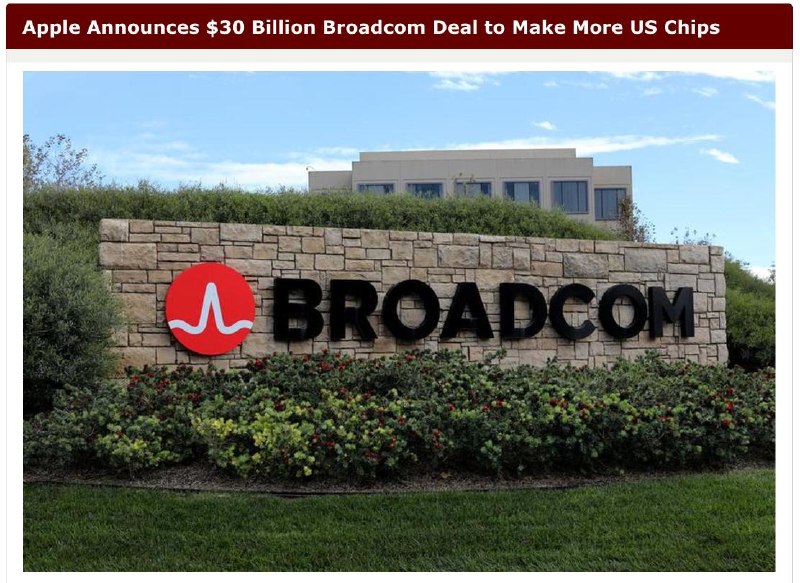
Apple's $30+ Billion Investment in Broadcom: A Strategic Move to Strengthen US Manufacturing and Supply Chain
In a significant development that underscores Apple's commitment to domestic manufacturing and supply chain resilience, the tech giant has entered into a multiyear agreement with semiconductor manufacturer Broadcom valued at over $30 billion. This landmark deal will focus on designing and producing custom silicon and wireless connectivity chips specifically for Apple's diverse product ecosystem, marking the largest commitment yet under Apple's American Manufacturing Program (AMP).
Breaking Down the Historic Agreement
The comprehensive agreement, announced earlier this month, represents a substantial expansion of Apple's partnership with Broadcom and includes several key components that will reshape the company's chip supply chain:
- Financial Commitment: A multiyear deal worth more than $30 billion dedicated to custom chip development and production
- Production Scale: Broadcom will manufacture over 15 billion wireless chips for Apple products within the United States
- Facility Investment: $1.5 billion allocated to expand and modernize Broadcom's manufacturing facility in Fort Collins, Colorado
- Technology Focus: Production of advanced RF components (including FBAR filters) and wireless connectivity technology
The Fort Collins Facility Expansion
A particularly noteworthy aspect of this agreement is the significant investment in Broadcom's Fort Collins, Colorado facility. The $1.5 billion infusion will enable substantial expansion and modernization of the manufacturing plant, which will become a critical production hub for Apple's wireless components.
The facility will focus on producing advanced RF components, including FBAR (Film Bulk Acoustic Resonator) filters, which are essential components in wireless communication systems. These filters help separate different frequency bands in wireless devices, ensuring clear signal transmission and reception while minimizing interference.
Apple's American Manufacturing Program Context
This Broadcom agreement represents the largest commitment to date under Apple's American Manufacturing Program (AMP), which was established to strengthen domestic production capabilities and reduce reliance on international supply chains. The deal aligns with Apple's broader strategic goal of investing $600 billion in the US economy over the next four years, as announced by the company earlier this year.
| Apple's Major US Manufacturing Investments | Value/Scope | Timeline |
|---|---|---|
| Broadcom Agreement | $30+ billion | Multiyear |
| American Manufacturing Program (AMP) | Largest single commitment | Part of ongoing program |
| Broader US Investment Pledge | $600 billion | Next four years |
Strategic Implications for Apple's Supply Chain
The agreement with Broadcom comes at a critical time as Apple continues to expand its product portfolio and increasingly relies on custom-designed silicon to differentiate its devices. The company has been progressively in-sourcing chip design capabilities, moving from reliance on third-party suppliers to developing proprietary solutions like the Apple Silicon M-series chips for Mac computers and the A-series chips for iPhone and iPad.
However, while Apple has made significant strides in designing its own chips, the manufacturing of certain specialized components—particularly wireless connectivity and RF modules—has remained dependent on partners like Broadcom. This new agreement aims to deepen that partnership while bringing more production capabilities to US soil.
Wireless Connectivity: A Critical Component
Wireless connectivity has become a cornerstone feature in Apple's product lineup, with devices increasingly supporting multiple wireless standards including Wi-Fi, Bluetooth, NFC, and cellular connectivity. The production of over 15 billion wireless chips underscores the scale and importance of these components across Apple's ecosystem.
Advanced RF components like FBAR filters are particularly crucial as they enable the miniaturization of wireless systems while maintaining performance—a key consideration in Apple's design philosophy. These components are especially important in devices like the Apple Watch and AirPods, where space constraints are significant but wireless performance expectations remain high.
Industry Context and Competitive Landscape
The semiconductor industry has undergone significant transformation in recent years, with global supply chain disruptions and geopolitical tensions prompting companies to reassess their manufacturing strategies. Apple's investment in Broadcom should be viewed within this broader context of supply chain resilience and localization efforts.
Broadcom, a leading developer of semiconductor and infrastructure software solutions, has been a key supplier to Apple for many years. The company specializes in complex mixed-signal and analog chips, which are areas where Apple has not yet developed in-house manufacturing capabilities. This agreement further solidifies Broadcom's position as a critical partner in Apple's supply chain.
| Key Wireless Technologies in Apple Products | Primary Suppliers | Apple's Integration Strategy |
|---|---|---|
| Wi-Fi/Bluetooth | Broadcom, others | Increasing in-house development |
| Cellular Modems | Broadcom, Qualcomm | Transitioning to in-house design |
| RF Components | Broadcom (primary) | Strategic partnership expansion |
| UWB (Ultra Wideband) | Broadcom, others | Developing custom solutions |
Economic Impact and Job Creation
Apple's investment in Broadcom is expected to have significant economic implications, particularly in Colorado where the Fort Collins facility is located. The expansion and modernization of the manufacturing plant will create numerous high-skilled jobs in engineering, manufacturing, and support roles.
Beyond direct employment, the agreement is likely to stimulate growth in the broader semiconductor ecosystem, potentially attracting additional suppliers and supporting industries to the region. This aligns with Apple's stated goal of not only creating jobs directly but also fostering economic development in the communities where it operates.
Broader Economic Implications
The $30+ billion investment represents a significant boost to the US semiconductor industry, which has been the focus of increased attention and policy support in recent years. The deal comes amid broader efforts to strengthen domestic semiconductor manufacturing capabilities, including the CHIPS and Science Act, which provides substantial incentives for semiconductor production in the United States.
By partnering with Broadcom and investing heavily in domestic production capabilities, Apple is positioning itself to benefit from both policy support and shifting market dynamics that favor localized supply chains. This approach may become increasingly important as geopolitical tensions continue to influence global trade and technology development.
Future Outlook and Potential Developments
Looking ahead, this agreement between Apple and Broadcom is likely to be the first of several major investments under Apple's American Manufacturing Program. The company has indicated that it plans to continue expanding its domestic production capabilities, with potential future investments in other areas of its supply chain.
Industry analysts suggest that Apple may pursue similar partnerships for other specialized components where it currently relies on external suppliers. The company's long-term vision appears to be a hybrid approach: maintaining in-house design capabilities for core technologies while strategically partnering with specialized manufacturers for components that require specific expertise or manufacturing processes.
Technological Evolution and Innovation
The agreement also positions both companies to benefit from emerging wireless technologies that are expected to become increasingly important in future Apple products. These include advancements in Wi-Fi standards (Wi-Fi 6E and Wi-Fi 7), improved Bluetooth capabilities, and the continued development of Ultra Wideband (UWB) technology for spatial awareness and precise location tracking.
By investing in advanced manufacturing capabilities now, Apple and Broadcom are ensuring that they will be well-positioned to meet the growing demands of next-generation wireless technologies while maintaining the performance and efficiency standards that Apple customers have come to expect.
Conclusion: A Strategic Milestone in Apple's Manufacturing Evolution
The $30+ billion investment in Broadcom represents more than just a supply chain agreement—it symbolizes Apple's evolving approach to manufacturing and its commitment to strengthening domestic production capabilities. As the company continues to navigate an increasingly complex global landscape, this strategic partnership with Broadcom provides both immediate benefits and long-term advantages.
For Apple, the agreement ensures a reliable supply of critical wireless components while supporting its broader goals of supply chain resilience and technological innovation. For Broadcom, the deal provides unprecedented scale and stability for its manufacturing operations. And for the US economy, the investment represents a significant boost to domestic semiconductor manufacturing capabilities and job creation.
As Apple continues to execute on its $600 billion US investment pledge, we can expect to see similar strategic partnerships emerge across other areas of its supply chain. The Broadcom agreement may well serve as a template for future collaborations that balance technological innovation with manufacturing localization—a balance that will likely define the next era of global technology development.
💸 Apple to invest $30B+ in Broadcom 📰 Apple has signed a multiyear agreement with Broadcom worth more than $30 billion to design and produce custom silicon and wireless connectivity chips for Apple devices. As part of the deal, Broadcom will manufacture over 15 billion wireless chips for Apple products in the US. 🏭 The agreement also includes a $1.5B investment to expand and modernize Broadcom's manufacturing facility in Fort Collins, Colorado, which will produce advanced RF components (including FBAR filters) and wireless connectivity technology. ℹ️ This is Apple's largest commitment yet under its American Manufacturing Program (AMP) – and part of the company's broader pledge to invest $600B in the US economy over the next four years. @DailyApple 💸 Apple to invest $30B+ in Broadcom 📰 Apple has signed a multiyear agreement with Broadcom worth more than $30 billion to design and produce custom silicon and wireless connectivity chips for Apple devices. As part of the deal, Broadcom will manufacture over 15 billion wireless chips for Apple products in the US. 🏭 The agreement also includes a $1.5B investment to expand and modernize Broadcom's manufacturing facility in Fort Collins, Colorado, which will produce advanced RF components (including FBAR filters) and wireless connectivity technology. ℹ️ This is Apple's largest commitment yet under its American Manufacturing Program (AMP) – and part of the company's broader pledge to invest $600B in the US economy over the next four years. @DailyApple


