 TechOffice
iPhone 18 Pro: Higher Prices Accompanied by Reduced Storage Speeds
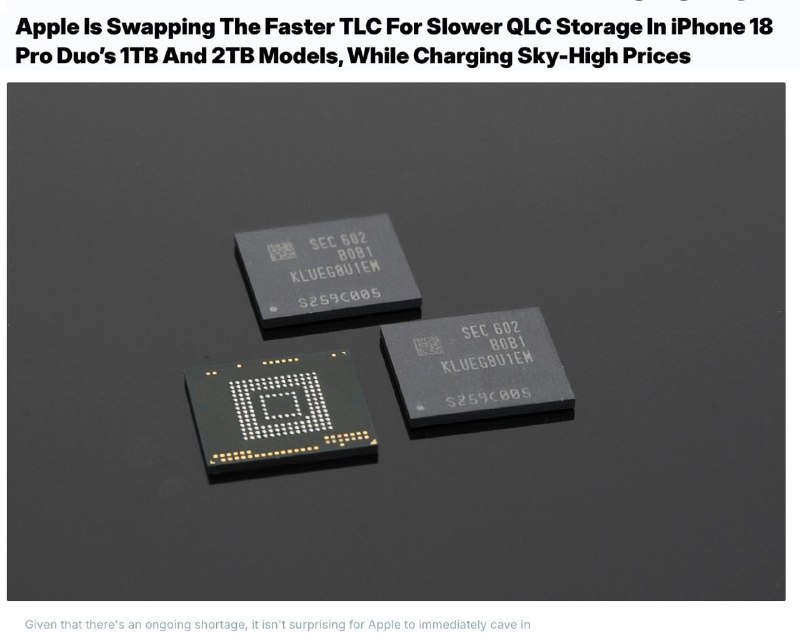
iPhone 18 Pro: Price Increases Amid Performance Decreases for Flash Storage
In a concerning twist for prospective buyers of Apple's upcoming flagship devices, recent leaks suggest that the iPhone 18 Pro and Pro Max may come equipped with slower flash storage options, despite their expected higher price tags. This revelation, initially put forth by Wccftech and corroborated by leaker Reptalicant, raises questions about Apple's priorities in balancing cost and performance.
Storage Configurations: What to Expect
The iPhone 18 Pro models are anticipated to follow a tiered storage approach, with varying technologies underpinning the internal memory, particularly across different capacities:
- 256GB and 512GB Models: These variants will utilize fast Triple-Level Cell (TLC) storage from established manufacturers such as SK hynix, Kioxia, and SanDisk. This technology allows three bits of information to be stored in each memory cell, providing a blend of speed and durability consistent with past models.
- 1TB Model: This version is set to shift primarily to a Quad-Level Cell (QLC) chip, specifically the SK hynix's BC8Q-1T. This chip offers four bits per cell, which, although allowing for higher capacities, invariably compromises speed and durability. A Samsung TLC chip may serve as a rare exception in this configuration.
- 2TB Model: The situation worsens for this variant, as it is expected to incorporate the SK hynix's BC8Q-2T, a QLC chip originally designed for server applications. According to Reptalicant, this chip is particularly deficient in random 4K performance, a critical metric for everyday smartphone users. In contrast, the 2TB iPhone 17 Pro Max boasts traditional TLC storage, highlighting a stark deviation from expected flagship standards.
Economic Factors Behind the Downgrade
The rationale behind these changes appears to be connected primarily to the rising costs associated with memory modules. Reports indicate that the cost of a 256GB flash module has surged from approximately $13 with the iPhone 17 Pro to about $51 for the iPhone 18 Pro. This substantial increase in cost prompts an examination of Apple's pricing strategy, particularly in relation to the expected base prices for the 18 Pro and Pro Max, projected to be $1399 and $1499 respectively.
| Model | Storage Type | Performance | Cost per Unit |
|---|---|---|---|
| 256GB | TLC (SK hynix, Kioxia, SanDisk) | Fast and Durable | $51 |
| 512GB | TLC (SK hynix, Kioxia, SanDisk) | Fast and Durable | $51 |
| 1TB | QLC (SK hynix's BC8Q-1T) | Slower, Less Durable | Not disclosed |
| 2TB | QLC (SK hynix's BC8Q-2T) | Significantly Slower | Not disclosed |
Implications for Consumers
The apparent downgrade in storage technology presents a troubling scenario for consumers looking for cutting-edge performance in their devices. The mismatch between escalating prices and declining performance metrics raises ethical questions regarding value for money. As Apple seemingly prioritizes its profit margins over customer experience, potential buyers will need to weigh these factors carefully.
In conclusion, while fans eagerly await the release of the iPhone 18 Pro, this information casts an uneasy shadow over what is expected to be a flagship device. With rising costs and downgrading technology, the stakes have never been higher for consumers who are prepared to invest substantially in Apple's latest offerings.
😰 iPhone 18 Pro: paying more, getting slower storage 📰 Apple is reportedly downgrading the flash storage in the high-capacity iPhone 18 Pro and Pro Max, according to Wccftech, citing leaker Reptalicant. 1️⃣ The 256GB and 512GB models will keep fast TLC (Triple-Level Cell) storage from SK hynix, Kioxia, and SanDisk – same tech as before, three bits per cell, quick and durable. But the 1TB model will mostly switch to a QLC (Quad-Level Cell) chip – SK hynix's BC8Q-1T – which packs four bits per cell but is slower and less durable. A Samsung TLC chip will only appear as a rare alternative. 2️⃣ The 2TB version gets it worse: it'll use SK hynix's BC8Q-2T, a QLC chip originally built for server workloads. The leaker claims this chip suffers noticeably in random 4K performance. For comparison, the 2TB iPhone 17 Pro Max still uses proper TLC storage, as you'd expect from a flagship. 💸 Why the downgrade? Wccftech points to rising memory costs — earlier reports suggested a 256GB flash module now costs Apple around $51 per unit, up from $13 for the iPhone 17 Pro. Meanwhile, base prices for the 18 Pro and Pro Max are expected to hit $1399 and $1499. The math doesn't add up in customers' favor – this looks less like a cost-driven necessity and more like Apple protecting its margins at the expense of top-tier buyers. @DailyApple 😰 iPhone 18 Pro: paying more, getting slower storage 📰 Apple is reportedly downgrading the flash storage in the high-capacity iPhone 18 Pro and Pro Max, according to Wccftech, citing leaker Reptalicant. 1️⃣ The 256GB and 512GB models will keep fast TLC (Triple-Level Cell) storage from SK hynix, Kioxia, and SanDisk – same tech as before, three bits per cell, quick and durable. But the 1TB model will mostly switch to a QLC (Quad-Level Cell) chip – SK hynix's BC8Q-1T – which packs four bits per cell but is slower and less durable. A Samsung TLC chip will only appear as a rare alternative. 2️⃣ The 2TB version gets it worse: it'll use SK hynix's BC8Q-2T, a QLC chip originally built for server workloads. The leaker claims this chip suffers noticeably in random 4K performance. For comparison, the 2TB iPhone 17 Pro Max still uses proper TLC storage, as you'd expect from a flagship. 💸 Why the downgrade? Wccftech points to rising memory costs — earlier reports suggested a 256GB flash module now costs Apple around $51 per unit, up from $13 for the iPhone 17 Pro. Meanwhile, base prices for the 18 Pro and Pro Max are expected to hit $1399 and $1499. The math doesn't add up in customers' favor – this looks less like a cost-driven necessity and more like Apple protecting its margins at the expense of top-tier buyers. @DailyApple


