 TechOffice
A Glimpse into the Future: An iPhone Designed for the Year 2276
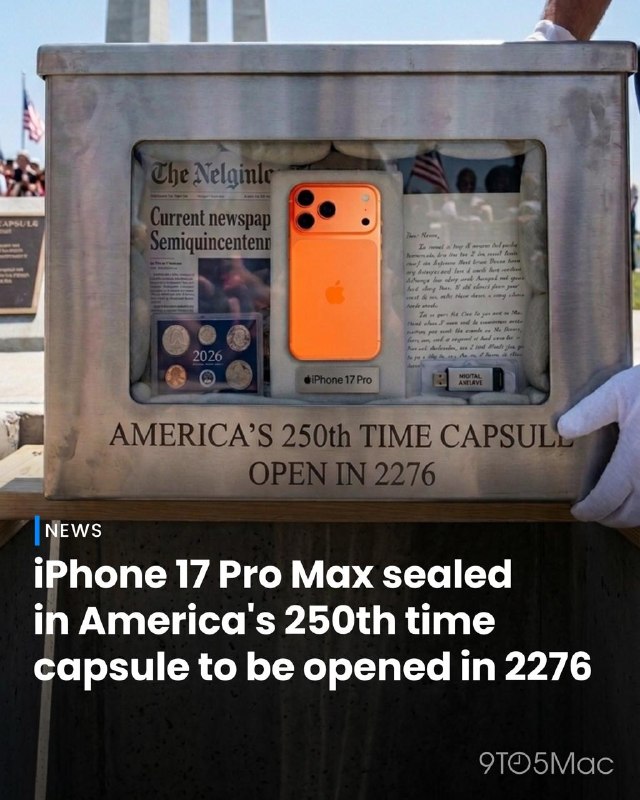
The Future in a Capsule: An iPhone Buried for 250 Years
In a monumental event to commemorate the 250th anniversary of the United States, a remarkable time capsule has been interred in Philadelphia. Weighing nearly 900 pounds, this robust stainless steel container is a testament to American history, culture, and ingenuity, holding an eclectic array of artifacts from all 50 states, Washington D.C., and five U.S. territories. Scheduled to remain sealed until the year 2276, the capsule serves as a bridge to the past for future generations celebrating the nation's 500th anniversary.
Highlight of the Capsule: The iPhone 17 Pro Max
Among the impressive items encapsulated within this time capsule is the iPhone 17 Pro Max, presented in the eye-catching color of Cosmic Orange. This smartphone carries not just technological prowess but also a collection of "digital artifacts" stored in the Notes app, intended for future discovery and reflection by the descendants of today.
The Challenges of Digital Preservation
While the initiative is commendable, the prospect of this smartphone functioning in 250 years raises numerous concerns, primarily surrounding technological obsolescence and decay.
Battery Durability
- Lithium-ion Battery Degradation: One of the major challenges with modern electronics, particularly smartphones like the iPhone 17 Pro Max, is the chemical composition of lithium-ion batteries. Over time, these batteries degrade significantly, often losing their ability to hold a charge or power on. As such, the likelihood of the iPhone being operational in 250 years borders on the improbable.
Dependency on Infrastructure
- Reliance on Apple’s Servers: Even if the device were to survive and its battery remains functional, there lies an even more significant hurdle—the reliance on Apple's servers for unlocking the device. Future generations may find themselves unable to access the digital contents without the appropriate authentication mechanisms. Given the rapid pace at which technology evolves, the servers supporting today’s devices may not exist or may have evolved into entirely different platforms, thus rendering the data inaccessible.
Conclusion
As we look forward to the future with excitement and curiosity, the time capsule crafted for America’s 250th anniversary serves as a poignant reminder of the complexities associated with preserving digital history. While the iPhone 17 Pro Max symbolizes cutting-edge technology and innovation, it also highlights the ephemeral nature of such advancements in the face of time. Only future generations will discover whether this time capsule was a gateway to knowledge or merely a relic of a bygone era.
| Challenge | Description | Potential Impact |
|---|---|---|
| Lithium-ion Battery Degradation | Batteries lose charge capacity over time. | Unlikely to power on in 250 years. |
| Dependence on Servers | Unlocking the phone requires server access. | Access to stored digital artifacts may be impossible. |
🙂 Time capsule: an iPhone bound for the year 2276 🇺🇸 To mark America's 250th anniversary, a massive time capsule was buried in Philadelphia — a nearly 900-pound stainless steel container holding hundreds of artifacts from all 50 states, Washington D.C., and five U.S. territories. It won't be opened until 2276, for the nation's 500th anniversary. 📱 Among the items is the iPhone 17 Pro Max in Cosmic Orange. The phone has "digital artifacts" saved in the Notes app for future generations to look through – assuming the device even turns on. But that's the real problem: 🔋 Lithium-ion batteries degrade over time, so the odds of the phone powering on in 250 years are basically zero. 🔒 But even if the battery somehow survives, there's a bigger catch – unlocking an iPhone depends on Apple's servers, which may not even exist 250 years from now. @iPhone 🙂 Time capsule: an iPhone bound for the year 2276 🇺🇸 To mark America's 250th anniversary, a massive time capsule was buried in Philadelphia — a nearly 900-pound stainless steel container holding hundreds of artifacts from all 50 states, Washington D.C., and five U.S. territories. It won't be opened until 2276, for the nation's 500th anniversary. 📱 Among the items is the iPhone 17 Pro Max in Cosmic Orange. The phone has "digital artifacts" saved in the Notes app for future generations to look through – assuming the device even turns on. But that's the real problem: 🔋 Lithium-ion batteries degrade over time, so the odds of the phone powering on in 250 years are basically zero. 🔒 But even if the battery somehow survives, there's a bigger catch – unlocking an iPhone depends on Apple's servers, which may not even exist 250 years from now. @iPhone


