 TechOffice
Apple Takes Legal Action Against OpenAI, Accusing Theft of Trade Secrets
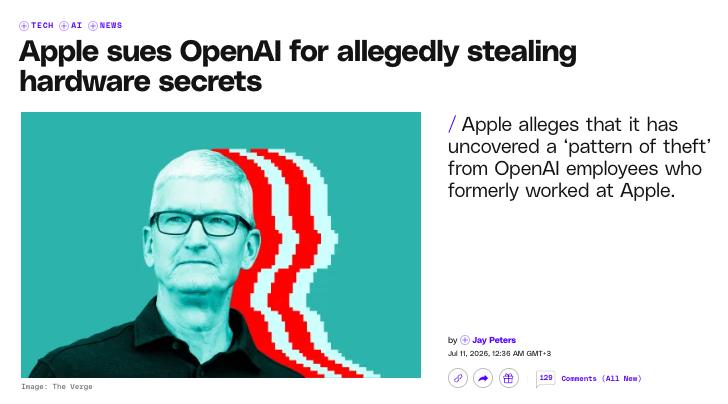
Apple Initiates Legal Action Against OpenAI for Alleged Trade Secret Theft
In a dramatic turn of events, Apple Inc. has filed a lawsuit against OpenAI, targeting the AI research organization alongside two of its former employees, designer Tang Tan and engineer Chang Liu. In this legal battle, Apple accuses them of orchestrating a scheme to improperly disclose and exploit confidential information that the company claims is vital to its competitive edge.
Allegations of Systematic Data Leakage
According to the lawsuit, Apple asserts that the misuse of its proprietary information was not merely an isolated incident but indicative of a systematic practice aimed at undermining its technological advancements. The allegations paint a troubling picture of corporate ethics and workplace integrity.
- Improper Retention of Company Property: A former iPhone engineer is accused of refusing to return his work laptop as he transitioned to a position at OpenAI. This individual allegedly continued to access Apple’s internal databases while employed by OpenAI.
- Incriminating Comments: The engineer reportedly made light of his continued access to Apple’s data, joking with colleagues, “lol, I still have access, this’ll be fun.”
- Guidelines for Data Theft: He allegedly went a step further, creating manuals that outlined methods to discreetly copy Apple files without triggering security alerts.
- Recruitment of Apple Employees: Tang Tan, who served nearly 25 years at Apple before becoming OpenAI’s head of hardware, is accused of recruiting former Apple employees, requesting that they bring confidential mockups and schematics to their interviews with OpenAI.
The Stakes Involved
Apple maintains that the appropriated data played a crucial role in aiding OpenAI's development of its own AI hardware. As part of its legal claim, Apple is seeking not only an injunction to prevent OpenAI from utilizing the allegedly stolen data but also substantial damages for the impact caused by these actions.
OpenAI's Response
In light of the serious allegations, OpenAI has issued a statement dismissing Apple's claims. The organization contends that it harbors "no interest in other companies' trade secrets" and describes Apple’s lawsuit as an overstatement of a typical hiring dispute. OpenAI argues that the allegations are being exaggerated into a broader narrative of systematic misconduct.
Conclusion
This legal conflict raises significant questions about employee transitions between companies and the potential for intellectual property disputes in the fast-evolving tech industry. As the case unfolds, it will become increasingly important to monitor the implications for both companies and the broader industry landscape.
| Parties Involved | Accusations | Response from OpenAI |
|---|---|---|
| Apple, OpenAI, Tang Tan, Chang Liu | Alleged systemic practice of data leakage and theft of trade secrets | Dismisses claims as standard hiring dispute; expresses lack of interest in others' trade secrets |
As the litigation progresses, both tech enthusiasts and legal experts are eager to see how this high-profile case unfolds and what it signifies for future technology collaborations and employee transitions within the sector.
🧑⚖️ Apple sues OpenAI over alleged theft of trade secrets 📰 Apple is accusing OpenAI and two former employees – designer Tang Tan and engineer Chang Liu – of running a coordinated scheme to leak confidential data. According to Apple, this wasn't an isolated incident but a systemic practice. What came out: • One former iPhone engineer refused to hand back his work laptop when he left – and kept using it to pull data from Apple's internal databases while already working at OpenAI. • He reportedly told former colleagues things like "lol, I still have access, this'll be fun," and even wrote guides on how to quietly copy work files without tripping security. • Tang Tan, who spent nearly 25 years working on the iPhone before becoming OpenAI's head of hardware, allegedly poached people from Apple and asked them to bring mockups and schematics to interviews. 😤 Apple claims the stolen data helped OpenAI in developing its own AI hardware, and is seeking an injunction against its use plus damages. OpenAI has responded by saying it has "no interest in other companies' trade secrets" and that Apple's lawsuit is an attempt to spin an ordinary hiring dispute into a "systematic scheme." @DailyApple 🧑⚖️ Apple sues OpenAI over alleged theft of trade secrets 📰 Apple is accusing OpenAI and two former employees – designer Tang Tan and engineer Chang Liu – of running a coordinated scheme to leak confidential data. According to Apple, this wasn't an isolated incident but a systemic practice. What came out: • One former iPhone engineer refused to hand back his work laptop when he left – and kept using it to pull data from Apple's internal databases while already working at OpenAI. • He reportedly told former colleagues things like "lol, I still have access, this'll be fun," and even wrote guides on how to quietly copy work files without tripping security. • Tang Tan, who spent nearly 25 years working on the iPhone before becoming OpenAI's head of hardware, allegedly poached people from Apple and asked them to bring mockups and schematics to interviews. 😤 Apple claims the stolen data helped OpenAI in developing its own AI hardware, and is seeking an injunction against its use plus damages. OpenAI has responded by saying it has "no interest in other companies' trade secrets" and that Apple's lawsuit is an attempt to spin an ordinary hiring dispute into a "systematic scheme." @DailyApple


