 TechOffice
iPhone 18 Pro: Higher Price Paired with Slower Storage Options
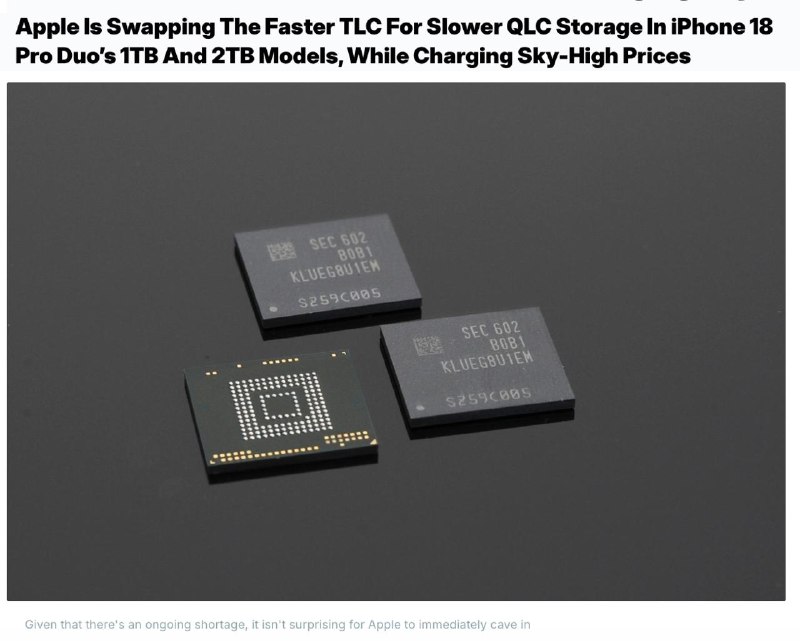
Apple's iPhone 18 Pro: Concerns Over Storage Downgrades Amid Rising Prices
In the ever-evolving world of smartphones, Apple continues to set trends while also raising questions among its loyal customer base. Recently, a leak has surfaced regarding the upcoming iPhone 18 Pro and Pro Max models, suggesting that the tech giant may be moving to slower storage options for its high-capacity versions. This revelation poses a dilemma for consumers who are already anticipating higher prices for these flagship devices.
Storage Specifications: A Shift from TLC to QLC
According to a report from Wccftech, sourced from the well-known leaker Reptalicant, Apple will make notable changes to the flash storage in the iPhone 18 Pro models. The shift is particularly evident in the storage configurations available:
| Model | Storage Type | Capacity | Remarks |
|---|---|---|---|
| iPhone 18 Pro (256GB) | TLC (Triple-Level Cell) | 256GB | Fast and durable storage from SK hynix, Kioxia, and SanDisk. |
| iPhone 18 Pro (512GB) | TLC (Triple-Level Cell) | 512GB | Same technology as previous models. |
| iPhone 18 Pro (1TB) | QLC (Quad-Level Cell) | 1TB | Uses SK hynix's BC8Q-1T, slower and less durable. Samsung TLC expected as rare alternative. |
| iPhone 18 Pro (2TB) | QLC (Quad-Level Cell) | 2TB | Utilizes SK hynix's BC8Q-2T, designed for server workloads; expected to underperform. |
The report indicates that while the 256GB and 512GB models maintain the reliable TLC (Triple-Level Cell) storage technology, the 1TB and 2TB models are transitioning to QLC (Quad-Level Cell) chips. The key difference lies in their design: QLC technology stores four bits per cell, which while increasing capacity, typically results in slower speeds and decreased durability compared to TLC technology that stores three bits per cell.
Performance Concerns
The leaker highlights that the QLC chips, particularly the BC8Q-2T in the 2TB iPhone 18 Pro, could witness significant performance drawbacks in random 4K performance, which is crucial for multimedia applications and gaming. This is a stark contrast to the 2TB iPhone 17 Pro Max, which continues to use more robust TLC storage.
Understanding the Price Increase
Amid these significant changes, questions arise about the rationale behind the storage downgrade, especially considering the anticipated increase in retail prices for the base models. Reports indicate that base prices for the iPhone 18 Pro and Pro Max may start at approximately $1399 and $1499, respectively. This increase occurs at a time when Apple may be facing higher component costs, specifically regarding memory:
- The cost of a 256GB flash module reportedly surged from $13 for the iPhone 17 Pro to around $51 for the iPhone 18 Pro.
- This increase raises eyebrows as the company appears to opt for a less optimal storage solution for its flagship models.
The disparity between rising costs and the expected menu of features and specifications leads to a broader implication: is Apple prioritizing profit margins over customer satisfaction? The enhanced profit on each device may come at the cost of user experience, as high-tier models traditionally offer cutting-edge technology and performance.
The Bottom Line
As the tech community anticipates the launch of the iPhone 18 Pro, it is crucial for consumers to critically assess the implications of these design choices. With rising prices paired with downgraded storage solutions, customers may face a tough decision about whether the new offerings meet their expectations for performance, longevity, and value. Apple's strategy may produce enhanced profits, but whether it aligns with customer interests remains to be seen.
😰 iPhone 18 Pro: paying more, getting slower storage 📰 Apple is reportedly downgrading the flash storage in the high-capacity iPhone 18 Pro and Pro Max, according to Wccftech, citing leaker Reptalicant. 1️⃣ The 256GB and 512GB models will keep fast TLC (Triple-Level Cell) storage from SK hynix, Kioxia, and SanDisk – same tech as before, three bits per cell, quick and durable. But the 1TB model will mostly switch to a QLC (Quad-Level Cell) chip – SK hynix's BC8Q-1T – which packs four bits per cell but is slower and less durable. A Samsung TLC chip will only appear as a rare alternative. 2️⃣ The 2TB version gets it worse: it'll use SK hynix's BC8Q-2T, a QLC chip originally built for server workloads. The leaker claims this chip suffers noticeably in random 4K performance. For comparison, the 2TB iPhone 17 Pro Max still uses proper TLC storage, as you'd expect from a flagship. 💸 Why the downgrade? Wccftech points to rising memory costs — earlier reports suggested a 256GB flash module now costs Apple around $51 per unit, up from $13 for the iPhone 17 Pro. Meanwhile, base prices for the 18 Pro and Pro Max are expected to hit $1399 and $1499. The math doesn't add up in customers' favor – this looks less like a cost-driven necessity and more like Apple protecting its margins at the expense of top-tier buyers. @DailyApple 😰 iPhone 18 Pro: paying more, getting slower storage 📰 Apple is reportedly downgrading the flash storage in the high-capacity iPhone 18 Pro and Pro Max, according to Wccftech, citing leaker Reptalicant. 1️⃣ The 256GB and 512GB models will keep fast TLC (Triple-Level Cell) storage from SK hynix, Kioxia, and SanDisk – same tech as before, three bits per cell, quick and durable. But the 1TB model will mostly switch to a QLC (Quad-Level Cell) chip – SK hynix's BC8Q-1T – which packs four bits per cell but is slower and less durable. A Samsung TLC chip will only appear as a rare alternative. 2️⃣ The 2TB version gets it worse: it'll use SK hynix's BC8Q-2T, a QLC chip originally built for server workloads. The leaker claims this chip suffers noticeably in random 4K performance. For comparison, the 2TB iPhone 17 Pro Max still uses proper TLC storage, as you'd expect from a flagship. 💸 Why the downgrade? Wccftech points to rising memory costs — earlier reports suggested a 256GB flash module now costs Apple around $51 per unit, up from $13 for the iPhone 17 Pro. Meanwhile, base prices for the 18 Pro and Pro Max are expected to hit $1399 and $1499. The math doesn't add up in customers' favor – this looks less like a cost-driven necessity and more like Apple protecting its margins at the expense of top-tier buyers. @DailyApple


