 TechOffice
iPhone 18 Pro: Higher Prices with Reduced Storage Speed
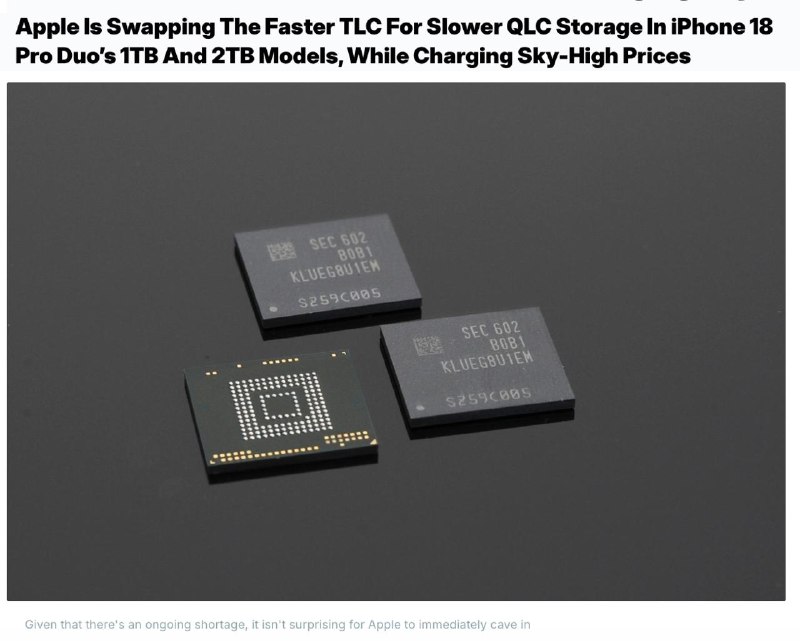
Apple's iPhone 18 Pro: A Controversial Shift in Storage Technology
In an unexpected turn of events, Apple appears to be downgrading the storage technology used in its upcoming iPhone 18 Pro and iPhone 18 Pro Max models. This revelation has sparked significant discussion, particularly given the company's reputation for premium products. According to sources cited by Wccftech, namely the leaker Reptalicant, the high-capacity variants of these models will feature a notable shift in the flash storage architecture.
A Breakdown of Storage Variants
The storage technology across different capacities in the iPhone 18 Pro lineup varies significantly, most prominently between the lower and higher-end models:
| Model Variant | Storage Type | Performance | Durability |
|---|---|---|---|
| 256GB | TLC (Triple-Level Cell) | Fast | High |
| 512GB | TLC (Triple-Level Cell) | Fast | High |
| 1TB | QLC (Quad-Level Cell) | Slower | Lower |
| 2TB | QLC (Quad-Level Cell) | Notably slower in 4K | Lower |
The 256GB and 512GB models will utilize TLC (Triple-Level Cell) storage from established manufacturers such as SK hynix, Kioxia, and SanDisk. This technology essentially allows for three bits to be stored per cell, resulting in quicker speeds and higher durability. However, as users move to the 1TB variant, Apple is transitioning predominantly to a QLC (Quad-Level Cell) storage format, specifically the SK hynix's BC8Q-1T, which only stores four bits per cell. Although this change is cost-effective, it sacrifices both speed and durability.
To complicate matters further, the 2TB version will employ SK hynix's BC8Q-2T chip, a QLC option initially designed for server scenarios, which reportedly struggles with random 4K performance. This is a stark contrast to the iPhone 17 Pro Max, which proudly featured TLC storage even at the 2TB capacity.
Understanding the Market Dynamics
As speculation surrounding the storage downgrade grows, attention has turned to the economic factors at play. Earlier reports indicate a significant increase in the cost of memory components, with Apple facing a steep rise in manufacturing expenses—suggested to be around $51 per 256GB flash module compared to just $13 reported for the iPhone 17 Pro.
The pricing strategy for the new models has also raised eyebrows, anticipating costs of $1399 for the iPhone 18 Pro and $1499 for the Pro Max. With this, customers would be paying a premium for what many perceive as a less advanced storage technology, raising concerns that this adjustment is less about responding to market needs and more about bolstering profit margins while sidelining loyal customers.
Conclusion: What Lies Ahead?
Apple’s choice to shift to QLC storage in its high-capacity variants of the iPhone 18 Pro and Pro Max has undoubtedly stirred controversy among tech enthusiasts and potential buyers alike. While the company may rationalize this move as a response to increased manufacturing costs, it raises important questions about product quality in the premium segment and customer expectations.
As we await the official launch of these models, it becomes increasingly clear that this storage strategy may redefine the parameters of flagship smartphones for Apple. Consumers will have to weigh the implications of these decisions, potentially redefining their relationship with the brand.
😰 iPhone 18 Pro: paying more, getting slower storage 📰 Apple is reportedly downgrading the flash storage in the high-capacity iPhone 18 Pro and Pro Max, according to Wccftech, citing leaker Reptalicant. 1️⃣ The 256GB and 512GB models will keep fast TLC (Triple-Level Cell) storage from SK hynix, Kioxia, and SanDisk – same tech as before, three bits per cell, quick and durable. But the 1TB model will mostly switch to a QLC (Quad-Level Cell) chip – SK hynix's BC8Q-1T – which packs four bits per cell but is slower and less durable. A Samsung TLC chip will only appear as a rare alternative. 2️⃣ The 2TB version gets it worse: it'll use SK hynix's BC8Q-2T, a QLC chip originally built for server workloads. The leaker claims this chip suffers noticeably in random 4K performance. For comparison, the 2TB iPhone 17 Pro Max still uses proper TLC storage, as you'd expect from a flagship. 💸 Why the downgrade? Wccftech points to rising memory costs — earlier reports suggested a 256GB flash module now costs Apple around $51 per unit, up from $13 for the iPhone 17 Pro. Meanwhile, base prices for the 18 Pro and Pro Max are expected to hit $1399 and $1499. The math doesn't add up in customers' favor – this looks less like a cost-driven necessity and more like Apple protecting its margins at the expense of top-tier buyers. @DailyApple 😰 iPhone 18 Pro: paying more, getting slower storage 📰 Apple is reportedly downgrading the flash storage in the high-capacity iPhone 18 Pro and Pro Max, according to Wccftech, citing leaker Reptalicant. 1️⃣ The 256GB and 512GB models will keep fast TLC (Triple-Level Cell) storage from SK hynix, Kioxia, and SanDisk – same tech as before, three bits per cell, quick and durable. But the 1TB model will mostly switch to a QLC (Quad-Level Cell) chip – SK hynix's BC8Q-1T – which packs four bits per cell but is slower and less durable. A Samsung TLC chip will only appear as a rare alternative. 2️⃣ The 2TB version gets it worse: it'll use SK hynix's BC8Q-2T, a QLC chip originally built for server workloads. The leaker claims this chip suffers noticeably in random 4K performance. For comparison, the 2TB iPhone 17 Pro Max still uses proper TLC storage, as you'd expect from a flagship. 💸 Why the downgrade? Wccftech points to rising memory costs — earlier reports suggested a 256GB flash module now costs Apple around $51 per unit, up from $13 for the iPhone 17 Pro. Meanwhile, base prices for the 18 Pro and Pro Max are expected to hit $1399 and $1499. The math doesn't add up in customers' favor – this looks less like a cost-driven necessity and more like Apple protecting its margins at the expense of top-tier buyers. @DailyApple


