 TechOffice
Apple Files Lawsuit Against OpenAI, Accusing Company of Trade Secret Misappropriation
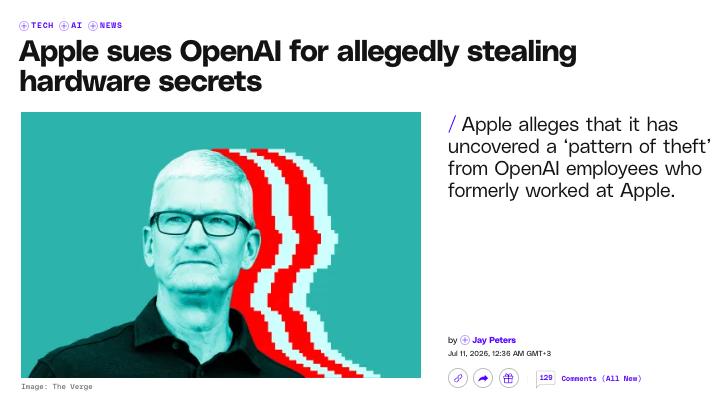
Apple Files Lawsuit Against OpenAI for Alleged Trade Secret Theft
In a notable legal battle that underscores the ongoing tensions in the tech industry, Apple has launched a lawsuit against OpenAI, alleging the theft of trade secrets. The lawsuit also implicates two former Apple employees, designer Tang Tan and engineer Chang Liu, whom Apple accuses of orchestrating a coordinated scheme to leak confidential data.
The Core Allegations
According to the lawsuit, this situation transcends an individual incident, pointing towards what Apple describes as a systemic practice of information misappropriation. The details unveiled in the court filings paint a concerning picture.
- One of the former iPhone engineers allegedly refused to return his work laptop upon leaving Apple. Instead, he continued to utilize it to extract data from Apple’s internal databases while he was already employed at OpenAI.
- In an act of apparent bravado, he reportedly communicated with former colleagues, remarking, "lol, I still have access, this'll be fun." Furthermore, he allegedly authored guides on how to discreetly copy work files without triggering security alerts.
- Tang Tan, who dedicated nearly 25 years to the development of the iPhone before assuming leadership of hardware at OpenAI, is accused of actively recruiting Apple employees. It is claimed that during the interview process, he solicited mockups and schematics from potential hires.
Impact on AI Development
Apple contends that the alleged stolen information significantly contributed to OpenAI’s advancements in developing its own AI hardware. To remedy this, Apple is seeking both an injunction against the utilization of the purloined data and financial damages.
Response from OpenAI
OpenAI has issued a rebuttal to Apple's claims. The organization maintains that it has "no interest in other companies' trade secrets," and asserts that Apple’s lawsuit mischaracterizes a standard hiring dispute as a broader and more elaborate scheme of systematic theft.
Summary of Allegations and Response
| Allegation | Details |
|---|---|
| Unauthorized Data Access | Former engineer continued to access Apple databases using a retained work laptop. |
| Communications with Colleagues | Made comments indicating ongoing access to confidential materials. |
| Recruitment of Apple Employees | Tang Tan allegedly solicited mockups and schematics from potential hires. |
| OpenAI's Response | Claims it has no interest in stealing trade secrets and characterizes Apple’s arguments as exaggerated. |
Conclusion
This lawsuit not only highlights the fiercely competitive nature of the technology sector but also raises pertinent questions about the ethical boundaries of recruitment and intellectual property rights. As the case unfolds, it will be significant to observe the implications this might have on industry hiring practices, trade secrets, and the development of emerging technologies.
🧑⚖️ Apple sues OpenAI over alleged theft of trade secrets 📰 Apple is accusing OpenAI and two former employees – designer Tang Tan and engineer Chang Liu – of running a coordinated scheme to leak confidential data. According to Apple, this wasn't an isolated incident but a systemic practice. What came out: • One former iPhone engineer refused to hand back his work laptop when he left – and kept using it to pull data from Apple's internal databases while already working at OpenAI. • He reportedly told former colleagues things like "lol, I still have access, this'll be fun," and even wrote guides on how to quietly copy work files without tripping security. • Tang Tan, who spent nearly 25 years working on the iPhone before becoming OpenAI's head of hardware, allegedly poached people from Apple and asked them to bring mockups and schematics to interviews. 😤 Apple claims the stolen data helped OpenAI in developing its own AI hardware, and is seeking an injunction against its use plus damages. OpenAI has responded by saying it has "no interest in other companies' trade secrets" and that Apple's lawsuit is an attempt to spin an ordinary hiring dispute into a "systematic scheme." @DailyApple 🧑⚖️ Apple sues OpenAI over alleged theft of trade secrets 📰 Apple is accusing OpenAI and two former employees – designer Tang Tan and engineer Chang Liu – of running a coordinated scheme to leak confidential data. According to Apple, this wasn't an isolated incident but a systemic practice. What came out: • One former iPhone engineer refused to hand back his work laptop when he left – and kept using it to pull data from Apple's internal databases while already working at OpenAI. • He reportedly told former colleagues things like "lol, I still have access, this'll be fun," and even wrote guides on how to quietly copy work files without tripping security. • Tang Tan, who spent nearly 25 years working on the iPhone before becoming OpenAI's head of hardware, allegedly poached people from Apple and asked them to bring mockups and schematics to interviews. 😤 Apple claims the stolen data helped OpenAI in developing its own AI hardware, and is seeking an injunction against its use plus damages. OpenAI has responded by saying it has "no interest in other companies' trade secrets" and that Apple's lawsuit is an attempt to spin an ordinary hiring dispute into a "systematic scheme." @DailyApple


