 TechOffice
Apple Takes Legal Action Against OpenAI for Alleged Trade Secret Misappropriation
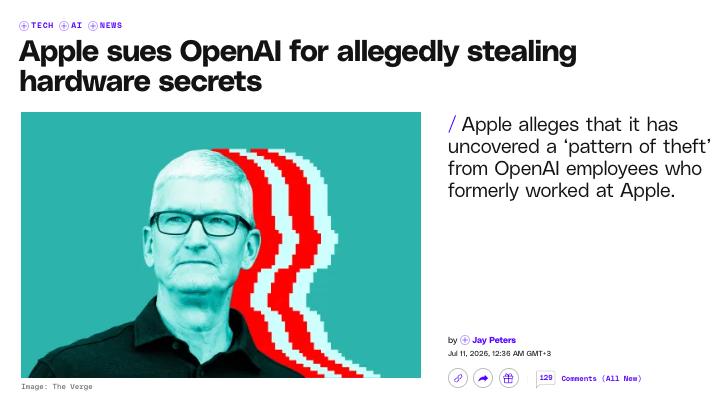
Apple Files Lawsuit Against OpenAI Over Alleged Trade Secret Theft
In a significant legal escalation within the tech industry, Apple Inc. has filed a lawsuit against OpenAI, asserting that the artificial intelligence company engaged in a coordinated scheme to misappropriate its confidential data. This legal action targets not just OpenAI but also two former Apple employees—designer Tang Tan and engineer Chang Liu—who are accused of being central figures in this alleged misconduct.
Background of the Allegations
Apple's complaint details what it claims is not an isolated incident but rather a systemic practice aimed at undermining its competitive advantage. The company has presented alarming allegations regarding the behavior of a former engineer who reportedly refused to return his work laptop upon his departure from Apple.
- He allegedly continued to access Apple’s sensitive internal databases even after beginning his employment at OpenAI.
- In a display of nonchalance, he is reported to have told former colleagues, “lol, I still have access, this’ll be fun.”
- This engineer supposedly took steps to educate others on how to covertly copy proprietary files without triggering security alarms.
Furthermore, Tang Tan, who dedicated nearly 25 years to the development of the iPhone before becoming the head of hardware at OpenAI, is accused of aggressively recruiting Apple talent. It is alleged that he solicited individuals to bring copies of mockups and product schematics to interviews, thereby directly undermining Apple’s intellectual property.
Implications of the Allegations
Apple asserts that the trade secrets in question significantly contributed to OpenAI’s development of its proprietary AI hardware capabilities. The lawsuit seeks not only an injunction to prevent the use of the alleged stolen data but also damages for the losses incurred due to these actions.
OpenAI's Response
In light of these serious allegations, OpenAI has issued a statement categorically denying any wrongdoing. The company emphasized that it has "no interest in other companies' trade secrets." They further characterized Apple's legal action as an attempt to elevate what they view as a standard hiring dispute into a sensationalized narrative of corporate espionage.
Summary of Key Points
| Aspect | Details |
|---|---|
| Accused Parties | OpenAI, Tang Tan, Chang Liu |
| Allegations Against Former Engineer | Refused to return work laptop, accessed confidential data while employed at OpenAI |
| Tang Tan's Role | Head of hardware at OpenAI, allegedly poached Apple employees and solicited confidential materials |
| Apple's Demands | Injunction against use of stolen data and monetary damages |
| OpenAI's Position | Denies interest in Apple’s trade secrets, calls lawsuit exaggerated |
Conclusion
This lawsuit marks a notable confrontation between two titans of the tech industry, with potential implications for talent mobility and trade secret protection. As the legal proceedings unfold, it remains to be seen how the courts will navigate the complex interplay of innovation and intellectual property rights within the rapidly evolving landscape of artificial intelligence.
🧑⚖️ Apple sues OpenAI over alleged theft of trade secrets 📰 Apple is accusing OpenAI and two former employees – designer Tang Tan and engineer Chang Liu – of running a coordinated scheme to leak confidential data. According to Apple, this wasn't an isolated incident but a systemic practice. What came out: • One former iPhone engineer refused to hand back his work laptop when he left – and kept using it to pull data from Apple's internal databases while already working at OpenAI. • He reportedly told former colleagues things like "lol, I still have access, this'll be fun," and even wrote guides on how to quietly copy work files without tripping security. • Tang Tan, who spent nearly 25 years working on the iPhone before becoming OpenAI's head of hardware, allegedly poached people from Apple and asked them to bring mockups and schematics to interviews. 😤 Apple claims the stolen data helped OpenAI in developing its own AI hardware, and is seeking an injunction against its use plus damages. OpenAI has responded by saying it has "no interest in other companies' trade secrets" and that Apple's lawsuit is an attempt to spin an ordinary hiring dispute into a "systematic scheme." @DailyApple 🧑⚖️ Apple sues OpenAI over alleged theft of trade secrets 📰 Apple is accusing OpenAI and two former employees – designer Tang Tan and engineer Chang Liu – of running a coordinated scheme to leak confidential data. According to Apple, this wasn't an isolated incident but a systemic practice. What came out: • One former iPhone engineer refused to hand back his work laptop when he left – and kept using it to pull data from Apple's internal databases while already working at OpenAI. • He reportedly told former colleagues things like "lol, I still have access, this'll be fun," and even wrote guides on how to quietly copy work files without tripping security. • Tang Tan, who spent nearly 25 years working on the iPhone before becoming OpenAI's head of hardware, allegedly poached people from Apple and asked them to bring mockups and schematics to interviews. 😤 Apple claims the stolen data helped OpenAI in developing its own AI hardware, and is seeking an injunction against its use plus damages. OpenAI has responded by saying it has "no interest in other companies' trade secrets" and that Apple's lawsuit is an attempt to spin an ordinary hiring dispute into a "systematic scheme." @DailyApple


