 TechOffice
iPhone 18 Pro: Higher Price, Yet Decreased Storage Speed
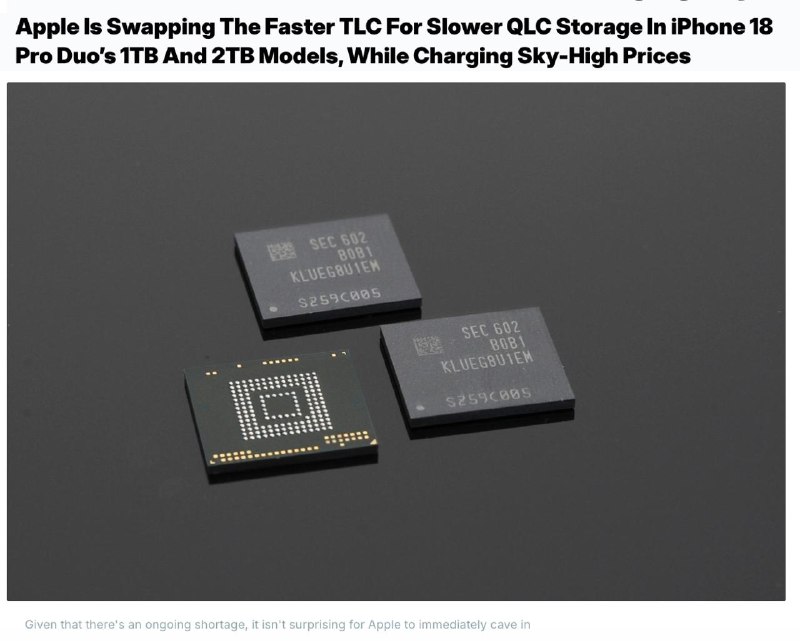
iPhone 18 Pro: Concerns Over Storage Performance Amid Rising Costs
In a surprising turn of events, Apple appears to be implementing significant changes to the storage technology used in its upcoming high-capacity iPhone 18 Pro and Pro Max models. According to recent reports from Wccftech, citing renowned leaker Reptalicant, customers may soon find themselves paying a premium for devices that utilize slower storage solutions, raising questions about the company's commitment to quality in its flagship products.
Storage Specifications: A Closer Look
For the iPhone 18 Pro and Pro Max, storage options will vary significantly depending on the model:
| Model | Capacity | Storage Type | Chip Supplier | Performance Comparison |
|---|---|---|---|---|
| iPhone 18 Pro / Pro Max | 256GB | TLC (Triple-Level Cell) | SK hynix, Kioxia, SanDisk | Fast and Durable |
| iPhone 18 Pro / Pro Max | 512GB | TLC (Triple-Level Cell) | SK hynix, Kioxia, SanDisk | Fast and Durable |
| iPhone 18 Pro / Pro Max | 1TB | QLC (Quad-Level Cell) | SK hynix (BC8Q-1T) | Slower and Less Durable |
| iPhone 18 Pro / Pro Max | 2TB | QLC (Quad-Level Cell) | SK hynix (BC8Q-2T) | Notably Poor Performance in 4K |
The 256GB and 512GB models will continue to utilize advanced TLC storage, renowned for its speed and durability, sourced from established manufacturers such as SK hynix, Kioxia, and SanDisk. However, the storage technology takes a noticeable downturn with the introduction of the 1TB and 2TB variants.
Implications of QLC Storage
For the 1TB version of the device, Apple is shifting to a QLC storage chip (specifically, SK hynix's BC8Q-1T), which uses four bits per cell. While this configuration increases density and potentially reduces costs, it does come at the expense of performance and longevity. The 2TB variant, in particular, will utilize the BC8Q-2T chip, which was originally designed for server workloads and reportedly suffers from significant random 4K performance issues. In contrast, the iPhone 17 Pro Max continues to use TLC storage for its 2TB model, indicative of its flagship status.
Rising Costs and Consumer Impact
The rationale behind this downgrade in storage technology largely stems from rising memory costs. Earlier reports indicate that the production cost for a 256GB flash module has surged from approximately $13 for the iPhone 17 Pro to around $51 for the iPhone 18 series. Despite these increased costs, the base prices for the new iPhone models are anticipated to leap to $1399 for the iPhone 18 Pro and $1499 for the Pro Max.
| Model | Base Price | Previous 256GB Cost | Current 256GB Cost |
|---|---|---|---|
| iPhone 17 Pro | N/A | $13 | N/A |
| iPhone 18 Pro | $1399 | N/A | $51 |
This disparity raises concerns regarding Apple's strategy, suggesting that the switch to slower storage may not solely be a necessity driven by cost but rather a maneuver to safeguard profit margins at the expense of top-tier clientele. Customers are left to grapple with the disappointing reality that they may be receiving slower performance while paying significantly higher prices.
Conclusion
The upcoming iPhone 18 Pro and Pro Max models are poised to generate considerable discussion among tech enthusiasts and loyal Apple users. As storage technology plays a critical role in the overall functionality and user experience of smartphones, the reported downgrade to QLC storage raises essential questions about long-term value and performance. As consumers await the official launch, they will undoubtedly examine these changes closely while considering their implications for the future of Apple's flagship devices.
😰 iPhone 18 Pro: paying more, getting slower storage 📰 Apple is reportedly downgrading the flash storage in the high-capacity iPhone 18 Pro and Pro Max, according to Wccftech, citing leaker Reptalicant. 1️⃣ The 256GB and 512GB models will keep fast TLC (Triple-Level Cell) storage from SK hynix, Kioxia, and SanDisk – same tech as before, three bits per cell, quick and durable. But the 1TB model will mostly switch to a QLC (Quad-Level Cell) chip – SK hynix's BC8Q-1T – which packs four bits per cell but is slower and less durable. A Samsung TLC chip will only appear as a rare alternative. 2️⃣ The 2TB version gets it worse: it'll use SK hynix's BC8Q-2T, a QLC chip originally built for server workloads. The leaker claims this chip suffers noticeably in random 4K performance. For comparison, the 2TB iPhone 17 Pro Max still uses proper TLC storage, as you'd expect from a flagship. 💸 Why the downgrade? Wccftech points to rising memory costs — earlier reports suggested a 256GB flash module now costs Apple around $51 per unit, up from $13 for the iPhone 17 Pro. Meanwhile, base prices for the 18 Pro and Pro Max are expected to hit $1399 and $1499. The math doesn't add up in customers' favor – this looks less like a cost-driven necessity and more like Apple protecting its margins at the expense of top-tier buyers. @DailyApple 😰 iPhone 18 Pro: paying more, getting slower storage 📰 Apple is reportedly downgrading the flash storage in the high-capacity iPhone 18 Pro and Pro Max, according to Wccftech, citing leaker Reptalicant. 1️⃣ The 256GB and 512GB models will keep fast TLC (Triple-Level Cell) storage from SK hynix, Kioxia, and SanDisk – same tech as before, three bits per cell, quick and durable. But the 1TB model will mostly switch to a QLC (Quad-Level Cell) chip – SK hynix's BC8Q-1T – which packs four bits per cell but is slower and less durable. A Samsung TLC chip will only appear as a rare alternative. 2️⃣ The 2TB version gets it worse: it'll use SK hynix's BC8Q-2T, a QLC chip originally built for server workloads. The leaker claims this chip suffers noticeably in random 4K performance. For comparison, the 2TB iPhone 17 Pro Max still uses proper TLC storage, as you'd expect from a flagship. 💸 Why the downgrade? Wccftech points to rising memory costs — earlier reports suggested a 256GB flash module now costs Apple around $51 per unit, up from $13 for the iPhone 17 Pro. Meanwhile, base prices for the 18 Pro and Pro Max are expected to hit $1399 and $1499. The math doesn't add up in customers' favor – this looks less like a cost-driven necessity and more like Apple protecting its margins at the expense of top-tier buyers. @DailyApple


