 TechOffice
iPhone 18 Pro: Higher Price Tag Accompanied by Decreased Storage Speed
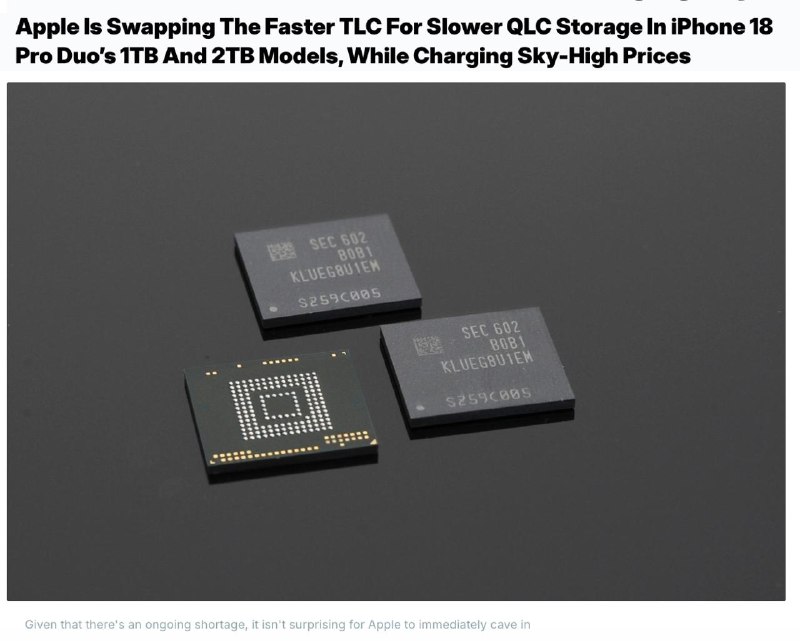
Apple's iPhone 18 Pro: An Unexpected Shift in Flash Storage Technology
In a surprising turn of events, Apple appears to be downgrading the flash storage options available in its upcoming iPhone 18 Pro and iPhone 18 Pro Max models. Reports from Wccftech, backed by renowned leaker Reptalicant, indicate that while consumers are expected to pay more for these new models, they may also receive slower and less durable storage technology, particularly in the higher-capacity configurations.
Storage Variants: What to Expect
Apple’s iPhone 18 Pro variants will feature different types of flash storage, differentiated primarily by the storage capacity:
| Storage Model | Type of Flash Storage | Performance Characteristics |
|---|---|---|
| 256GB | TLC (Triple-Level Cell) | Fast, durable, 3 bits per cell |
| 512GB | TLC (Triple-Level Cell) | Fast, durable, 3 bits per cell |
| 1TB | QLC (Quad-Level Cell) | Slower, less durable, 4 bits per cell |
| 2TB | QLC (Quad-Level Cell) | Substantial performance drop, originally intended for servers |
The 256GB and 512GB models will maintain the familiar, high-performance TLC storage from established manufacturers such as SK hynix, Kioxia, and SanDisk. However, the situation becomes concerning for users opting for the larger 1TB and 2TB models.
A Closer Look at QLC Storage
The 1TB model is expected to be primarily equipped with the SK hynix's BC8Q-1T chip, which represents a shift to Quad-Level Cell (QLC) technology. This type of storage packs four bits per cell, which, while allowing for more data to be stored, generally results in slower read and write speeds compared to TLC storage. A Samsung TLC chip may occasionally be included as an alternative but is expected to be rare.
Even more concerning is the 2TB model, which is slated to use SK hynix's BC8Q-2T QLC chip. Originally designed for server workloads, this chip is reported to suffer significantly in random 4K performance. This is a marked degradation from the 2TB iPhone 17 Pro Max, which features solid TLC storage consistent with high-end flagship expectations.
Impact of Rising Costs
But why would Apple opt for this downgrade in storage quality, particularly as the prices for the iPhone 18 Pro and Pro Max are projected to increase? Reports suggest that the rising costs of memory components are to blame. The manufacturing cost for a 256GB flash module has reportedly surged from $13 for the iPhone 17 Pro to approximately $51 for the upcoming model.
With base prices for the iPhone 18 Pro and Pro Max expected to reach $1399 and $1499, respectively, the disparity between the expected performance and actual delivered capabilities grows stark. It has led some analysts to speculate that this move is less about necessity due to cost and more about Apple strategically protecting its profit margins at the expense of high-end consumers.
Consumer Backlash?
This shift in storage technology has provoked speculation about how it will be received by consumers, particularly given the premium pricing associated with the Pro and Pro Max versions. As users become increasingly aware of the hardware specifications that differentiate high-end smartphones, the perception of value versus cost may affect purchasing decisions. In a world where performance is closely tied to user experience, the choice to downgrade storage capabilities in flagship devices may lead to consumer dissatisfaction.
Conclusion
The iPhone 18 Pro and Pro Max are set to make waves in the smartphone market, yet the news regarding slower storage raises critical questions about Apple's approach to premium product offerings. As consumers weigh the benefits against the costs, the ramifications of this storage downgrade will unfold in the months following the devices' anticipated release.
With market responses still uncertain, all eyes will be on the smartphone giant as it navigates this challenging landscape of rising component costs and consumer expectations.
😰 iPhone 18 Pro: paying more, getting slower storage 📰 Apple is reportedly downgrading the flash storage in the high-capacity iPhone 18 Pro and Pro Max, according to Wccftech, citing leaker Reptalicant. 1️⃣ The 256GB and 512GB models will keep fast TLC (Triple-Level Cell) storage from SK hynix, Kioxia, and SanDisk – same tech as before, three bits per cell, quick and durable. But the 1TB model will mostly switch to a QLC (Quad-Level Cell) chip – SK hynix's BC8Q-1T – which packs four bits per cell but is slower and less durable. A Samsung TLC chip will only appear as a rare alternative. 2️⃣ The 2TB version gets it worse: it'll use SK hynix's BC8Q-2T, a QLC chip originally built for server workloads. The leaker claims this chip suffers noticeably in random 4K performance. For comparison, the 2TB iPhone 17 Pro Max still uses proper TLC storage, as you'd expect from a flagship. 💸 Why the downgrade? Wccftech points to rising memory costs — earlier reports suggested a 256GB flash module now costs Apple around $51 per unit, up from $13 for the iPhone 17 Pro. Meanwhile, base prices for the 18 Pro and Pro Max are expected to hit $1399 and $1499. The math doesn't add up in customers' favor – this looks less like a cost-driven necessity and more like Apple protecting its margins at the expense of top-tier buyers. @DailyApple 😰 iPhone 18 Pro: paying more, getting slower storage 📰 Apple is reportedly downgrading the flash storage in the high-capacity iPhone 18 Pro and Pro Max, according to Wccftech, citing leaker Reptalicant. 1️⃣ The 256GB and 512GB models will keep fast TLC (Triple-Level Cell) storage from SK hynix, Kioxia, and SanDisk – same tech as before, three bits per cell, quick and durable. But the 1TB model will mostly switch to a QLC (Quad-Level Cell) chip – SK hynix's BC8Q-1T – which packs four bits per cell but is slower and less durable. A Samsung TLC chip will only appear as a rare alternative. 2️⃣ The 2TB version gets it worse: it'll use SK hynix's BC8Q-2T, a QLC chip originally built for server workloads. The leaker claims this chip suffers noticeably in random 4K performance. For comparison, the 2TB iPhone 17 Pro Max still uses proper TLC storage, as you'd expect from a flagship. 💸 Why the downgrade? Wccftech points to rising memory costs — earlier reports suggested a 256GB flash module now costs Apple around $51 per unit, up from $13 for the iPhone 17 Pro. Meanwhile, base prices for the 18 Pro and Pro Max are expected to hit $1399 and $1499. The math doesn't add up in customers' favor – this looks less like a cost-driven necessity and more like Apple protecting its margins at the expense of top-tier buyers. @DailyApple


