 TechOffice
iPhone 18 Pro: Higher Price, Slower Storage Options Raise Concerns
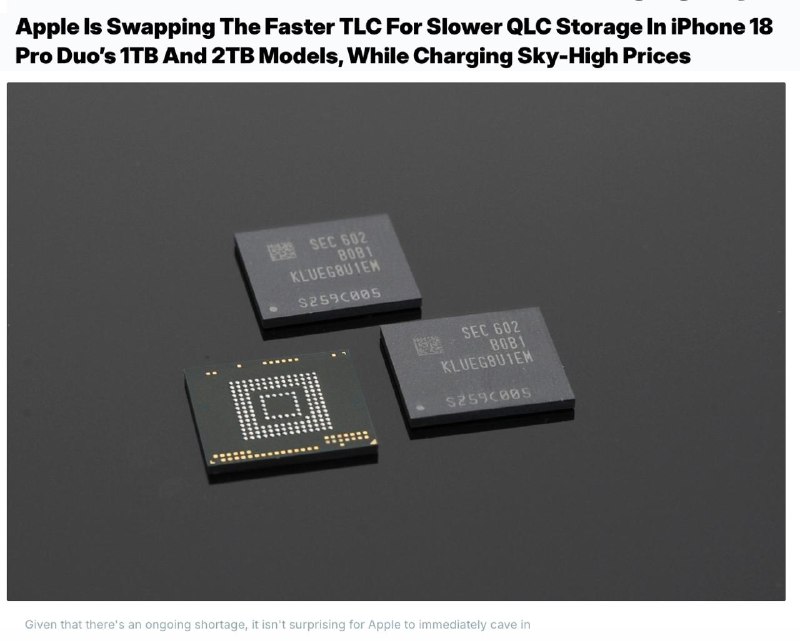
iPhone 18 Pro: Price Increases Coupled with Slower Storage Technology
In a significant revelation reported by Wccftech and echoed by industry leaker Reptalicant, Apple appears poised to downgrade the flash storage technology in the high-capacity iPhone 18 Pro and Pro Max models. This decision has raised eyebrows in tech circles, primarily due to the implications it bears for both product performance and consumer value.
Storage Specifications: A Closer Look
- 256GB and 512GB Models: Both models will continue to utilize fast TLC (Triple-Level Cell) storage technology sourced from renowned manufacturers such as SK hynix, Kioxia, and SanDisk. This enduring technology permits three bits per cell, striking a balance between speed and durability.
- 1TB Model: The landscape changes for users opting for the 1TB variant. It will predominantly feature a QLC (Quad-Level Cell) chip, specifically the SK hynix BC8Q-1T, which integrates four bits per cell. While offering increased storage capacity, this transition raises concerns regarding slower data transfer rates and diminished overall durability. A Samsung TLC chip may be available, but only as a rare alternative.
- 2TB Model: In the most concerning development, the 2TB version will utilize the SK hynix BC8Q-2T, a QLC chip designed initially for server workloads. Reports indicate that this chip exhibits noticeable deficiencies in random 4K performance—a critical metric for many power users. Comparatively, the iPhone 17 Pro Max with its 2TB configuration maintains traditional TLC storage, a hallmark of its flagship status.
Economic Factors Behind the Downgrade
The motivations behind this shift may be tied to increasing memory costs. Recent analyses suggest that the cost of a 256GB flash module has surged to approximately $51 per unit, an increase from the $13 Apple paid for the equivalent component in the iPhone 17 Pro. These rising costs create a challenging scenario for Apple, particularly as the anticipated base prices for the iPhone 18 Pro and Pro Max are projected to reach $1399 and $1499, respectively.
Consumer Value Under Scrutiny
This price increase, combined with a downgrade in storage quality, appears to challenge the traditional value proposition offered by Apple’s premium products. The current circumstances present a stark contrast to previously established norms where consumers could expect top-tier performance alongside a premium price tag.
Given the current trajectory, it seems that Apple may be more focused on protecting its profit margins rather than delivering enhanced value to its most loyal customers, particularly those investing in high-capacity models.
Summary of Storage Specifications
| Model | Storage Type | Manufacturer | Key Characteristics |
|---|---|---|---|
| iPhone 18 Pro 256GB | TLC | SK hynix, Kioxia, SanDisk | Fast, durable |
| iPhone 18 Pro 512GB | TLC | SK hynix, Kioxia, SanDisk | Fast, durable |
| iPhone 18 Pro 1TB | QLC | SK hynix BC8Q-1T | Slower, less durable; Samsung TLC as rare option |
| iPhone 18 Pro 2TB | QLC | SK hynix BC8Q-2T | Designed for server workloads, lower performance |
Conclusion
As Apple gears up for the launch of the iPhone 18 Pro and Pro Max, the downgrade in storage technology raises significant questions about value and performance for consumers willing to pay a premium. The company’s approach may signal a shift in priorities, prompting discussions about the long-term implications for brand loyalty and customer satisfaction in an increasingly competitive market.
😰 iPhone 18 Pro: paying more, getting slower storage 📰 Apple is reportedly downgrading the flash storage in the high-capacity iPhone 18 Pro and Pro Max, according to Wccftech, citing leaker Reptalicant. 1️⃣ The 256GB and 512GB models will keep fast TLC (Triple-Level Cell) storage from SK hynix, Kioxia, and SanDisk – same tech as before, three bits per cell, quick and durable. But the 1TB model will mostly switch to a QLC (Quad-Level Cell) chip – SK hynix's BC8Q-1T – which packs four bits per cell but is slower and less durable. A Samsung TLC chip will only appear as a rare alternative. 2️⃣ The 2TB version gets it worse: it'll use SK hynix's BC8Q-2T, a QLC chip originally built for server workloads. The leaker claims this chip suffers noticeably in random 4K performance. For comparison, the 2TB iPhone 17 Pro Max still uses proper TLC storage, as you'd expect from a flagship. 💸 Why the downgrade? Wccftech points to rising memory costs — earlier reports suggested a 256GB flash module now costs Apple around $51 per unit, up from $13 for the iPhone 17 Pro. Meanwhile, base prices for the 18 Pro and Pro Max are expected to hit $1399 and $1499. The math doesn't add up in customers' favor – this looks less like a cost-driven necessity and more like Apple protecting its margins at the expense of top-tier buyers. @DailyApple 😰 iPhone 18 Pro: paying more, getting slower storage 📰 Apple is reportedly downgrading the flash storage in the high-capacity iPhone 18 Pro and Pro Max, according to Wccftech, citing leaker Reptalicant. 1️⃣ The 256GB and 512GB models will keep fast TLC (Triple-Level Cell) storage from SK hynix, Kioxia, and SanDisk – same tech as before, three bits per cell, quick and durable. But the 1TB model will mostly switch to a QLC (Quad-Level Cell) chip – SK hynix's BC8Q-1T – which packs four bits per cell but is slower and less durable. A Samsung TLC chip will only appear as a rare alternative. 2️⃣ The 2TB version gets it worse: it'll use SK hynix's BC8Q-2T, a QLC chip originally built for server workloads. The leaker claims this chip suffers noticeably in random 4K performance. For comparison, the 2TB iPhone 17 Pro Max still uses proper TLC storage, as you'd expect from a flagship. 💸 Why the downgrade? Wccftech points to rising memory costs — earlier reports suggested a 256GB flash module now costs Apple around $51 per unit, up from $13 for the iPhone 17 Pro. Meanwhile, base prices for the 18 Pro and Pro Max are expected to hit $1399 and $1499. The math doesn't add up in customers' favor – this looks less like a cost-driven necessity and more like Apple protecting its margins at the expense of top-tier buyers. @DailyApple


