 TechOffice
iPhone 18 Pro: Higher Costs but Slower Storage Performance
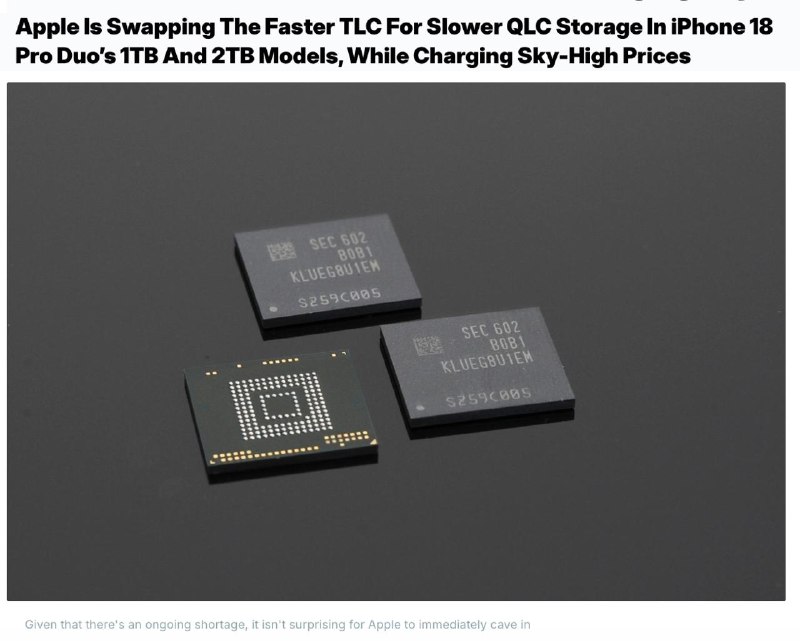
Concerns Arise Over iPhone 18 Pro Storage Changes
In a recent revelation, Apple seems poised to alter the flash storage specifications for its upcoming high-capacity iPhone 18 Pro and Pro Max models, raising alarms among tech enthusiasts and potential buyers. According to Wccftech, the information stems from the leaker Reptalicant, who indicates a significant shift in the storage technology utilized in these flagship devices.
Storage Specifications Breakdown
The iPhone 18 Pro lineup will feature various storage options, but the flash storage quality is reportedly being downgraded for larger capacities. A comprehensive overview of the storage configurations is provided below:
| Storage Capacity | Storage Type | Chipset Manufacturer | Performance Characteristics |
|---|---|---|---|
| 256GB | TLC (Triple-Level Cell) | SK hynix, Kioxia, SanDisk | Fast and durable |
| 512GB | TLC (Triple-Level Cell) | SK hynix, Kioxia, SanDisk | Fast and durable |
| 1TB | QLC (Quad-Level Cell) | SK hynix (BC8Q-1T) | Slower and less durable |
| 2TB | QLC (Quad-Level Cell) | SK hynix (BC8Q-2T) | Notably poor random 4K performance |
The 256GB and 512GB models are expected to retain the tried-and-true TLC (Triple-Level Cell) storage, known for its speed and reliability. However, a dramatic change is noted for the 1TB and 2TB models. The 1TB version is shifting predominantly to a QLC (Quad-Level Cell) chip, specifically the BC8Q-1T from SK hynix. Though QLC chips allow for four bits of data per cell, they are generally slower and less durable than their TLC counterparts. The two-terabyte model, on the other hand, will adopt the QLC chip BC8Q-2T, originally designed for server workloads, which is reportedly a poor performer in random 4K operations. This contrasts sharply with the previous iPhone 17 Pro Max model, which featured TLC storage even in its 2TB capacity.
Rising Costs Behind the Downgrade?
Several factors have contributed to this unexpected downgrade, primarily revolving around rising memory costs. Reports suggest that the cost of a 256GB flash module has surged to approximately $51 per unit, an alarming increase from the $13 cost associated with the iPhone 17 Pro's storage. This marks a significant deviation in pricing strategy for Apple, as they revamp their flagship models.
In tandem with the storage downgrade, pricing for the iPhone 18 Pro and Pro Max is expected to escalate, with projected base prices set at $1,399 and $1,499 respectively. The juxtaposition of increased costs with a reduction in storage performance raises questions about Apple’s priorities. Many consumers are beginning to view this move not as a necessary business adaptation but rather as a strategic decision by Apple to safeguard its profit margins, potentially at the expense of high-end customers.
Conclusion: A Risky Move for Apple?
The shift in storage technology for the iPhone 18 Pro and Pro Max models serves as a pivotal point in Apple's evolving strategy. As the tech giant seeks to balance rising manufacturing costs against consumer expectations, the potential trade-offs in performance may cause discontent among its dedicated user base. The forthcoming release will undoubtedly be scrutinized to gauge whether Apple's innovations will outweigh the apparent compromises.
As consumers weigh their options, the landscape of the smartphone market continues to evolve, and Apple's decisions will reverberate throughout the industry. Only time will tell how this move will affect consumer sentiment and Apple's brand reputation in an increasingly competitive market.
😰 iPhone 18 Pro: paying more, getting slower storage 📰 Apple is reportedly downgrading the flash storage in the high-capacity iPhone 18 Pro and Pro Max, according to Wccftech, citing leaker Reptalicant. 1️⃣ The 256GB and 512GB models will keep fast TLC (Triple-Level Cell) storage from SK hynix, Kioxia, and SanDisk – same tech as before, three bits per cell, quick and durable. But the 1TB model will mostly switch to a QLC (Quad-Level Cell) chip – SK hynix's BC8Q-1T – which packs four bits per cell but is slower and less durable. A Samsung TLC chip will only appear as a rare alternative. 2️⃣ The 2TB version gets it worse: it'll use SK hynix's BC8Q-2T, a QLC chip originally built for server workloads. The leaker claims this chip suffers noticeably in random 4K performance. For comparison, the 2TB iPhone 17 Pro Max still uses proper TLC storage, as you'd expect from a flagship. 💸 Why the downgrade? Wccftech points to rising memory costs — earlier reports suggested a 256GB flash module now costs Apple around $51 per unit, up from $13 for the iPhone 17 Pro. Meanwhile, base prices for the 18 Pro and Pro Max are expected to hit $1399 and $1499. The math doesn't add up in customers' favor – this looks less like a cost-driven necessity and more like Apple protecting its margins at the expense of top-tier buyers. @DailyApple 😰 iPhone 18 Pro: paying more, getting slower storage 📰 Apple is reportedly downgrading the flash storage in the high-capacity iPhone 18 Pro and Pro Max, according to Wccftech, citing leaker Reptalicant. 1️⃣ The 256GB and 512GB models will keep fast TLC (Triple-Level Cell) storage from SK hynix, Kioxia, and SanDisk – same tech as before, three bits per cell, quick and durable. But the 1TB model will mostly switch to a QLC (Quad-Level Cell) chip – SK hynix's BC8Q-1T – which packs four bits per cell but is slower and less durable. A Samsung TLC chip will only appear as a rare alternative. 2️⃣ The 2TB version gets it worse: it'll use SK hynix's BC8Q-2T, a QLC chip originally built for server workloads. The leaker claims this chip suffers noticeably in random 4K performance. For comparison, the 2TB iPhone 17 Pro Max still uses proper TLC storage, as you'd expect from a flagship. 💸 Why the downgrade? Wccftech points to rising memory costs — earlier reports suggested a 256GB flash module now costs Apple around $51 per unit, up from $13 for the iPhone 17 Pro. Meanwhile, base prices for the 18 Pro and Pro Max are expected to hit $1399 and $1499. The math doesn't add up in customers' favor – this looks less like a cost-driven necessity and more like Apple protecting its margins at the expense of top-tier buyers. @DailyApple


