 TechOffice
iPhone 18 Pro: Higher Prices Coupled with Slower Storage Options
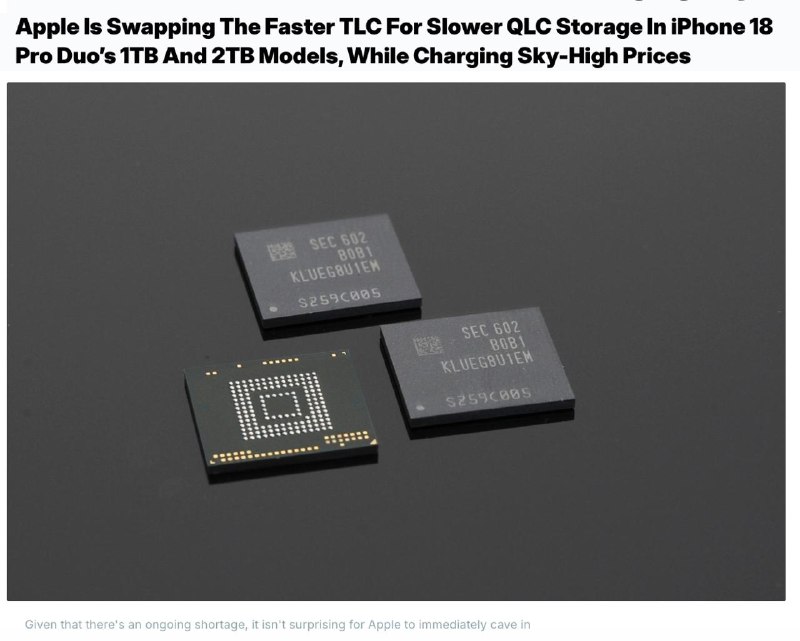
Apple’s iPhone 18 Pro: A Shift Toward Slower Storage at a Higher Price
As anticipation builds for the release of Apple’s latest flagship devices, the iPhone 18 Pro and Pro Max, recent reports indicate a troubling trend regarding their storage capabilities. According to Wccftech, which cites prominent leaker Reptalicant, the high-capacity models of the iPhone 18 series will see a downgrade in flash storage technology, raising concerns among potential buyers.
Storage Specifications: What to Expect
The iPhone 18 Pro and Pro Max will feature various storage configurations, which provide significant distinctions between models:
- 256GB & 512GB Models: These configurations will continue to utilize fast TLC (Triple-Level Cell) storage from reputable manufacturers such as SK hynix, Kioxia, and SanDisk. With three bits stored per cell, TLC technology is known for high speed and durability.
- 1TB Model: This version will transition primarily to QLC (Quad-Level Cell) storage, specifically using the SK hynix BC8Q-1T chip, which accommodates four bits per cell. This shift to QLC means slower read and write speeds and potentially diminished durability. Samsung's TLC chip may be available as a rare alternative for this model.
- 2TB Model: The situation worsens for this configuration, which will adopt the SK hynix BC8Q-2T chip—another QLC variant but one originally designed for server workloads. Reports suggest that this chip experiences noticeable degradation in random 4K performance. In contrast, the 2TB variant of the iPhone 17 Pro Max maintains TLC storage, aligning with consumer expectations for flagship devices.
| Model | Storage Type | Details |
|---|---|---|
| 256GB | TLC | Fast and durable storage from SK hynix, Kioxia, SanDisk |
| 512GB | TLC | Continues the tradition of high-performance storage |
| 1TB | QLC | Primarily using SK hynix’s BC8Q-1T, slower and less durable |
| 2TB | QLC | Based on SK hynix’s BC8Q-2T, designed for server workloads, lower 4K performance |
Understanding the Reasons Behind This Downgrade
The rationale for this significant storage downgrade has been linked to escalating memory costs. Previous insights suggest that the current cost of a 256GB flash module for Apple has surged to approximately $51 per unit, a stark increase from the $13 reported for the iPhone 17 Pro. This financial strain comes at a time when the base prices for the iPhone 18 Pro and Pro Max are projected to reach $1,399 and $1,499 respectively.
This pricing structure raises questions about Apple’s intent in introducing these changes. Industry analysts suggest that rather than being a pure cost-driven necessity, this move may reflect Apple's strategic decisions to protect its profit margins at the expense of premium customers who invest in their flagship devices.
Conclusion
As consumers look forward to the launch of the iPhone 18 Pro and Pro Max, the implications of slower storage technology in higher-priced models could deter potential buyers. Apple’s historical reputation for delivering cutting-edge technology appears to be at risk, prompting a need for transparency and assurance that premium pricing will correspond to top-tier performance. As the launch date approaches, further scrutiny from the tech community and consumers alike will undoubtedly unfold.
😰 iPhone 18 Pro: paying more, getting slower storage 📰 Apple is reportedly downgrading the flash storage in the high-capacity iPhone 18 Pro and Pro Max, according to Wccftech, citing leaker Reptalicant. 1️⃣ The 256GB and 512GB models will keep fast TLC (Triple-Level Cell) storage from SK hynix, Kioxia, and SanDisk – same tech as before, three bits per cell, quick and durable. But the 1TB model will mostly switch to a QLC (Quad-Level Cell) chip – SK hynix's BC8Q-1T – which packs four bits per cell but is slower and less durable. A Samsung TLC chip will only appear as a rare alternative. 2️⃣ The 2TB version gets it worse: it'll use SK hynix's BC8Q-2T, a QLC chip originally built for server workloads. The leaker claims this chip suffers noticeably in random 4K performance. For comparison, the 2TB iPhone 17 Pro Max still uses proper TLC storage, as you'd expect from a flagship. 💸 Why the downgrade? Wccftech points to rising memory costs — earlier reports suggested a 256GB flash module now costs Apple around $51 per unit, up from $13 for the iPhone 17 Pro. Meanwhile, base prices for the 18 Pro and Pro Max are expected to hit $1399 and $1499. The math doesn't add up in customers' favor – this looks less like a cost-driven necessity and more like Apple protecting its margins at the expense of top-tier buyers. @DailyApple 😰 iPhone 18 Pro: paying more, getting slower storage 📰 Apple is reportedly downgrading the flash storage in the high-capacity iPhone 18 Pro and Pro Max, according to Wccftech, citing leaker Reptalicant. 1️⃣ The 256GB and 512GB models will keep fast TLC (Triple-Level Cell) storage from SK hynix, Kioxia, and SanDisk – same tech as before, three bits per cell, quick and durable. But the 1TB model will mostly switch to a QLC (Quad-Level Cell) chip – SK hynix's BC8Q-1T – which packs four bits per cell but is slower and less durable. A Samsung TLC chip will only appear as a rare alternative. 2️⃣ The 2TB version gets it worse: it'll use SK hynix's BC8Q-2T, a QLC chip originally built for server workloads. The leaker claims this chip suffers noticeably in random 4K performance. For comparison, the 2TB iPhone 17 Pro Max still uses proper TLC storage, as you'd expect from a flagship. 💸 Why the downgrade? Wccftech points to rising memory costs — earlier reports suggested a 256GB flash module now costs Apple around $51 per unit, up from $13 for the iPhone 17 Pro. Meanwhile, base prices for the 18 Pro and Pro Max are expected to hit $1399 and $1499. The math doesn't add up in customers' favor – this looks less like a cost-driven necessity and more like Apple protecting its margins at the expense of top-tier buyers. @DailyApple


